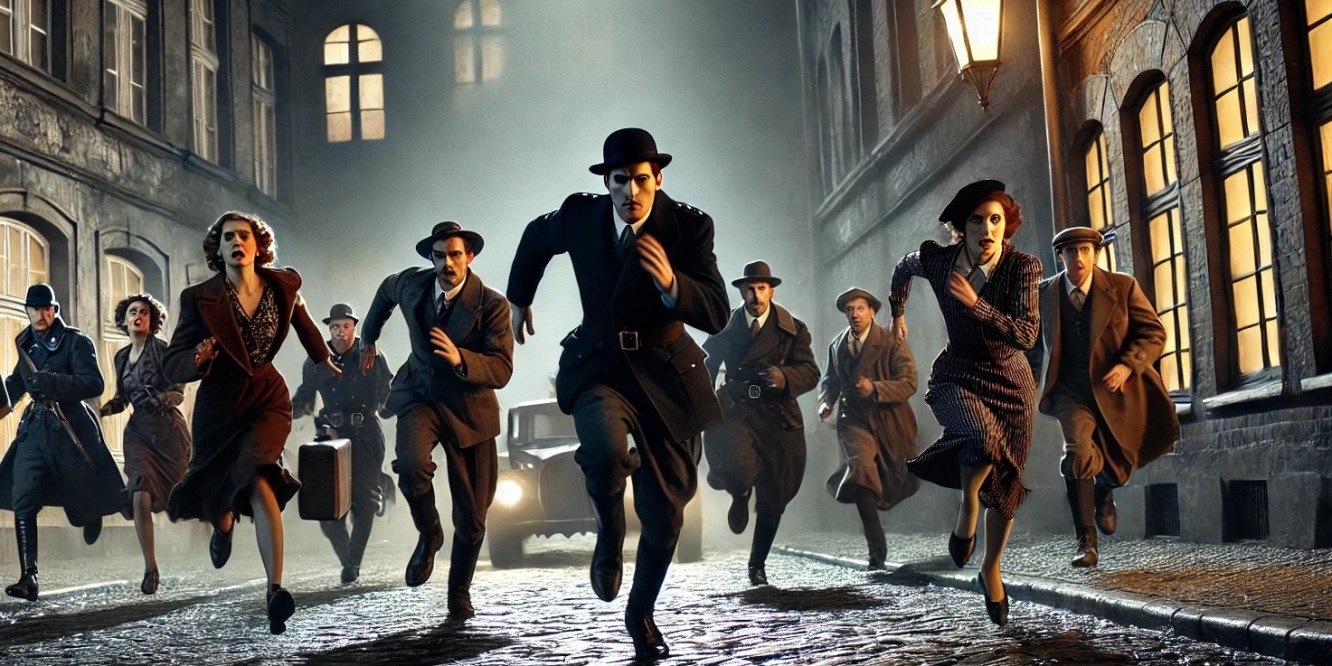
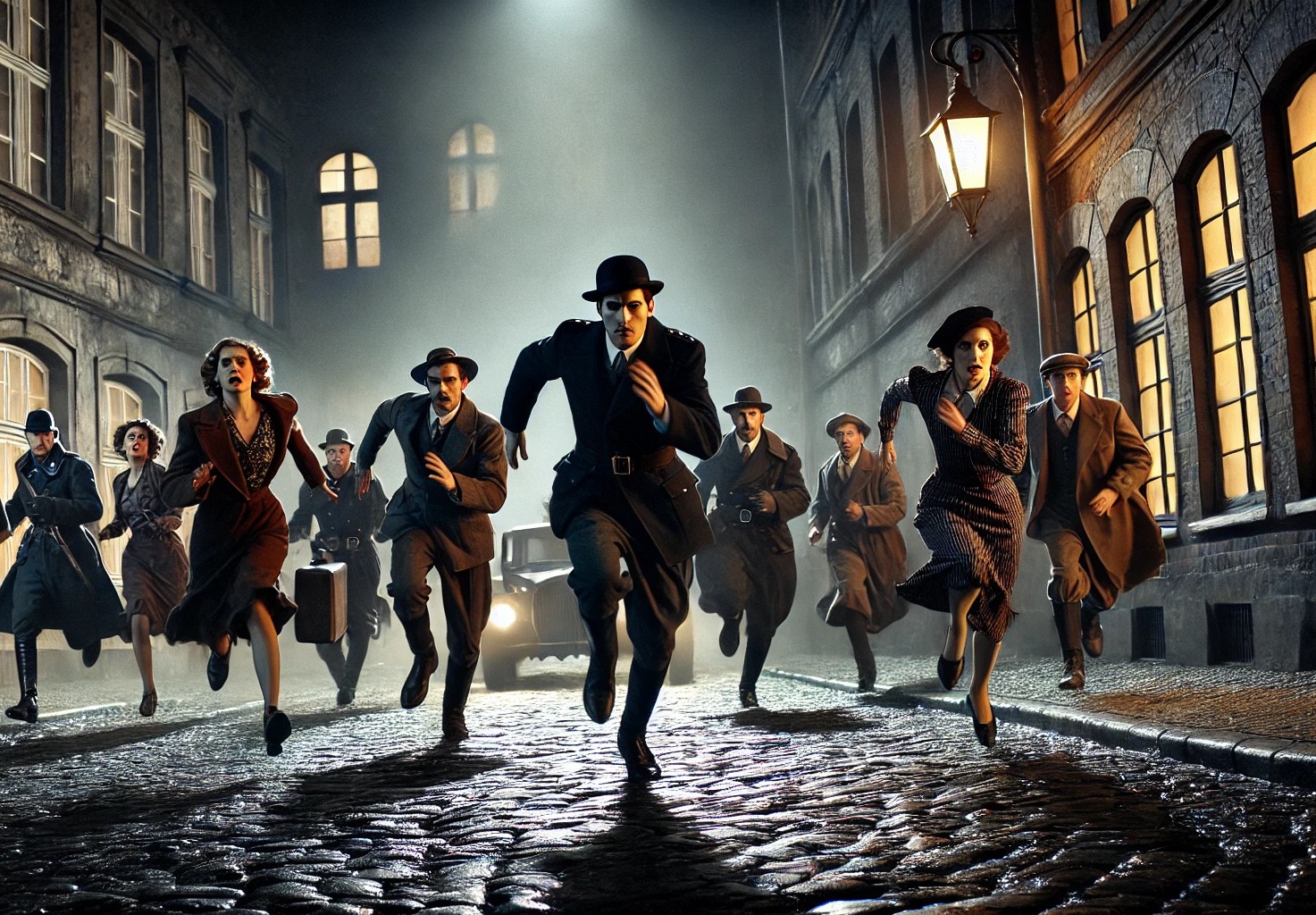
“The sisters were low on sleep after their train journey, their theatrical troop mixed in with refugees, pushing and shoving for seats together in the crowded compartments, as the train steamed out of Berlin. Now, only yards from safety in Neutral Denmark , the sisters linked arms for mutual support, and walked towards the border crossing at Flensburg, their Stage Manager herding the troop together desperate not to lose anyone in the milling crowds. At the barrier armed Military Police took their papers from their Stage Manager and scrutinised them, a Gestapo agent walked over, took his time over Hilda and Doris’s papers, his eyes looked them over from top to toe, lingering, sending a chill down their spines. Just a few more yards to Freedom.”
We looked at Robbie Williams’ Family Story in the last installment (Robbie Williams Family Story Part 3) we found out about how Robbie’s Family came to be called Williams, now we look at a lighter hearted aspect of the Family and a drama! This happens with Robbie’s cousins Hilda and Doris from Robbie’s Grandmother’s Durber Family, related through his 5th Great Grandparents.
Hanley Babes
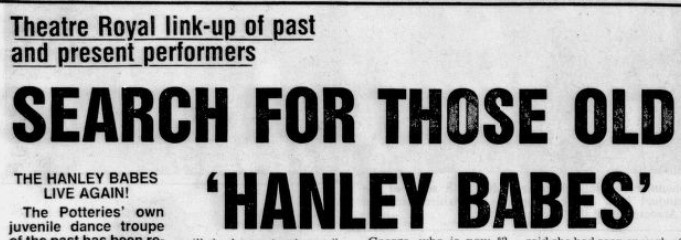
On Friday 18th November 1983 to mark the recommencement of Pantomime Performances at the Theatre Royal, the Staffordshire Weekly Sentinel ran a piece on behalf of the Theatre who were trying to get previous generations of “The Hanley Babes” back together. The Hanley Babes were a group of Chorus Girls, first known as “The Pottery Kids” who performed at the theatre from the early 1930s onwards. What caught my eye in the story was the mention of Hilda and Doris Durber as two of the girls, interesting as Durber is a fairly unusual name, and is prominent in Robbie Williams’s family tree.
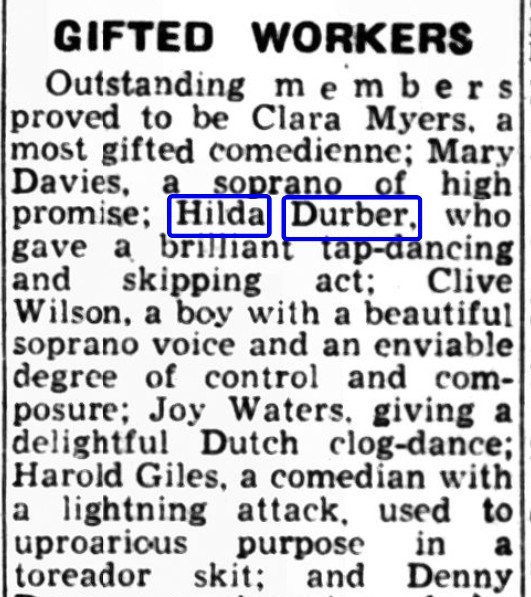
Going back to 1942 we find Hilda called out in a local Newspaper as an outstanding performer at a Wartime Concert in a “Midlands War Factory” performing a brilliant Tap Dancing and Skipping act, among a list of a Comedienne and a Comedian, a Boy Soprano, a Clog Dancer, and Margaret Danso described in one report as a “a charming dusky crooner”. Margaret had been living in Glasgow and was probably the daughter of a West African Seaman. Margaret had been a professional singer but gave her reasons for going into War Work: ” My father, a seaman was torpedoed last June and we have not heard anything since. We do not know whether he is alive. So I came here to get a hit back at the murderers.” So Hilda Durber and a group of former professional performers were now keeping morale up on the home front and doing War Work in a Factory.
Southampton and the South Coast
But where did Hilda learn her skills? And did she have particular personal reasons for her War Work? Well, we know more about Hilda from before the outbreak of The Second World War, as in 1938 we find Hilda steaming into Southampton from London onboard the Royal Mail Motor Vessel, the R.M.M.V. Dunvegan Castle (pictured below) having boarded with the rest of her troop in London. She was listed as a Theatrical Performer, and with her were in First Class were the Stage Manager, Dancers, Actresses, Actors, and other Theatrical Performers, most were Londoners, two were from Liverpool, one from Manchester, and an Iris Colclough, Hilda’s friend, was recorded as living at the same address as Hilda in Stoke. With them, and with a companion in tow, was the film actress Norah Dwyer, no doubt the star of the show. Doris was part of a troop putting on Light Entertainment Shows and Musical Comedies, touring the country.

It looks like the Theatrical Production Company were taking their Show from London to Southampton and the South Coast. The fact they were traveling by ship rather than train implies that it was quite a big production and there was a lot of equipment/scenery to transport, and the troop were travelling 1st Class so the show was a well financed production.
In 1939 Hilda was living at home with her parents in Chell Street Hanley, Stoke on Trent, registered as “An Acrobatic Dancer (Travelling)” But shortly after this, through a piece of bad timing and world events, her family almost lost her and her sister for good, and the girls would face the biggest adventure of her lives.
Fleeing the Nazis
Hilda and at least one of her sisters, probably Doris, were having some success in musical theatre, no longer playing London and the South Coast of England, they had gone international! Not bad for the daughters of a Coal Hewer from Hanley.
In 1939, in their twenties, the sisters had an opportunity to travel abroad and jumped at the chance to perform in a Music Hall Act. The problem was that the booking was in Berlin Germany, and in September 1939 Great Britain declared war on Nazi Germany after the Germans invaded Poland. Finding themselves cutoff behind enemy lines the Company were forced to flee to avoid internment, or worse, at the hands of the Nazis, as the dreaded Gestapo started rounding up enemy aliens for questioning.
They fled across North Germany, probably heading for Hamburg by train, and then find another train to get them to the Danish Border, a journey of nearly three hundred miles. Once at Flensburg on the border, they would face interrogation of their papers before being allowed into Denmark, and if denied access would have been handed over as enemy aliens to the Civil Police, the Military, or worst of all the Gestapo. The border crossing would have been clogged with foreign nationals desperate to get out of Germany, and we can only imagine the chaos and bureaucracy that the girls would have faced, with Gestapo Agents all the time looking for signs that anyone crossing was more than just a refugee, perhaps an enemy agent fleeing the country, ready to take them away for interrogation and torture. The a note of threat was in the air, and their fear was palpable.
The troop got through, and once across the border they then had a further one hundred miles of travel to get from that border to the port of Esbjerg with a direct link to the UK, all the while with the threat of German invasion close behind them. When they reached Esbjerg the little theatrical company had to wait for six weeks before they negotiated a rough passage aboard a cargo ship heading back to England across the stormy North Sea to Harwich.
Home to Hanley! ITMA!
Hilda and her sister arrived home shortly before Christmas in 1939 to the great relief of their family in Stoke. A few months later the Germans poured across the Danish border and overran the Denmark.
They had had a n extremely close call. We know that Hilda ended up doing war work in a factory, but there is a chance that once safely back in England she had a final fling at the theatre, perhaps performing twice nightly in the chorus, when Norah Dwyer and the troop of “It’s That Man Again” came to the Theatre Royal in her home town of Hanley in December 1939.
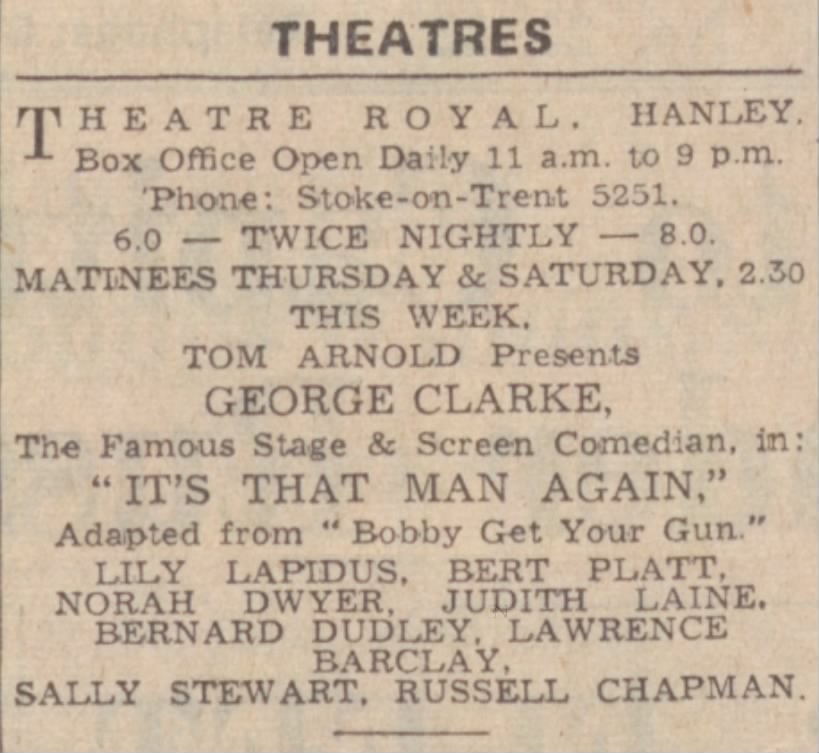
“It’s That Man Again” or ITMA as it came to be called, was a popular BBC radio comedy program from 1939 to 1949. The show featured Tommy Handley in the central role, with a cast of characters that included the bibulous Colonel Chinstrap, the charlady Mrs. Mopp, and the incompetent German agent Funf, and also George Clarke as mentioned in the show in Hanley above. The program was known for its fast-paced humor, satirical take on wartime regulations, and use of sound effects. The show included various songs and musical interludes performed by the cast and guest artists. These musical segments were an integral part of the program, adding to its entertainment value and helping to break up the comedy sketches. Just possibly the Durber girls were part of this hit programme, when it toured, the timings and people involved could support this, and to add to the intriguing possibility ITMA made a recording for BBC Radio from a “Midlands Factory” in 1944, were Hilda or Doris in the chorus?
All in all, a fitting end to a Christmas Story, with the Durber Girls safely back from Nazi Germany, having the chance to perform in a hit show, and being home with the Family for Christmas!

In Part 5 of Robbie Williams’ Family Story we’ll see the Hard Defending Lady Footballer from the 1920s!

 Travelling Through Time to Trace Your Ancestors
2 Replies to “The Dancing Durbers Robbie William’s Family History Part 4: A Brush with Hitler”