
Having seen the Real life of Hezekiah Moscow, we now pass on to his best friend Alec Monroe.
The Killing of a Prize Fighter
Just after midnight on Saturday, 5 September 1885, a prize fighter named Alexander Hayes Munroe was fatally stabbed in a Common Lodging House, called a “Den of Thieves” by some Policemen, at 6 Little Pearl Street Spitalfields in the East End of London. Alexander Hayes Munroe was the “Alec Munroe” of the TV series A Thousand Blows.

The details of the killing were confused and miss-told by many witnesses, and compounded by a bungling and confused Police investigation, and a lack of initiative and interest by the authorities in ensuring a proper disposition of the events by the victim before he died. This was compounded by bizarre miss reporting in the Newspapers of the time, including Alec being portrayed primarily as a Lion Tamer, and with many variations on various testimonies.
Who was Alec Munroe?
As far as we can tell from the historical records Alec (also Alex) Munroe (also (Monroe, and Munro) was Alexander Hayes Munroe, born in Jamaica, either late 1850 or early 1851. Alec was said to have arrived in England from Kingston Jamaica, although his exact background is not clear, but I have researched births in Jamaica and found a potential birth that would fit with his profile, that of Alexander Munroe christened on 26th January 1851, in St Elizabeth Parish Jamaica, about a day or two’s walk from Kingston.
St Elizabeth is the second most populace Parish in Jamaica. The area was originally home to the Taino people in the pre-Columbian period, before the Spanish arrived in the 16th century, who were in turn supplanted by the English in the later 1650s, and made it a centre for Sugar Growing and logwood export. From 1700 the area was settled by refugees from Scotland’s doomed Darien Colony in Panama which had been besieged by the Spanish.
This Scottish influence explains the traditionally Scottish surnames of many Afro-Caribbean families from the area, who were descended from slaves on the plantations and logging ventures of Scottish derived families, and typically took the surnames of their former slave owners, and indeed some of the emancipated slaves may have shared ancestry with the slave owners. Hence “Alec (or Alex) Munroe” as typical from the area.
If the Parish records are correctly aligned with Alec Munroe then his parents were Neptune Munroe born in 1820 and Jane Hanson born in 1833, meaning that Jane may have given birth to her first child at 13, and to Alec at 18, and would continue in childbirth till she was 29 years old, giving birth to seven children, all boys, Alec being the third child.
Given that slavery in British Colonies was formerly abolished in 1834 with full emancipation following by 1838, it is highly likely that both of Alec’s parents were born into Slavery, although their children including Alec were not. Given that the Trans-Atlantic Slave Trade was outlawed by Britain in 1807, and that was aggressively enforced by the Royal Navy thereafter, Neptune and Jane’s Parents, and most likely Grandparents, and possibly a few generations before that would also have been either born into slavery in Jamaica. It is also likely that their African Ancestors would have come from West Africa, most likely Ghana, given that a nearby “Maroon” (escaped slaves) independent fortified “rebel” settlement was called Accompong derived from the Ghanaian word Acheampong usually translated as “Destined for Greatness” or “Born to Fight”.
Alec at Sea
Like many men from large families in the West Indies, Alec wished for a better life, and so went to sea to find it. Life as a seaman was hard, but gave a huge degree of freedom, and of course travel and new experiences. It also meant that a man would mix socially with people from many different backgrounds, nationalities, and races. His utility as a seaman would matter more than his background when life or death could depend on trusting your crew members on a transatlantic passage. It was far harder to achieve this on a plantation in Jamaica with its strict racial and social hierarchy that had survived the abolition of slavery.
We know little of his background at sea, some memoirs and recollections claim that Alec had arrived in England around 1870, which would equate with him leaving Jamaica and going to sea at the age of 19 or 20, which would be feasible, from St Elizabeth it would have been easy enough for a fit young man to travel to Kingston to sign up for a ship shipping Sugar or tropical wood from Jamaica to Britain.
He doesn’t show up in the records as a Mariner in 1881, when he was lodging at the George Inn in the High Street in Rochester Kent. Rochester is on the Thames just downriver from London, near to the busy River Medway, a tributary of the Thames, a place with many Mariners in temporary lodgings either leaving ships, or looking for a new birth on a ship, for both local and international shipping.
The fact that Alec was an Afro-Caribbean man would have been rare at the time in Britain, but less rare in a maritime town like Rochester, where foreign Seamen were not a completely unusual sight, although still relatively novel, and Dockside Inns were more interested in a man’s ability to pay for bed, board, and beer, than where he came from. Working Class Capitalism is a great leveller. The other Lodgers were a Stonemason, an unemployed Painter and two Musicians, and indeed the inhabitants of the High Street at Rochester in 1881 were entirely respectable, although with a number of Inns and drinking houses in it, which tended to provide lodgings for workers from further afield in England, whereas the vast majority of people in the HIgh Street were born and bred in Kent. The other notable exception was the wife of the Ironmonger from next door to the George Inn who was born in the Pacific Islands, but was a British Citizen. The only other foreign born people were two Swiss Confectioners, an Irishman, and a British Solicitor born on the Island of Corfu (which had been a British Protectorate for many years).
Alec Boxing
Prior to his registration in the Census of 1881 Alec makes an appearance in a Newspaper taking part in a benefit boxing match in Shoreditch in 1880 as “Alec Munroe – The Black” being a black boxer at the time was again a novelty in Britain, and was noted in the advertisements for matches in order to draw a crowd. Such a nickname was not unusual, names like “Punch” “Sugar” “Young” and “Lumpy” were commonly added to surnames to build the character and following of boxers, so not much other marketing nous can be read into it.
The next time Alec makes the records was in 1881 when he was boxing in exhibition matches as Alec Munro or Alec Munroe, with a number of other “well known” boxers in the the famous Boxing Pub the Blue Anchor in Shoreditch, alongside Sugar Goodson, and the Kingsland Arms in the East End of London.
These early mentions would seem to indicate that he had been around for a number of years, perhaps working the ships coming in and out of the Thames, and Boxing in between to help supplement his income, but he was certainly starting to build a reputation, as an entertaining fighter. He even managed to come up with a gimmick of wearing blackened gloves and his white opponents wearing whitened gloves, so that each other’s punches would should up on their respective bodies when they made contact. It should be remembered that most of these fights were not blood and guts engagements of the bare knuckle variety, they were mainly demonstrations and sparring, as examples of the scientific art of boxing under Queensberry Rules, very few fighters wanted to damage themselves or their opponents too badly, as they were fighting a few times a month, so a quick recovery was essential, and the more popular fighters that there were on a bill, the bigger the crowds that could be pulled in. It was rare for Alec to be referred to as anything other than “the Black” only one time that I can find was the “N” word used or the more common term “Darkie”, so the evidence of prejudice against his skin colour was less than may have been expected considering the general prejudices of the time, and it seems that the relative novelty of his colour in London at the time was actually an asset in the ring in terms of his popularity and therefore ability to make a living.
Indeed, Alec was taken up by the Manager and Promoter Jim Mace, the ex-Heavyweight “Bare Knuckle” Boxing World Champion, and it seems that Alec may have taken Hezekiah under his wing and possibly into Jem Mace’s Management once Hezekiah left his Lion Taming job (see previous article on Hezekiah).
By 1882 Alec was appearing on the same bill as Ching Ghook (Hezekiah Moscow) at the Blue Coat Boy, and he sparred on several occasions with Hezekiah, they were obviously close friends, not surprisingly being two young Jamaicans in a Country where Afro-Caribbean people were thin on the ground. Although not really emphasised at the time, coverage of Alec after his death sometimes refer to Hezekiah as one of his “pupils” so it is possible that Alec taught him how to make the most of his boxing career.
Alec continued boxing right up to the year of his death, and was even mistakenly billed as fighting after his death where an advertisement was not amended before going out, showing that he was being booked months in advance, so his career in the ring was a constant and active one, albeit entirely in the London area. Not for him the travelling arenas of his pupil Hezekiah.
Lion Tamer?
He was labelled as a Lion Tamer in many accounts of his death, however there is no evidence for this, and although possible, it is more likely that a reporter had confused Alec with his pupil Hezekiah who had definitely been a Lion Tamer and had worked with Bears, so a piece of lazy reporting had been picked up and amplified by many provincial Newspapers.
I did look to see if I could find references for Alec as a Lion Tamer, but nothing added up. I thought that perhaps he had taken over from Hezekiah at The East London Aquarium, but Hezekiah does seem to have been the last Lion Tamer there, and even once was billed under his ring name of Ching “Hooke” in this case. But after a scandal involving a large court case concerning cruelty to animals, the East London Aquarium went into receivership, before “mysteriously” burning down in June 1884, so there was no real opportunity for Alec to have become involved.
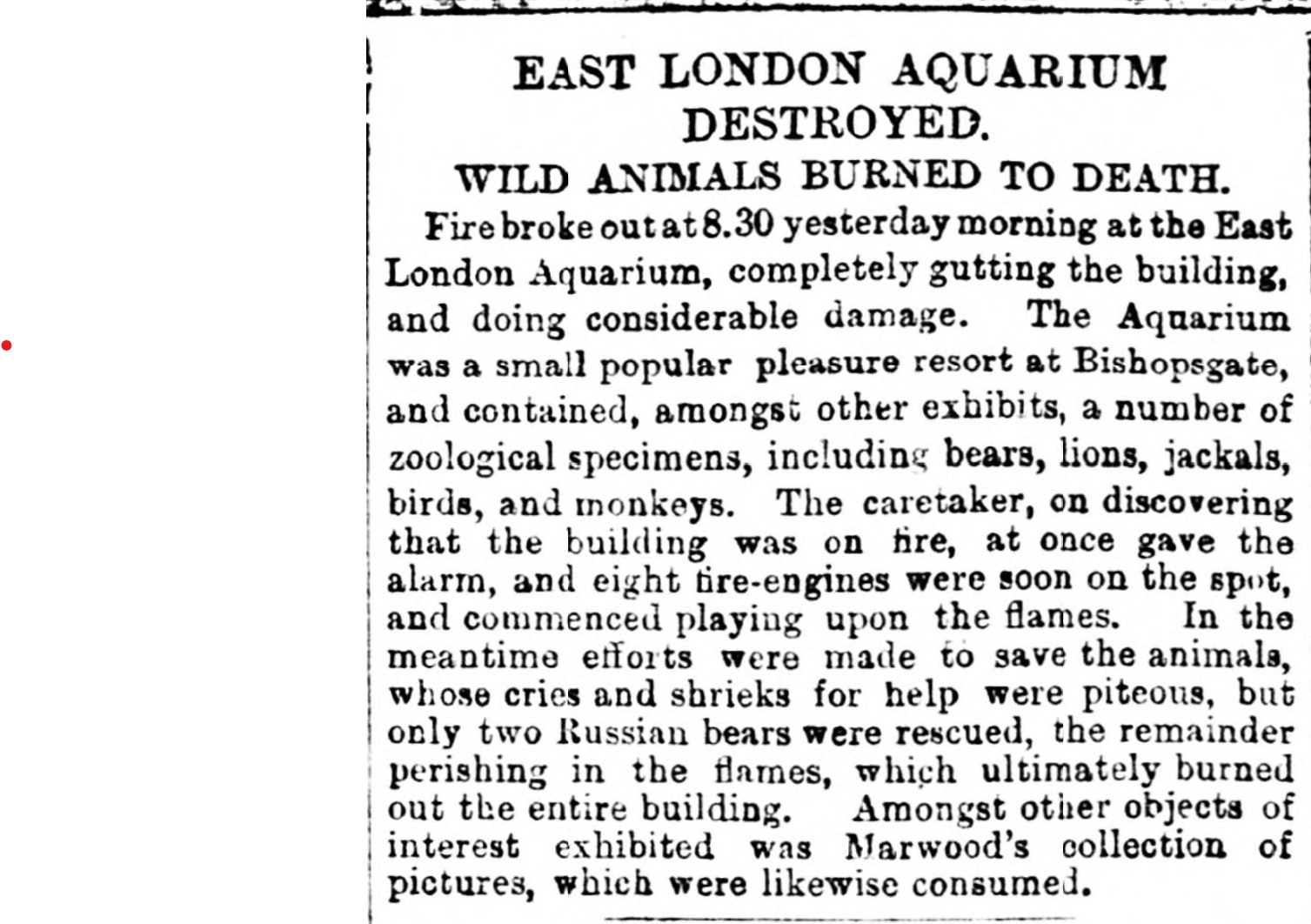
Reports of Lion Taming therefore seem a straight case of conflating Alec with Hezekiah.
26 Pearl Street where Alec Lived
The Lodging House where Alec lived was described as “a Thieves’ Den” by the Police. This was probably a slight exaggeration, as not everyone there was a criminal, least of all Alec. But there were a number of felons living there, so it was a pretty grim and rough place, and although as a boxer Alec could handle himself, some of the men there were not out to fight under Queensberry Rules. In fact testimony shows that he had been threatened with a knife on more than one occasion, and simply did the right thing and walked away when it happened. He wasn’t a man who looked for trouble, and was generally praised for his pleasant demeanor by everyone who knew him.
26 Pearl Street was a lodging house for those with little many with a transitory population, of mainly single men, some did have criminal records, but it provided individual rooms with all common areas shared, such as kitchen and toilets. It was rough. Drinking was rife, as well as some drunkenness, and knives were commonly carried, for both legitimate reasons (most men and boys carried “penknives” and lock knives for a variety of purposes at the time) as well as for nefarious reasons, the difference was blurred. People tended to rub along, but there was always a possibility of offence leading to violence, especially when drinking was involved.
Most of the dwellers were working men in low paid sweatshop type trades like Shoemaking, as well as Labouring men from the Docks and building sites, tough, rough, and poorly paid, and Hawkers, living on their wits in the grey area between honest trade and petty criminal activity. Alec seems strangely out of place there, and it may be that enjoying a drink himself he liked lodgings where genteel activity was not expected, and no one cared much about the colour of your skin or your background, perhaps more genteel accommodation would have been much more expensive and may have been harder to get for a Black Pugilist.
The Killing
The earliest report from Worship Street Court House was by a witness named Richard Butler, a shoemaker, he was a lodger in the house 6, Little Pearl-street, he was quoted as saying The prisoner was also a lodger, and the deceased man, Munroe, he knew had been lodging in the house for years. At about 12.20 on the Saturday morning, witness having taken some beer into the common kitchen, was sitting there, and saw the prisoner cutting tobacco on the corner of a table. Munroe entered, and put his arm on the prisoner’s neck in play, and witness saw the prisoner push him, but there was no roughness. In about two minutes Munroe staggered, and said he was stabbed. Witness said he could not believe it, but on looking he saw the man was bleeding from a wound on the right side, just below the ribs. There was little blood, but witness thought it only a scratch, and as Munroe refused to go to the hospital, witness left him and went to bed.
The problem with this was that the prisoner they had in court was the wrong man. Alec had said that he had been stabbed by “Little Tommy” on this information Police-sergeant 15 H said that early that Tuesday morning he received certain information from a man named Richard Butler (the Shoemaker) in consequence of which he made inquiries at the London Hospital, and learned there that a man named Alexander Munroe was lying dead there from a stab wound in the abdomen. Afterwards he proceeded to a lodging-house, and there apprehended the prisoner, Thomas McCarthy, 17, a labourer, whom he found in bed, and charged him with killing Alec. The prisoner said, “It was not me; I was in bed at the time.” The prisoner was not represented in court, but Detective-sergeant Rolfe, H Division, said that there were a number of witnesses in Court to say that the prisoner was not the “Little Tommy” who stabbed Alec. The house in question was a resort of thieves, and the prisoner himself had been wanted for watch robbery; but there was some doubt now whether a mistake had not been made as to this matter.—Other witnesses were then called, who said a different man altogether had stabbed deceased. Mr Hannay the Magistrate on the application of the police, decided to remand the prisoner to give time for the fullest inquiry.
It seems that Richard Butler having had a drink or two had witnessed part of what happened, but not the whole scene. At the subsequent hearing another witness, Henry Cook, said his wife was the deputy of the common lodging-house. He had known Alec as a lodger on and off for about four or five years. On the night in question Alec had came home about midnight, and was then very drunk. On going into the kitchen, Cook heard him say, “You dirty dogs.” Another man was there, Thomas Ewington. Ewington was cutting a piece of tobacco. On turning round Cook saw Alec wriggling about “as though he had had a punch in the wind.” Finding he was injured Cook brought him to the London Hospital.
Getting the Right Man
Based on the witness statements, William Rolf, a Police Sergeant was subsequently sent to Ewington’s home on 9th September, found him in bed—and said to him;
“I want you for stabbing Alexander Munroe on the 5th, you know he is dead”
Ewington replied;
“I am glad you have come, I am sorry for poor Alexander; when I stabbed him I was cutting some hard tobacco on the table; he came in very drunk in the lodging-house; I did bind him after he was stabbed; I went to the London Hospital and saw him; I told the nurse I stabbed him, but that it was an accident”
The deputy of the lodging house afterwards handed the weapon to the Sergeant the knife to the Police Sergeant, who also picked up Alec’s clothes; clearly showing the cut through waistcoat and shirt.
Another witness, Thomas Wheeler, a labourer, said he was in the kitchen of the lodging-house when Alec came in. He was very drunk, and Ewington was also present. Ewington was cutting a piece of hard tobacco. Witness heard the Alec say, “You Englishmen are dirty dogs.” Ewington then came from round the table, and he had a knife in his hand. When he got to the deceased he stabbed him in the centre of the abdomen. Ewington appeared to have also been drinking.
Mr. Hannay commented strongly on the fact that deceased was in the Hospital on Friday, Saturday, and Sunday, and died on Monday morning, and no deposition was taken.
Inquest
The Inquest was carried out at the Hospital by Sir John Humphreys, coroner for East Middlesex, held an inquest at the London Hospital. Mr. Walter Blackton, house surgeon at the London Hospital, said he had made a post-mortem examination and found in the centre of the small intestine was a small wound a quarter of an inch in depth, from which had exuded some irritating matter, which set up inflammation. That brought about death from peritonitis. Sir John Humphreys having summed up at length, the jury returned a verdict of Manslaughter against Thomas Ewington, who was committed for trial on the coroner’s warrant.
The Trial At The Old Bailey
Thomas Hewington aged 26 was indicted for the wilful murder of Alexander Hayes Munroe .
MESSRS. Poland and Montagu Williams Prosecuted.
Interestingly The prisoner went under both the surnames of “Ewington” and “Hewington”, this may have been for nefarious reasons, but may just have been because of his Cockney accent, dropping the leading “H” from Hewington.
Thomas Wheeler stated:
In September last I was living at 6, Little Pearl Street, a registered lodging-house—on Saturday morning, 5th September, just after midnight, I was in the kitchen—there were three or four others there—the prisoner who was a stranger to me was sitting at a table near the door cutting some twist tobacco with a knife—I heard someone singing—the deceased, a black man, came in saying Englishmen were dirty dogs; there were four or five Englishmen there—the prisoner was drunk—there was a table between him and the deceased—when he said “Englishmen are dirty dogs,” the prisoner got up and went round the table, and made a round-handed blow with his right hand—he struck him about here—before that he said “We are not dirty dogs; we are toffs”—deceased walked a few paces, and then took off his coat and laid it down, and the prisoner sat down, and the people in the kitchen went to the black man’s assistance, and they undid his waistcoat and trousers, and found a wound in his stomach—Williams and Cook bathed it—Cook and I took the man to the hospital.
In actual fact, Alec went to bed after the injury, but later crawled down the stairs to the kitchen after loosing a large amount of blood, his wounds were then tended to
Cross examined by Hewington Wheeler added:
I saw you make a blow at him, but whether the knife was in your hand I cannot say—I did not see him staggering against you.
And when questioned by the Court:
I did not notice him staggering—this is my cross to my deposition—I must have said the deceased was staggering—the man walked some few yards—the blow came and you both fell together—that is true—the blow might had been with his hand; the wound might have been inflicted when they fell—the man went upstairs—a man helped him off with his trousers, and then he afterwards came downstairs and asked to be taken to the hospital—we got there about 2 o’clock—I did not hear him blame anyone for injuring him—the man’s weight was about 12 stone—he was very drunk, and he might have inflicted the wound as he fell—they could see one another when the blow was struck—neither fell right down: they fell towards each other.
Next John Williams gave evidence:
I was at this lodging-house—the prisoner was cutting some tobacco at the table—I had spoken to him—he was the worse for drink—I saw the deceased come into the kitchen—I had known him some time before; he was a middle-sized man—he was very drunk—I heard him coming along saying to himself “Dirty dogs,” and as he came down the passage into the kitchen head downwards he said “Dirty dogs”—the prisoner got up from where he was sitting with the knife in his hand, and said “Englishmen are all toffs”—he walked a couple of yards—he had this knife in his hand, and struck at the deceased like this—the deceased was staggering about—he never said anything, and I laughed with others, because he was making funny faces—I said “I wonder if it has cut him?” and pulled his trousers down, and found just a mere scratch with a spot of blood on the top of it—we did not think much of it—the deceased took off his coat and laid it down—I attended to him and bathed him, and then said to the prisoner “It has cut him”—he said “Has it?” and assisted me to bathe it, and he was then taken up to bed, and I left—I was sober then—I have not been drunk for a long time.
Cross examined by Hewington he added:
I did not say at Worship Street that it was done by accident—I said I did not believe you intended to do him any harm—I did not see him roll against you as he came to the table—he may have fallen on the point of the knife.
And by the Court:
The prisoner did not seem angry when he did this; he did not do it to do him any harm—it has been the rule to show the deceased a knife and he would then run away, he was afraid of a knife—I do not think he intended to do him any harm; he intended to touch him.
Next came Frederick Dringer:
I am the proprietor of this lodging-house—the deceased has lodged in my house for some years; the prisoner lodged there for three or four nights—on Saturday, 5th September, I saw the prisoner; at that time the deceased had been stabbed—I spoke to all in the kitchen and said, “Every person using a knife ought to have for their natural”—the prisoner then said, “Suppose it was an accident?”—I said, “How could that the occurred?”—he said, “I did it, and I am very sorry, and I am very miserable”—the deceased and the prisoner to the best of my knowledge had been on friendly terms—I know they had been in the habit of showing him a knife and frightening him, it was a common occurrence; he used to run away.
Cross-examined. I expressed sympathy with the man, but I never inquired at the hospital about how he was injured.
Charlotte Goodwin a Nurse at the London Hospital was next:
I am nurse at the London Hospital—I was there on the morning of Saturday, 5th September, between 2 and 3 o’clock, when this coloured man was brought in—he remained under my care—the doctor saw him about 5 a.m.—he remained under my care from the time he was brought in—the prisoner came to the hospital on the following Monday, about 4.20, before the deceased died, and asked me, as he was going out, if he was dangerously ill—I said yes, I thought he was—he then told me, as if he was speaking of another man, “A man was sitting at a table, and cutting some hard tobacco, and the injury came, in rolling about”—I said, “How very sorry the man must be”—he said “Yes,” and went away—as he was going out at the door he came back and said, “Nurse, I must tell you I did it”—I said, “How sorry you must be, I don’t believe you”—he said, “Yes, I did, but it was an accident.”
Cross-examined:
The deceased was quite conscious when this conversation was going on—the deceased told me every night that it was an accident.
Then came the House Surgeon from the London Hospital, Walter Blacksland:
I am house surgeon at the London Hospital—the deceased was admitted there on Saturday, 5th September, and I saw him next morning between 10 and 11 o’clock—he lived till 4.20 on Monday, 7th September—he was suffering from a wound in the stomach—I made a post-mortem examination, and found that the wound had penetrated a part of the small intestine—it was half an inch long; the cut was about a quarter of an inch long, and irritating matter had exuded into the cavity of the stomach, which set up inflammation and caused death—the wound might have been produced with this knife—death was caused by peritonitis, which was caused by the wound.
Hewington stated to the Magistrate previously, and in his defence in court, that he was cutting some tobacco, and on getting up with the knife in his hand the deceased tumbled against it, and that he had no reason to injure him at they had always been on the best of terms.
He was found Not Guilty. It seems that the fact that both parties were drunk, and most of the witnesses had been drinking, meant that testimony was suspect. It seems likely that the drunken Hewington had been reckless as to his actions at the very least, probably wanted to try to frighten Alec with the knife, as had happened on previous occasions, and had got himself into a position where he completely misjudged his actions, which lead to Alec’s wounding, albeit a small wound, but enough to prove fatal.
Alec seems very unlucky to have fallen in with a rough, drunken, bullying man, showing off with his reckless behaviour, so in modern times we would have expected a manslaughter charge at least. Perhaps a lot was made of Alec’s shouting insults, albeit fairly mild ones, and being rolling drunk himself, at least it seems as if the court saw it that way.
Postscript on the Killer Hewington
It seems Hewington didn’t learn his lesson as to violence as this offence in 1890 shows:
At the Thames Court, on Thursday, Thomas Hewington, twenty-nine, was charged on a warrant with assaulting Catherine Cash, of 13, Dagnall-place, Whitechapel; he was also summoned for committing wilful damage to the amount of £5. Mr. George Hay Young prosecuted. Prosecutrix stated prisoner was living with her niece. At half-past twelve on Saturday morning last she was going along the Whitechapel-road, when Hewington came up and struck her on the jaw with his fist. She crossed the road to get away from him, when he followed her, called her a beastly name, and kicked her on the thigh, severely injuring her. He then said, “Now you ——, I’ll go and smash up your furniture.” The next morning witness found that a quantity of furniture, which was stored at 12, Salmon-street, Mile End, had been completely smashed up. The furniture was worth over £5. Some time ago prisoner was sentenced to six months’ hard labour for assaulting witness’s niece, and since he had come out of prison he was continually threatening witness. On Saturday she was obliged to go to a doctor.
By the prisoner: She denied she was fighting with a man on Saturday last. Two years ago she cut open a man’s head because he had struck her niece. She had also cut another man’s face open with a glass, and had bitten her niece’s finger. She had received eighteen months’ hard labour for drugging and robbing a publican, who was nearly killed. Just before last Christmas she received three months’ hard labour for stealing a purse and money. She denied that she lived with the man who was hanged for the Carlisle murder. She was an unfortunate woman. It was not true that the majority of the men she had lived with had been either hung or transported. Prisoner was remanded.
Then in 1896 he was caught up in vote rigging and intimidation in an election:
The hearing of the St. George’s election petition is still proceeding. Just before the Court rose on Tuesday two men, named respectively Thomas Hewington and Thomas Chattaway deposed that they were paid 8s. each by Connor to work for Mr. Marks (the respondent) on the election day. Their duty was to stand outside the polling-booths and ask voters to support Mr. Marks, and, where necessary, to take “doubtfuls” to Connor’s house, the Refiners’ Arms, for drinks. There were nine of them, known as “Connor’s men,” who were paid by that individual to help Mr. Marks against the Local Veto Bill.
Thomas Hewington, labourer, was called to corroborate. He said he took about twenty people to the North Pole to drink on the day of the poll. He did not pay, but the men he took in did.
Cross-examined by Mr. Jelf:
“Did you object to the Local Veto Bill?”
“I like a drop of beer.” (Laughter.)
Re-examined by Mr. Willis:
“I was not paid for attending meetings in St. George’s, but I was paid for going to Holloway. Mr. Hoare paid me 12s. 6d. It was for drinks.”
Mr. Jelf (excitedly):
“Mr. Willis is breaking through every rule adopted in nisi prius for years, and I submit it is not right to go on in this way.“
Hewington:
“Look what a muddle I am in.” (Laughter.)
So no sign of remorse or redemption in Hewington’s behaviour.
Alec’s Funeral
Alec’s friend and fellow boxer Hezekiah Moscow helped organise his funeral along with other of his boxing associates, and indeed the Professional Boxing Association. He was highly regarded in the professional Boxing World.
The Public flocked out in their thousands as a mark of respect to him, as the newspapers of the time reported:
FUNERAL OF A COLOURED PUGILIST.
On Sunday afternoon there was an extraordinary scene at the funeral of Alexander Munroe, the coloured pugilist, who was fatally stabbed at a common lodging-house, in Pearl-street, Spitalfields. Bethnal-green-road and its surroundings were thronged by a dense mass of vehicles and pedestrians, and when the open funeral car containing the coffin of deceased started for Ilford Cemetery, it was computed there could not have been less than 20,000 persons present.
The deceased, who was well known in pugilistic circles, had been in England 15 years, having come from King’s Town, Jamaica, in 1870. He had been engaged in a large number of prize fights, one of his first encounters being with “Billy Crane.” This was fought on Wanstead Flats, in May, 1880, and lasted over an hour and a half, finally ending in a draw. His next fight was with a coloured man, known as the “Meat Market Black,” whom he easily beat in two rounds. He afterwards had an encounter with one of his pupils, “Ching Hook.” This was at first fought with gloves, both men being backed heavily. Nothing came of this, however, and in 1882 the contest was renewed in a public-house in Shoreditch, for a purse of gold, with a similar result, the struggle having lasted one hour and 20 minutes.
The deceased was also engaged in several other minor fights in which he generally came off the victor.
Epitaph
It was a sad end to an exciting life, and a pointless waste of talent for a popular man who, killed, probably unintentionally, by a violent idiot with criminal tendencies who achieved nothing memorable in his own life, other than pointlessly ending Alec’s life.
Alec engaged in life to the full, excelled at what he did, helped his friends, and was liked by all he met.
In the next installment we shall find out about Henry “Sugar” Goodson.

 Travelling Through Time to Trace Your Ancestors
2 Replies to “The Real Lives of “A Thousand Blows” Part 2 Alec Monroe”