

President Donald Trump has an interesting Family Story spanning both Germany and Scotland, but the question many people are curious about is; where did the Trump family’s undoubted business success originate?
Was it Scotland?
His mother was Mary Anne McCleod from a Crofting Fisherman’s Family in Tong on the Isle of Lewis. Humble beginnings, and Mary was a Domestic Servant when she married Fred Trump in New York on 11th January 1936. So her background was the far from a privileged one.
Was it Germany?
The success in the family came from Donald Trump’s father Fred’s side of the Family, and it is here that we find the answer, one generation before, in Donald Trump’s Grandfather Friedrich “Fred” Trump.
Friedrich “Fred” Trump
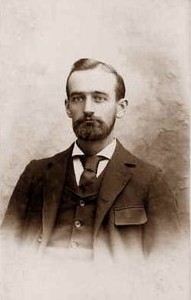
In October 1885 16 year old Friedrich Trump, a penniless immigrant, stepped ashore at Ellis Island and started the Trump Dynasty in the USA.
Friedrich was from Kallstadt Village in Pfalz, in what was then part of the Kingdom of Bavaria part of The Empire of Germany. Friedrich’s family had worked the land as wine growers and farmers, but life was hard, and two of his older siblings had died as children in the 1860s, followed by his father in 1877. Friedrich’s remaining sibling, his older sister Katharina, had emigrated to the USA in 1883.
It must have looked like there was nothing much for Friedrich in Kallstadt, and family legend suggests he took off one night without telling his mother what he was planning, running off to the train station to leave Kallstadt for good. This is possibly true, but maybe not?
In order to get to the USA, he he had plan carefully to travel by train the 300 miles from Kallstadt to Bremerhaven on the North Sea Coast, which would have taken up to 15 hours by train in 1885, Friedrich would have had to have already booked his passage on a steamer to New York, so this must have been a planned journey, probably based on his sister’s experience from a couple of years before.
It seems that although Friedrich had perhaps a few barbering skills, he was listed with “None” as his trade on the ship’s manifest that he steamed away on. Once in New York he took up residence with his married sister who had anglicised her name to Catherine. He took up work as a barber in New York and spent the first few years of his life in America living with his sister and her family.
Mining the Miners
In 1889 Washington State was gripped by the discovery of Gold and Silver Ore at a place named Monte Cristo, and this caused an influx of miners and speculators from the east of the USA to try to take advantage of the opportunities.
By 1891 Friedrich, now “Fred” Trump joined them, setting up his Barber business in Seattle, by this time he was 22 years old, and had realised that there was money to be made from the huge numbers of people seeking their fortunes in Washington State. The miners who flocked there, needed haircuts, and this was his initial opportunity, but they also needed feeding, so Fred established what we would call a “pop-up” restaurant. The prospectors also needed a place to sleep, so he combined barbering, food, and beds to provide an in demand service for the thousands of prospectors coming through.
Very cleverly Fred learned by observing the masses of prospectors that came back from the diggings empty handed, that it was hard to make money from actually mining, but much easier to make money by “Mining the Miners” i.e. providing the comfort, services, and essentials they needed when trying their luck in the frozen north.
Anti-Fragile Fred
Fred Trump was what N.N. Taleb would call “Anti-Fragile” i.e. the more turbulent the times became, the more Fred saw how to make a buck from them. In 1893 we find Fred running the Phoenix Hotel as a quarantine boarding house in Seattle, and charging the local Health Board for providing food to both prospectors and incoming overseas immigrants. Seattle’s quarantine measures included the establishment of quarantine stations to inspect and isolate potentially infected individuals and goods. These measures were part of broader efforts to protect public health and prevent the spread of infectious diseases like Smallpox and Cholera in the rapidly growing city.
The Caterer of Monte Cristo
In 1896 Fred became the front man for an East Coast Mining Syndicate moved out of Seattle and set himself up in Goat Lake Monte Cristo, where he was elected as a Justice of the Peace, and was legally entitled to marry couples there, which he did in the Grand Central Hotel.
The new claims in Monte Cristo started to run dry of Gold and Silver Ore, and Fred moved back to Seattle, but not before he had realised that it was easier to buy a parcel of land for prospecting purposes, compared to trying to buy land for the express purpose of building on it. You could buy a claim for $15 dollars and then build a “dwelling” on it without fuss or red tape.
Yukon Gold Rush
In 1897 when the Yukon Gold Rush started in British Columbia in Canada, Fred backed some experienced prospecting miners with supplies and stake money and sent them off to make claims on diggings in Dawson City. Speculation was rife, it was the equivalent of today’s bit-coin mania, with claims having initially no known actual value, but massive potential, or of course, none at all. The first claim they staked for $15 was sold for $400 dollars the next day, other $15 stakes subsequently went for $150 and then $2,000, this was a terrific way of quickly flipping a claim to make a profit if you could get the first claim in before anyone else. This became so lucrative that Fred appears to have headed for Dawson in person.
Famine
During this journey seeming disaster struck, with the area being hit in the winter of 1897/1898 by famine due to the big influx of hungry miners and the winter weather slowing supplies.
The situation became desperate and Fred made the 300 mile journey up the frozen Yukon River to Circle City (named after the Arctic Circle on which it sat), where there was food in abundance. He had offered to sell a half stake in his claim for $2,500 ($500,000-$800,000) to fund the buying of food but could find no takers.
Gold Struck
Unbeknownst to him, whilst he was 300 miles away from Dawson in Circle City, Gold was struck in the gravel of an adjacent claim to his at Hunker Creek, and that stake sold for $100,000 (perhaps $20-$30M in today’s value).
Race for a Fortune

Realising that Fred would not know the value of his claim, being cut off from the news, there ensued a mad “Race for a Fortune” by several teams of prospectors to get to Fred in Dawson City and buy his half claim before he realised its true value.
At 11 pm on the night of 9th December 1897 the race began over 300 miles down the frozen Yukon River during a blizzard from Dawson to Circle City. First to set out was Ramps Peterson a highly experienced prospector with seven dogs and an Indian Guide.
At five in the morning Captain Geiger, an explorer and prospector with 12 dogs and two Indians followed after Peterson.
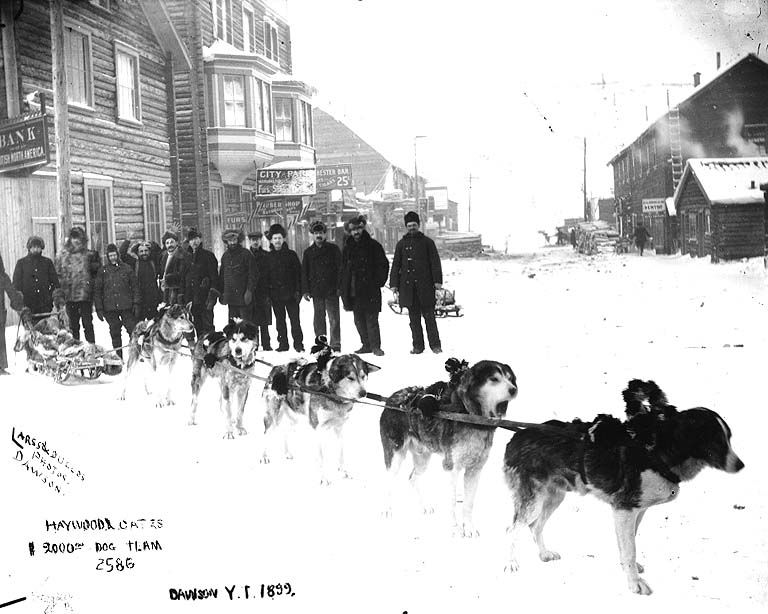
Behind these two teams went Tom Lynch a prospector backed by a notorious Gambler called Goldie. Following these were several other teams streaming over the craggy frozen Yukon River, they travelled in the pitch black of an arctic winter, in a blizzard with temperatures dropping to the minus 20 centigrade.
Over a week later Ramps Peterson tore into Dawson, tracked down a somewhat surprised Fred Trump, and negotiated the purchase of Fred’s half claim. Ramps Peterson had turned a six hour advantage over Captain Geiger into a three day gap by the time his dog team careered into Circle City.
We don’t know how much the deal was done for; some people say that the claim went for as little as $2,000, but, I have found a quote in a local newspaper that said that Peterson went in with $25,000 in Gold dust and came out with $14,000, which would mean that Fred cannily negotiated a sale price of $11,000 despite not having news of what had happened in Dawson. That sale would have been the equivalent of around $3,000,000 in today’s money. After the deal Peterson spent a month travelling to Minneapolis to see his parents who he hadn’t seen for fourteen years.
Arctic Hotel
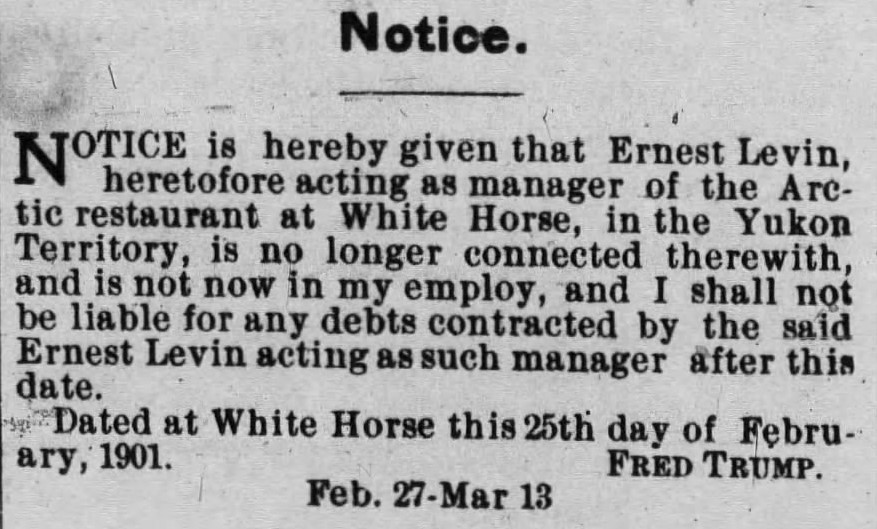
Fred took the Gold and used it wisely, the claims were changing hands for ridiculous amounts on speculation, but Fred decided to go back to a tried and trusted plan, he went into partnership with Earnest Levin establishing the Arctic Hotel in Bennett British Columbia, which proved so successful that he opened up a second establishment also called the Arctic Hotel in White Horse British Columbia.

Fred went back to San Francisco leaving Levin to Manage the Hotels. This proved a mistake, as Levin was fond of his drink and women, and was eventually arrested in connection a complaint from two “Travelling Ladies” who had been persuaded by a fixer to stay at the Arctic Hotel where they were joined in their room by Levin and the fixer, and took to drinking and other activities. The Ladies vacated the room at Midnight, but left their baggage there, only for the now drunk Levin and the fixer to throw the baggage out of the hotel window, through to an adjacent building, where they opened it and removed the women’s jewelry. The women brought in the local Sheriff, the men were tried, and due to their intoxicated state were let off. Fred however had had enough of Levin and dissolved their partnership.
Marriage
Having made a success of the hotels and got rid of Levin, Fred sold up and returned to Kallstadt in Pfalz where he married a lady eleven years his junior named Elisabeth Christ on 21st August 1902 at Ludwigshafen am Rhein in Pfalz Bavaria. The intention was said to be to settle in Pfalz, but that seems unlikely to me as Fred’s fortune lay in the USA and he was a naturalised US Citizen from 1892. In any case it was claimed that Fred was banished from Bavaria for allegedly dodging Military Service when he emigrated to the USA. However, Fred was four years below the conscription age of 20 when he left for the USA so it seems to me that he was pursued for a technicality, i.e. he had failed to register for service once he reached military age, obviously because he was living in the USA as an American citizen, having renounced any allegiance to King Ludwig in the process.
New York
Fred and Elisabeth, who now changed her name to the anglicised form of Elizabeth, settled and raised a family in New York. Fred variously described himself as a Barber, Restauranter and an Hotelier, it seems that he had interests in a number of areas, and his “occupation” may have had as much to do with acquiring real estate as the actual activities carried on within them.
The couple lived in Jamaica New York, and raised three children Elizabeth, Fred Jnr, and John George. In 1918 after a walk with Fred Jnr, Fred Trump returned home and dropped dead from Spanish Flu. Spanish Flu was an epidemic which was sweeping the world and would kill 100 million people, over 600,000 in the USA alone. Fred left at least $31,000 in his will, the equivalent to perhaps $3M today.
Donald’s Dad
Fred’s wife Elizabeth and his eldest son Fred Jnr (Donald Trump’s father) took up the business, and Fred trained in the building trade, carried through a number of real estate deals, including developing parking lots and Apartment Buildings. This built the Trump fortune even more than his father had, and the family initially found fame by opening the first modern Supermarket in New York. In 1936 Fred married Mary Anne McCleod a Domestic Servant and an immigrant to New York from the Isle of Skye in Scotland, the daughter of a Crofter Fisherman.
Donald Trump then carried on with the Real Estate business concentrating on Hotels, Office Blocks, and Casinos.
Pause for thought
Interestingly there is another angle to the Dawson Hunker Creek Goldrush Story. There was actually another Gold Prospector operating in the far North, specifically in Alaska at the time, named Fred Trumpf. It’s been argued that it was this Fred Trumpf who had been in Dawson rather than Fred Trump. The evidence is equivocal. Every Newspaper Report, and there are many, referred to “Fred Trump” not “Trumpf”, the dates and timings fit with it being Fred Trump, and his subsequent ability to invest, travel, and spend would also map to a windfall in exactly the right timescale.
If we examine Fred “Trumpf” he was a Gold Prospector and he was recorded as operating in Alaska during the period, he may or may not have been to Dawson; the name Trumpf is mentioned in a Newspaper in March 1898 as a person passing through to Fort Yukon, and there were two claims logged under the surnames Trump and Trumpf in the Dawson Area. Was either this “Fred Trumpf” or a misspelling of Fred Trump”? Just to confuse matters further, Fred Trump’s original spelling of his name when he arrived from Germany was actually “Trumpf”, also his claims were said to have been logged by the Miners he had staked to go to Dawson in the first instance, so the spelling of the name could be their interpretation.
The rest, as they say, is history, but none of it would have happened if a 16 year old penniless German immigrant hadn’t worked his way up, perhaps trading a $15 Gold Digging claim for the equivalent of $3m in 1898.

 Travelling Through Time to Trace Your Ancestors