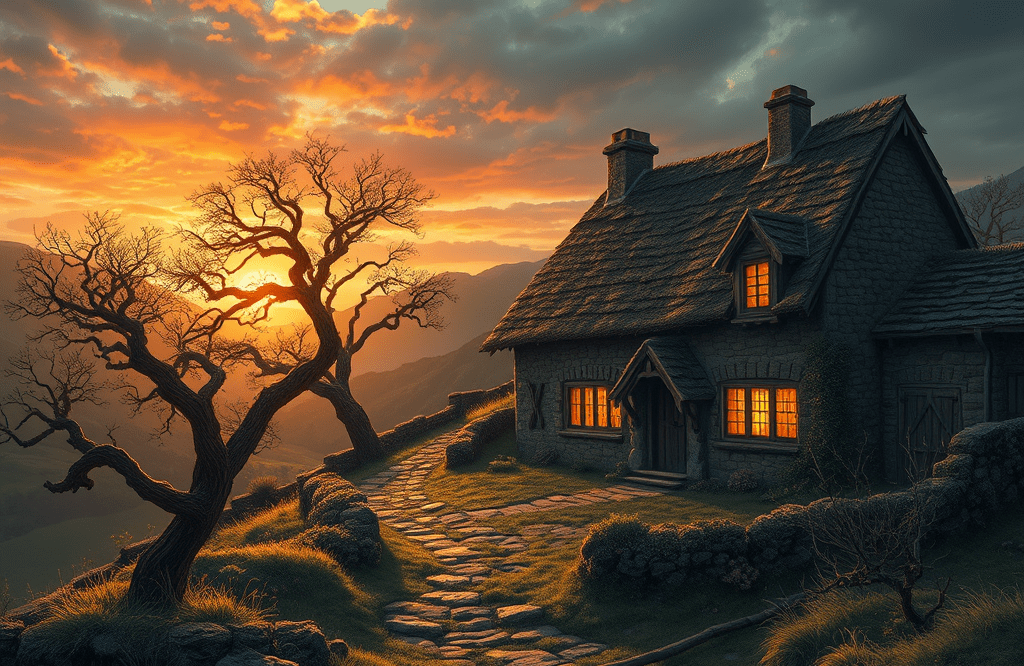
When I research a client’s family history I never know what I’ll come across, a hero or a villain, or, just occasionally, something a little stranger!
This family started to appear in the Records of the Quarnford in the Staffordshire Moorlands in a time of great change and were located early on in the rugged upland areas just outside of the main Villages. To understand the reputation of an area it’s useful to get the local stories ‘Straight from the Horse’s mouth’ rather than just relying on dry official records, it’s the difference between just getting data and getting the full flavour of the locals way of thinking.
A History of Violence
We are lucky in this case, as while researching I came across an old forgotten book containing a set of local legends published in verse form in 1860 written by a ‘Miss Dakeyne’.

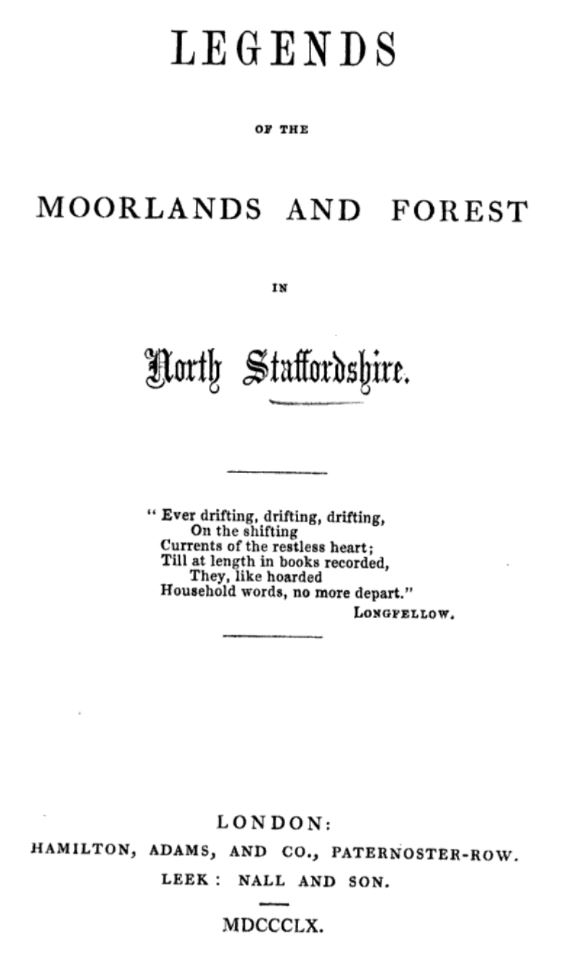
At first it was necessary to consider if the stories were just made up by the author, and this led to some investigation into who Miss Dakeyne was. Was she local? What were her credentials? How likely was it that she had penned the stories faithfully rather than making parts up or embellishing them? My research showed that Miss Dakeyne was one of a trio of Spinster Sisters, although which one is not clear, all born and bred in the Quarnford area, all had ample contact with local people being School Mistresses at a local Boarding school and displayed a good grasp of not only local stories, but also the detail of more recent specific events that had impacted on the area, some mentioned in the book. So well placed, well educated, and well informed.
Armed with a reasonable assurance that the stories were indeed local, well researched, and gathered from local people, we ended up with the ‘Story of Caster’s Bridge’ giving a flavour of the early character of the area at the time that the family being researched first appeared there as Peddlers.
Peddlers and Hawkers or ‘Badgers’ as they were known locally, transported goods, through rugged areas to urban areas with larger populations, and as there was no mass transport at the time, individual itinerant Peddlers were what powered commerce in the area. Groups of these Peddlers started to settle on the Common Land in Quarnford, but especially around Flash. They squatted either permanently or on a transitory basis, most were men, a mixture of young and old, mostly single, and therefore always a source of suspicion for more settled people in the surrounding countryside and further afield. Their choice of Flash as a “home area” have been connected to the fact that Quarnford was close to three county boundaries, and the good road network meant that it was relatively easy for the less salubrious hawkers to escape across County and Parish lines into a separate jurisdiction should the Magistrates or other authorities decide to pursue any them for minor transgressions.
The Story of Caster’s Bridge concerns an honest Peddler plodding homeward towards Quarnford after some time spent away on the road, eager to see his Mother again, coming upon the old Cattle Drovers’ Pathway through the uplands, forests, and marshes that would take him back to his childhood home in Quarnford. The Path was different from when he first left home, having become less well travelled and overgrown in places, and before he started on the trek across it, he came upon a Cottage where an elderly couple offered him shelter as the sun was on the wane, but they warn him of the dangers of trying to cross the ‘Roches’ – the name of the uplands that lay ahead – both in terms of the terrain and the people he may encounter, but being so close to home our hero the Peddler hoisted his pack on his back and walked on into the hills.
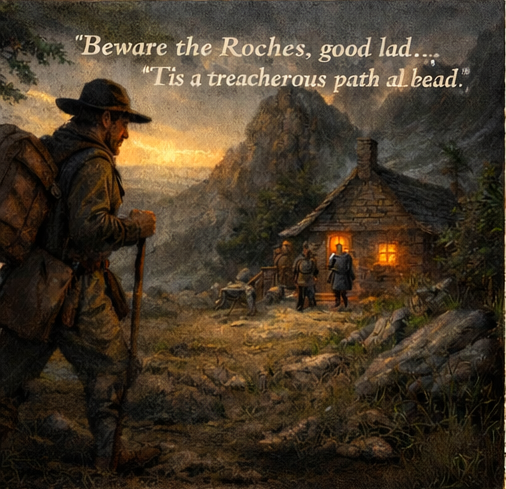
Having taken in the beauty of the countryside and the views from the high ridges,
‘…so glorious, and yet so wild in its magnificence’
He finds that the light is beginning to fade, and he needs to find somewhere to stay overnight. He eventually came to a lonely cottage by a riverside. Outside sat a Mastiff guard dog, that barks at his approach, followed by a man with a ‘grisly beard’ followed by a woman who ‘…peered with furtive looks’. The couple quieten the dog and then invite the Peddler in to stay the night. The Peddler is wary of the couple, weary but not wanting to travel in the dark, he is eventually swayed by the sound of children’s voices, reassuring him that this is a simple family home offering a resting place for strangers in order to help ends meet.
In the approach to the Cottage are the workings of Iron Smelting, obviously the Family’s main income, and walking up to the Cottage the Peddler pulls off his pack, stretches and calls to the couple that he will take bed and supper, but as he puts his hand to the latch on the cottage door to enter, he hears the tread of many feet of unseen people inside, sees the light and feels the heat of what he takes to be a smelting furnace in full blaze, strangely coming from inside the cottage, this makes him pause at the door, and as he does so he hears a child’s voice say:
‘Mother, when will that queer old man be dead? I’m sure the oven will soon be very hot!’
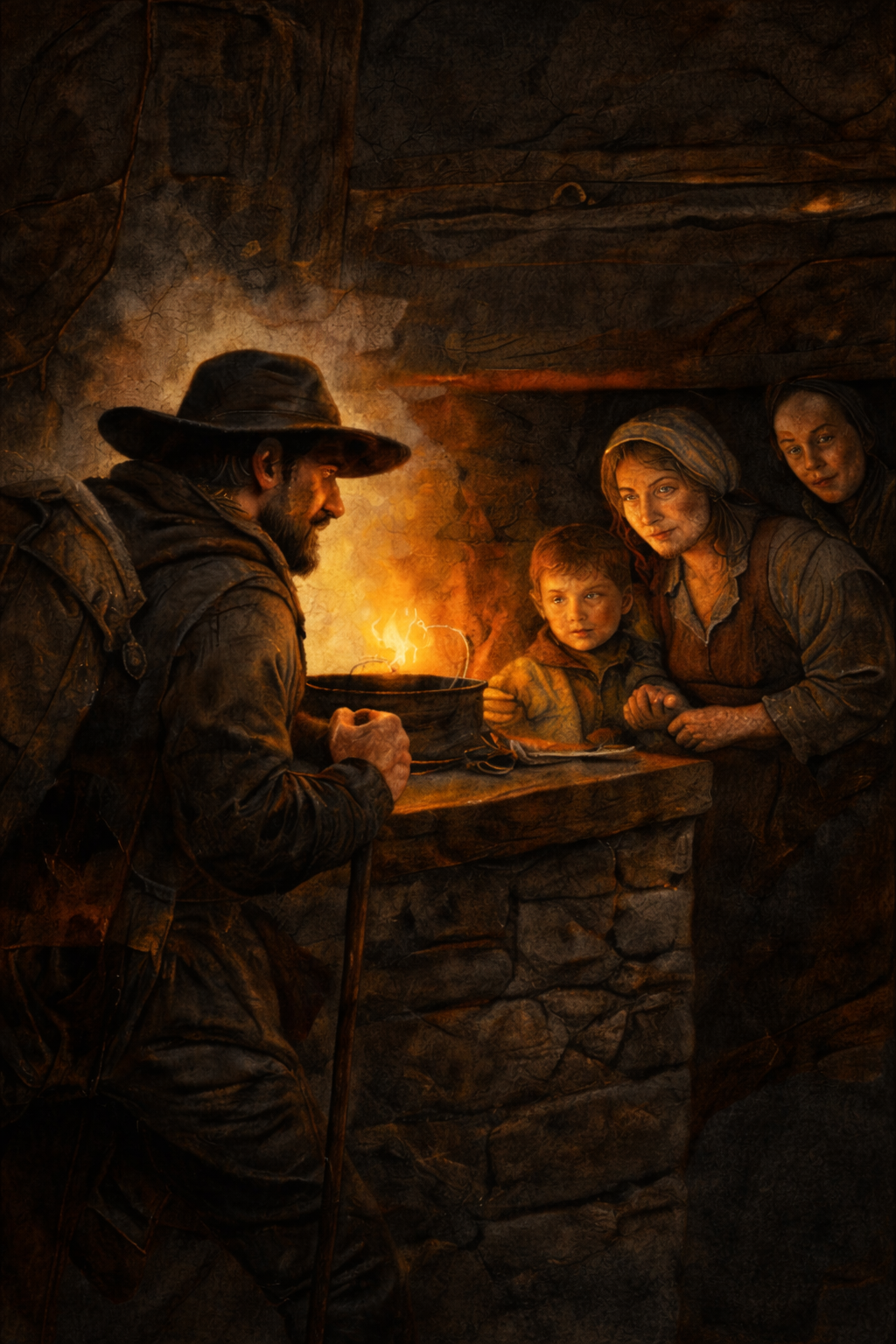
The Pedlar is overcome by dread, and fearing an ambush, runs from the cottage, down the road until he reaches Caster’s Bridge, all the way hearing dogs barking and the footfall of people pursuing him. Faced with the Bridge but fearing capture the Peddler climbs the stonework;
‘…for, climbing up the side, from where the stonework rose above the tide, he reached the top, and grasped a narrow ridge, within the arching roof of Caster’s Bridge!’
Out of sight his pursuers soon appear;
‘…a murderous pack of women, men, and dogs; who sure revealed their horrid purpose.’
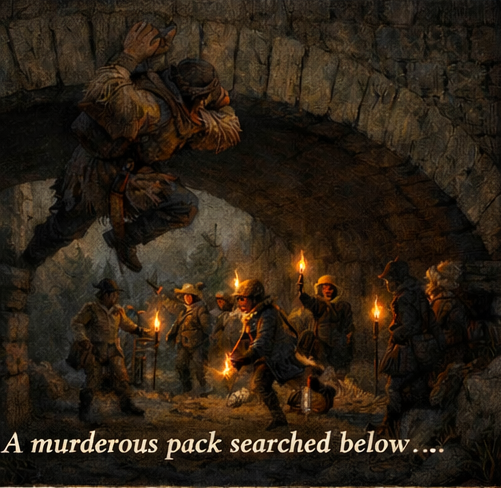
He watches them searching around the riverside with flaming torches trying to find his hiding place, and hears them exclaiming that he’ll never escape or live to see the light of day. The Peddler has no choice but to stay hidden in the roof of the bridge for most of the night, until he can see by the disappearance of their fiery torches into the woods, that his pursuers are no longer nearby.
“With what tenacity his fingers clung, as on his ear their dreadful voices rung! And thus the night in greater part was passed, and every breath the peddler deemed his last!”
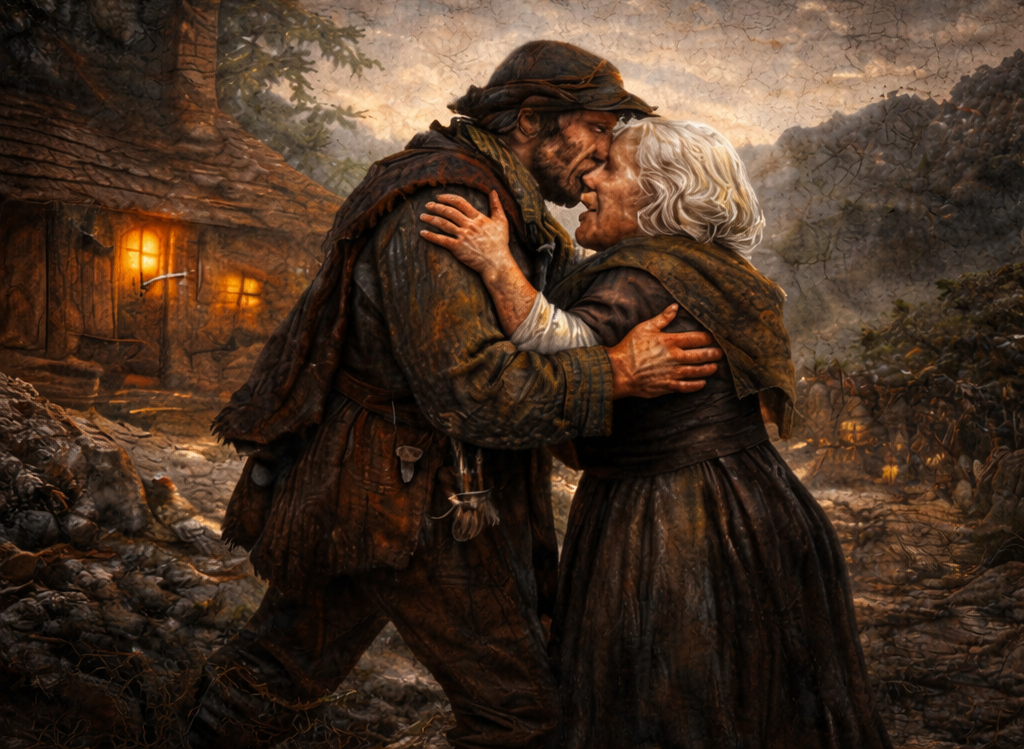
Sure that they have moved on he makes his way in the moonlight along the overgrown banks of the river, ripped and torn by brambles, trudging through the river to put the dogs off his scent, he makes his escape, gives praise to heaven, and finally makes it home, where he finds his Father and brothers are long dead, and there is just his old grey haired mother to greet him, and he falls into her arms, safe at last!
The next day he travels to the Town and tells the Magistrates what had befallen him. The Magistrates immediately gather a force of soldiers to capture the miscreants, who are duly rounded up and their house burned to the ground. Captured, the robbers are forced to confess;
‘And then no doubt remained as to their crimes, which they in full confessed, and of the times when weary travellers, albeit brave and bold, had lost their lives, a sacrifice to gold!’

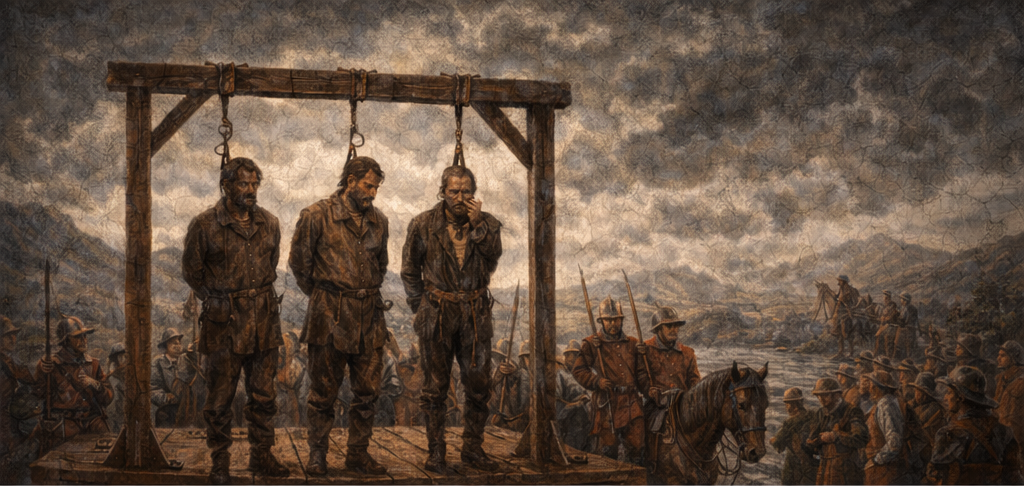
Justice was swift in those days, and we hear that;
‘For to the Laws atonement must be made, and their most wretched lives the forfeit paid!’
Followed by a flood of the river that washes the remains of their cottage and ironworks away.
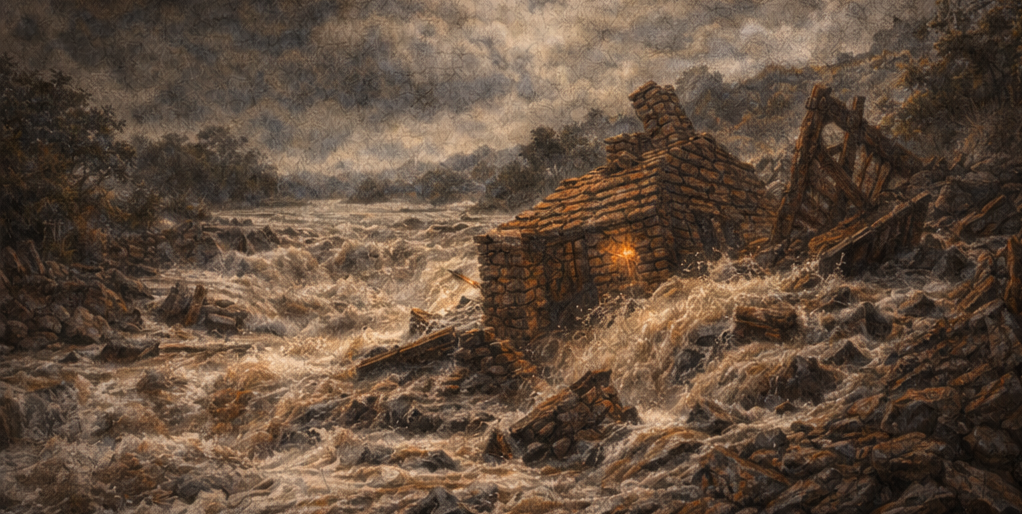
Gothic as the story is, it most likely has its origins in some aspects of truth, local landmarks are mentioned, like the Roches the local peaks, Caster’s Bridge itself, and the River Blackwater, with detail added by the author about certain aspects, like where specific trees are mentioned by the Bridge, the fact that these and part of the bridge had been washed away in a flood in the 1840s, explaining why some details of the landscape had changed from the time the story was set to her retelling of it. The remains of buildings and smelting works have also been found in the woods nearby the bridge, and there were stories about the local villagers only venturing into the uplands in groups for fear of bands of ruffians frequenting them armed with staves.
Taking these details all together we get a picture of a wild area that had previously being highly used, but had had its trade disrupted by the English Civil War, linking this to the description of where Miss Dakeyne had got her stories from, she refers to grey haired old men who had heard the stories from their forefathers, if she had first heard the stories as a child in the 1830s, then the old men who told them could have heard them from their own grandfathers bringing us back in a couple of jumps to the early 1700s.
This would fit well, as the Civil War in the mid-1600s had caused great disruption to trade, and there was a huge amount of fighting in the Staffordshire and other Midlands areas for a prolonged period of time, this lead to both the growth of bands of ill disciplined soldiers taking what they wanted from the local peasantry, and the peasants response of forming bands of ‘Clubmen’ i.e. men armed with clubs and staves and other makeshift weapons to defend their villages. It’s not hard to imagine the roads across the peaks falling into disuse for many years, until the economy picked up again, and with it came the growth of Peddlers documented in the Quarnford area as being a major component of the early 18th century population.
Locals who had lived through the Civil War, and were used to lawlessness and violence, may not have been averse to turning to it for profit, and being Iron Smelters or ‘Casters’ gave them the added advantage of being able to easily dispose of victims bodies in their furnaces. This lawless upland area around Quarnford, was the environment that the client’s family were living in in the early 1700s, and formed the background to their story.
The moral of the story? Stay off the Moors and Forests at night or expect an uncomfortably “warm” greeting!
One from which you may never return from.

 Travelling Through Time to Trace Your Ancestors