I had a pint in The Three Cups Inn in Stockbridge, The Three Cups is a lovely friendly Pub standing on the High Street of Stockbridge, a small market town in the Test Valley. Frequented by both visitors to the small town and friendly locals, a very traditional pub, with beams and fireplaces and a nice garden reflecting its welcoming reputation.
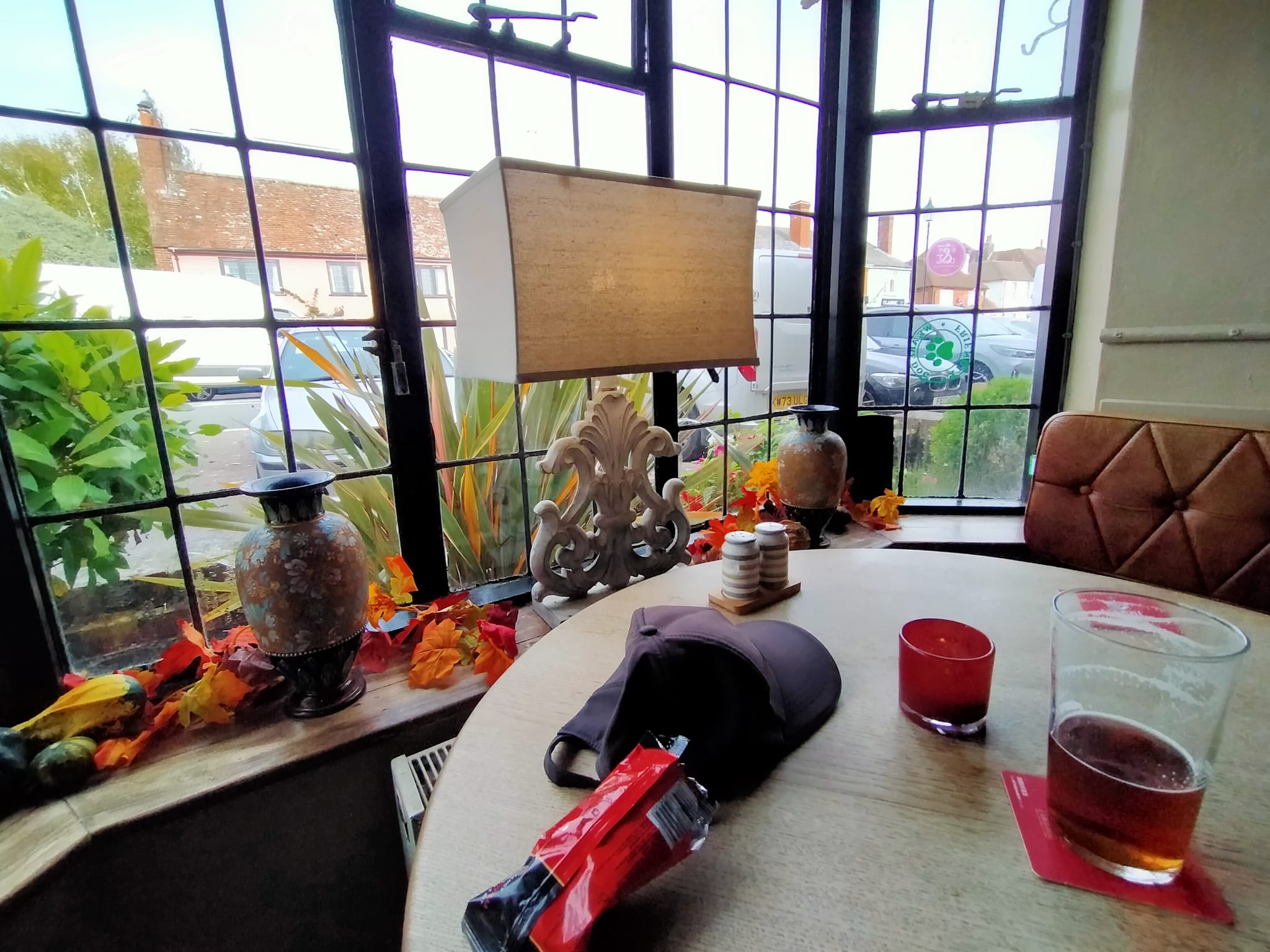
I got speaking to the Landlady, Lucia, about the recent history of the pub, as well as the possibility of doing a talk in the pub garden come the summer. Fingers crossed that’ll be a nice event for locals and visitors alike.
The Three Cups isn’t just “an old pub.” It’s documented for at least four‑centuries as a social institution, with legal deeds, insurance records, court cases, community events, colourful characters, and a continuous thread of human drama, it was documented, deeded, insured, fined, fought over, and occasionally set on fire. Many pubs can only claim history, but the Three Cups can prove it. All within a landscape that was defined by travel, trade, and roadside hospitality for nearly two thousand years. The Three Cups story stretches from the middle ages to the present day, and every generation has left its trace.
This is the kind of history Time Detectives thrives on: evidence‑based, character‑driven, and gloriously human.
The Genesis of Stockbridge
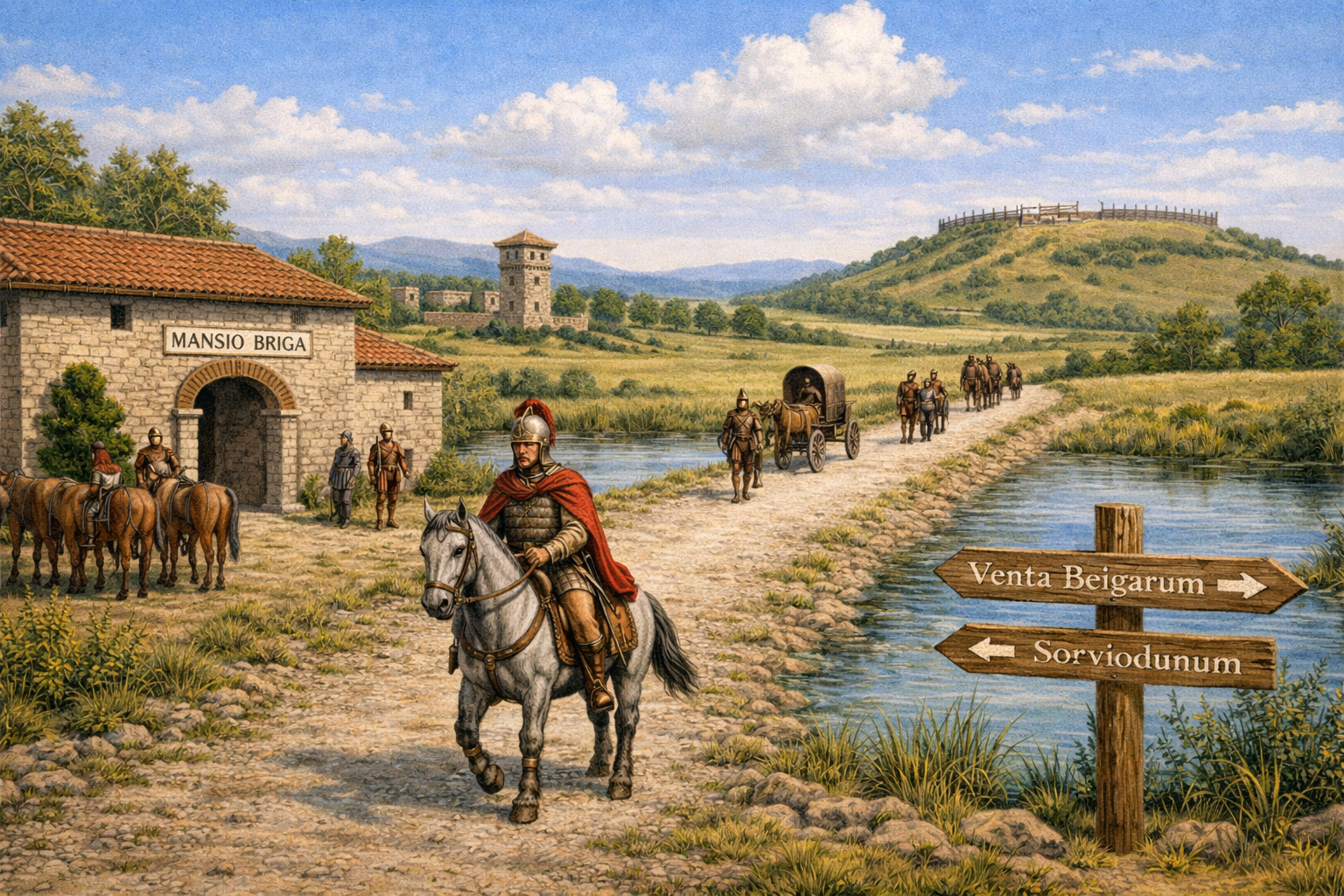
The actual building’s origins lie in the late mediaeval period, possibly back to the 1400s, but Stockbridge as a stopping place to gain bed, board, and stabling can be traced as far back as the Roman period more than a thousand years before that. Stockbridge was one of the few crossing points of the River Test and the only one on a direct route between Winchester (Venta Belgarum – Market of the Belgae Tribe) and Old Sarum (Sorviodunum – the Fort by the flowing River) and all places West. Initially the crossing was via a causeway dating back originally to Roman or pre-Roman times. We know that the Stockbridge area , was called “Briga” by the Romans, the Brythonic (British Celtic) name for a high place, Briga was a recorded by the Romans as a “statio” i.e. an official stopping place, probably a “mansio” or posting-house, more or less an official “Inn”.
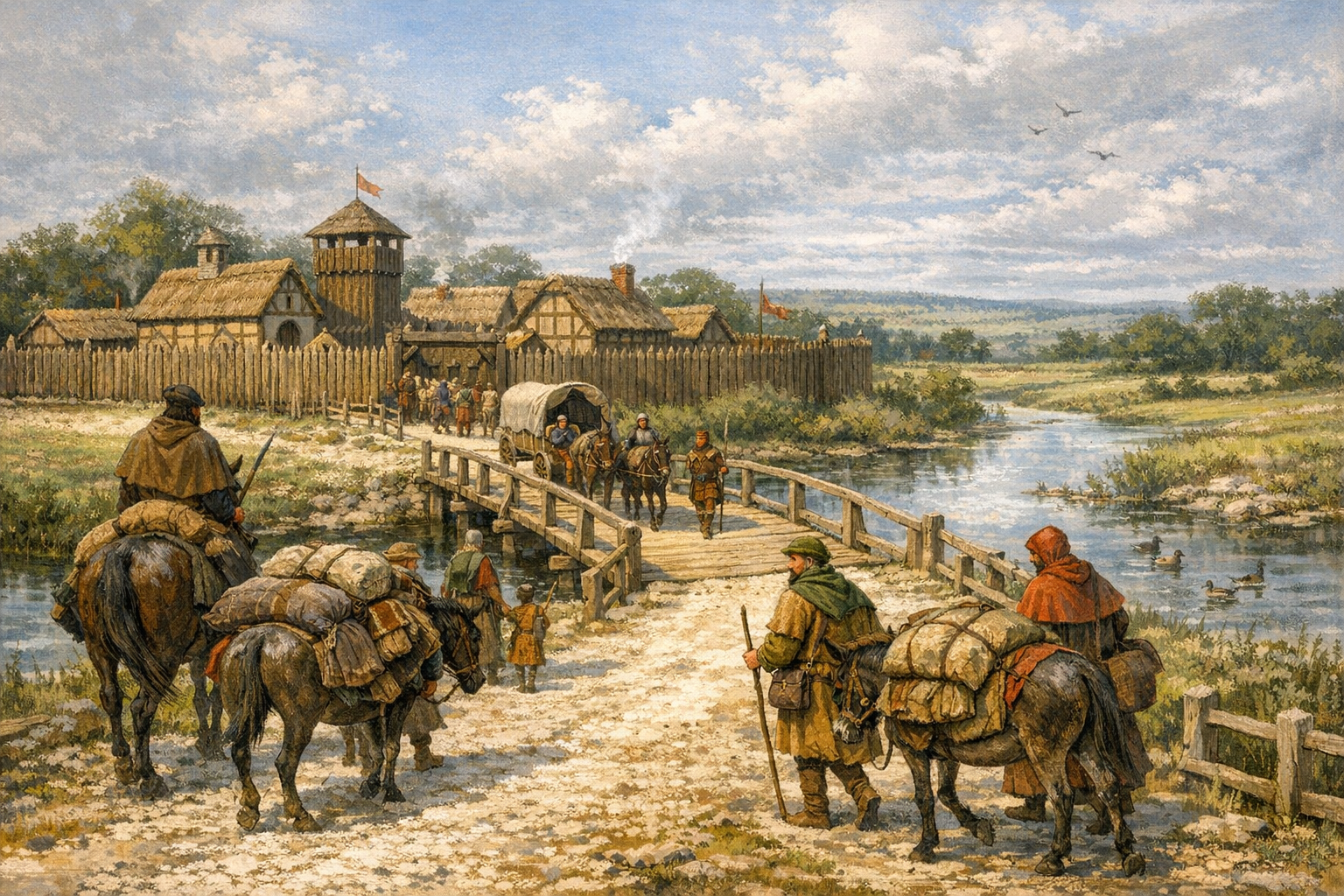
During English times Syockbridge would most likely have been called “Straet” in acknowledgment of its long wide causeway used as a Roman road. The Normans called it “Le Street” taking the English name, and rebuilt the causeway with gravel and chalk by around the year 1200. The crossing became important enough as a route between Winchester and Old Sarum that by the middle of the 1200s a Bridge was built, and the stockaded bridge or stockaded settlement by the bridge gradually took the name of Stocbrug → Stocbrigg → Stokbrigge → Stockbridge.
The name “Three Cups” is medieval in origin and is commonly associated with the symbol of the three cups or chalices of St Nicholas, patron saint of travelling traders and merchants.
Given that The Three Cups began as an inn serving travellers, traders, and livestock dealers travelling through the Test valley, the dedication to St Nicholas the patron saint of merchants and traders is very fitting, especially as the Innkeepers may have acquired the land from the old Abbess of Leckford, the local Nunnery, who would have needed an outlet to sell off surplus ale, beer, and cider produced at the Nunnery.
Henry VIII and the Wigge Family
In 1539 Henry VIII dissolved the Abbess of Leckford, an outlying manor of St Mary Winchester. It was an Abbess not an Abbey as it housed Nuns and was run by an Abbess. This meant the property and lands reverted to the crown, in 1544 the King granted the lands to Sir Richard Lyster.
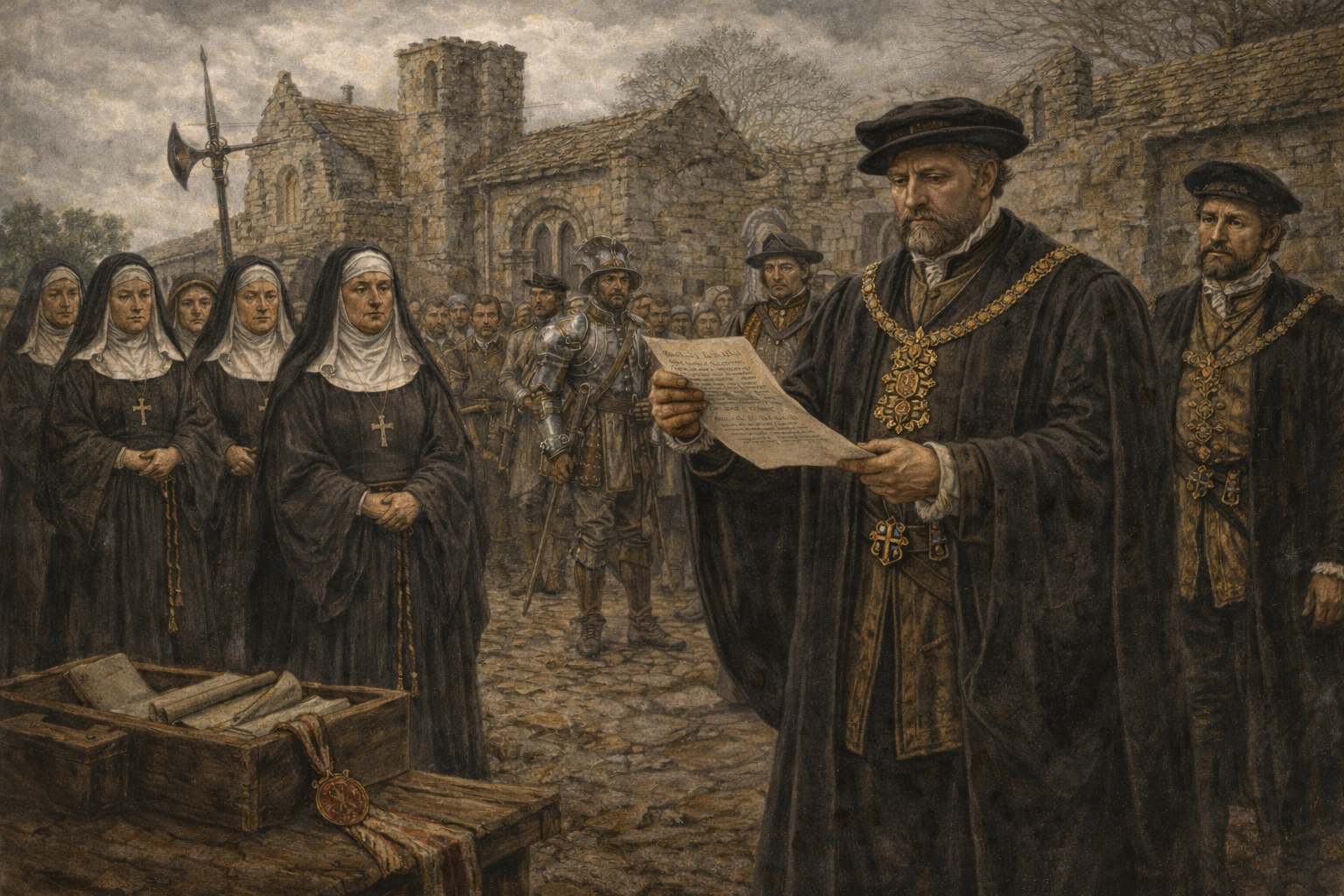
However some parcels of land had already been sub-let by tenants, or formally conveyed to new owners, or held under other agreements with the Abbess before the dissolution, and the title to these lands became a legally grey area. Sure enough, around sixty years later the ownership and title of various tenants on the land were in dispute and in 1603 a case was brought by Benedict Winchcombe claiming legal ownership, or superior title to these lands now held by others including the Wigge Family and the Knights and the Bedburys amongst many others:
“Title to lands alleged parcel of the manors of Ashley and Leckford Abbey”
Over seventy people ranging from members of the aristocracy to tenant farmers are mentioned, including a Richard Wigge, who was important enough to have been mentioned by name in the litigation. The Wigge are the first family we find associated with the Three Cups Inn.
The Wigges were “Yeomen” i.e. farmers who worked their own or rented land for their own profit, and it is land ownership that that brings them into the light of historical records prior to the mention of the Three Cups.
Despite a court battle of over twenty years, Winchcombe seems to have failed in his litigation, and the Wigge Family held on to their land holdings and properties in the Test Valley, which may have included the Three Cups Inn, and explains a close relationship and trust between the Wigges, Knights, and Bedburys, having defended their titles against a hostile takeover together. This relationship would become important in the context of the Three Cups Inn.
1632 — A Yeoman’s Gift for his Wife and Daughter’s Future
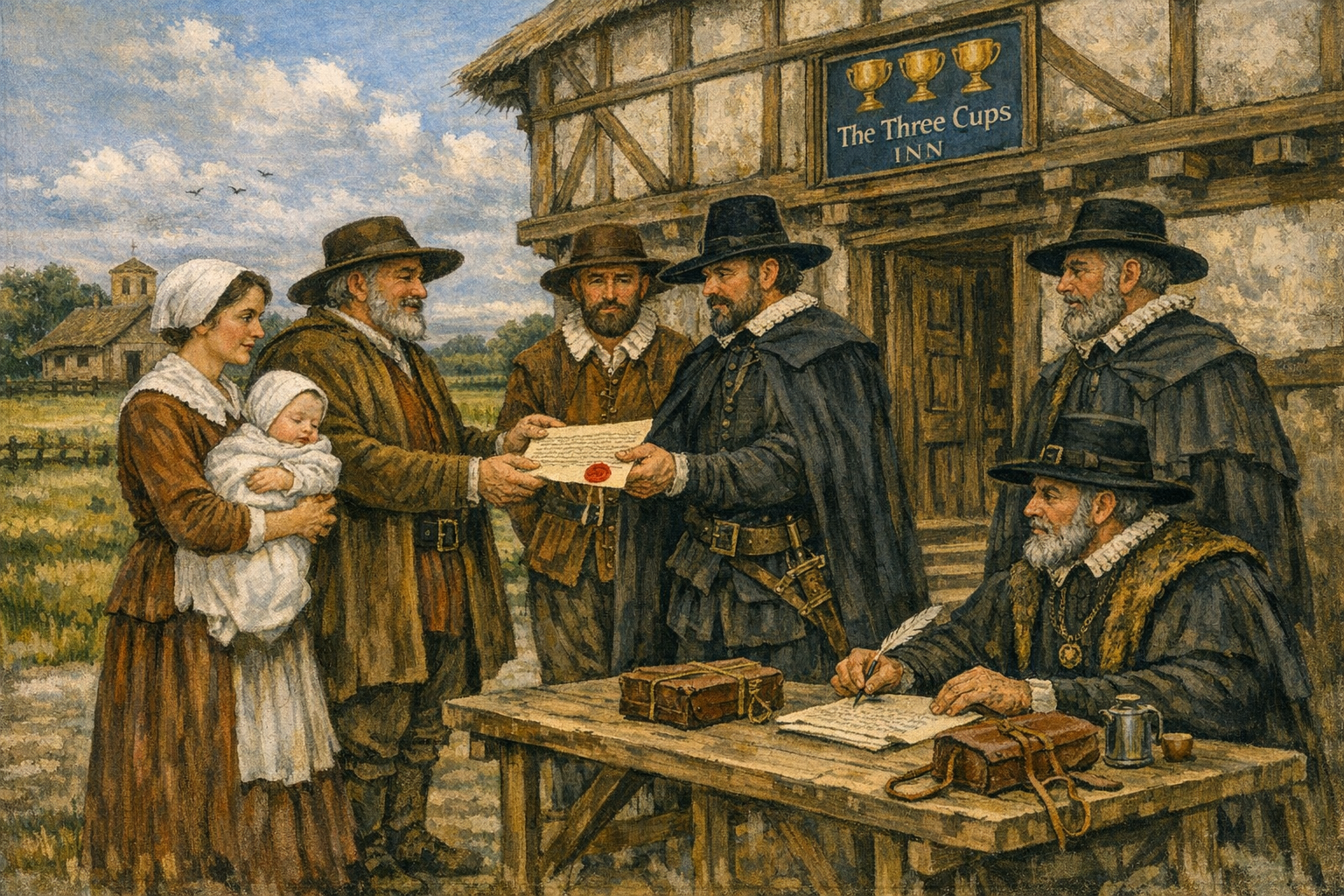
“Feoffment from William Wigge of Salisbury, yeoman, to Edward Knight and George Bedbury of same, gents., of the Three Cups Inn, with meadow adjoining, and also another messuage, in Stockbridge, being a settlement on Dorothy his wife for her jointure after death of Wigge, with remainder to Anne their daughter. Robert Goddard and Michael Goddard of Stockbridge, gents., attorneys to deliver seisin.“
This small paragraph delivers a wealth of information, so let’s start the story with an early record with a date of 29 September 1632, when William Wigge of Salisbury, a yeoman, settled the Three Cups Inn on his wife Dorothy as her jointure – a provision made for a wife’s support after her husband’s death, often involving land either at the time of their marriage or on the making of a will. This also shows that the Inn was already in existence as a working Inn before that date of 1632, it also included a one‑acre meadow on the north side of Stockbridge High Street — quite possibly the former land of the Abbess of Leckford.
This wasn’t a casual handover. It was a formal feoffment, a legal transfer of ownership, complete with attorneys delivering seisin which means legal possession of the land. These terms reflect the ceremonial and property-based nature of early modern conveyancing. And so the Three Cups enters our story with full legal ceremony.
In the feoffment two men are named as feoffees – Edward Knight and George Bedbury these are trusted men appointed to hold legal title to land “to the use” of another person, in this case William’s wife Dorothy and his daughter Anne. This was a common legal device, dating back to at least Tudor times, for managing inheritance, protecting widows, or avoiding feudal dues. This was a different time from today, and unsupported women and minors were at much greater prey to unscrupulous men, as was shown in the Winchcombe legal case, than they would be today both legally and in terms of illegal intimidation.
When I looked into William Wigge and his wife Dorothy, I found that William Wigge had married Dorothy “Knight” in 1630 in Salisbury, and Dorothy Knight’s father was Edward Knight, one of the trusted feoffees on the document. So the Wigges were related to the Knights, and the Knights had a long association with the Bedbury family, and the Goddards, who acted as attorneys for the Wigges, also acted legally for the Knights. So there was evidence of a high trust network of intermarriage and business associations between the families.
But all of this would be thrown into turmoil within a decade.
Civil War 1642-1651
Records become scarcer ten years after William Wigge made his bequest to his wife Dorothy, this was because Great Britain, Ireland, and Scotland were convulsed by Civil War. The King and Parliament took up arms against each other, and the conflict engulfed Hampshire.
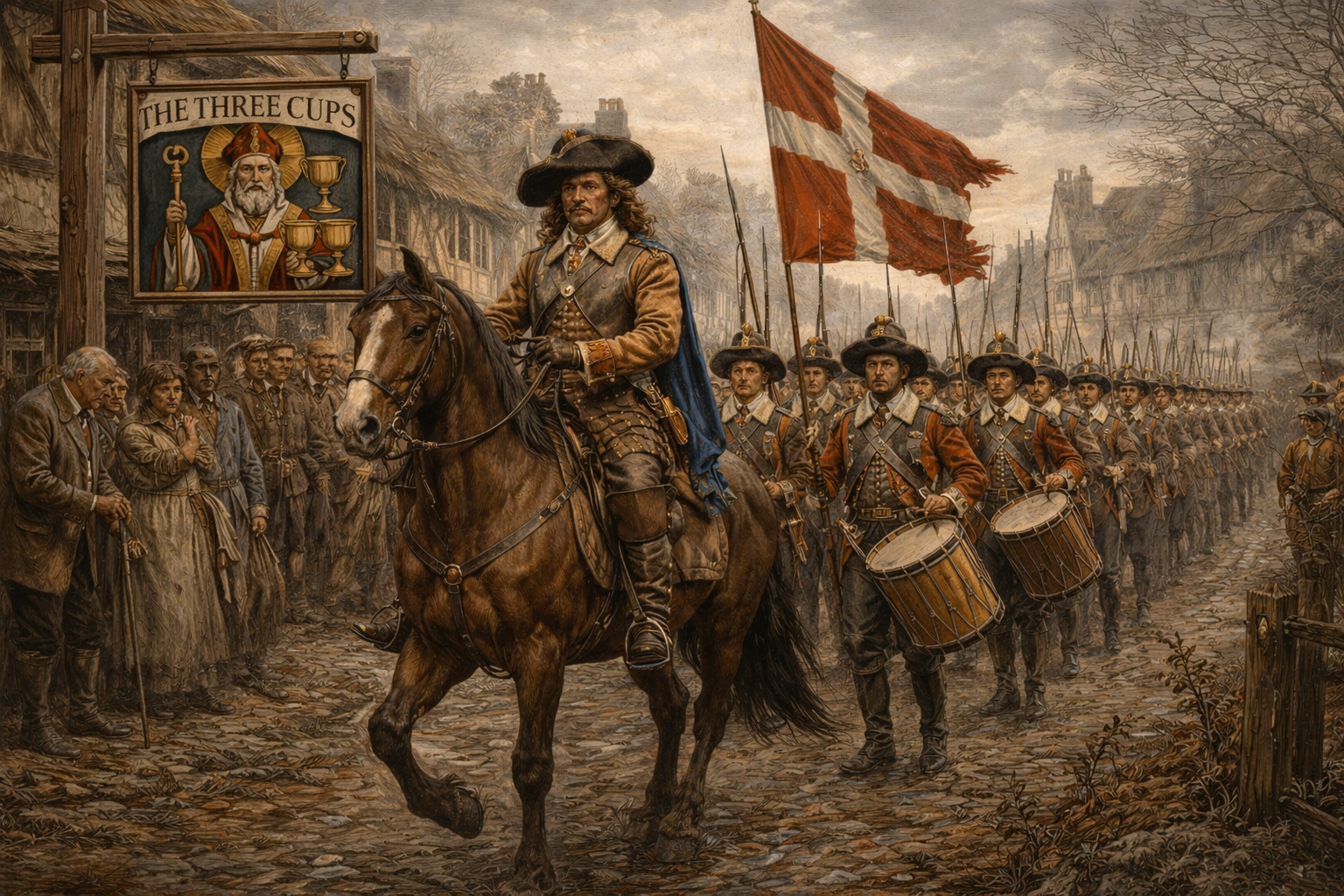
For the people of Stockbridge, the English Civil War was not a distant clash of kings and parliaments — it was something that arrived on horseback, clattered across the bridge, and demanded ale, beds, fodder, and obedience. The Wigge Family lived through a decade in which the Test Valley became a military corridor. Troops marched between Winchester and Salisbury, scouts rode ahead of them, and wagons groaned under the weight of munitions and supplies. Every one of them passed the doors of the Three Cups Inn.
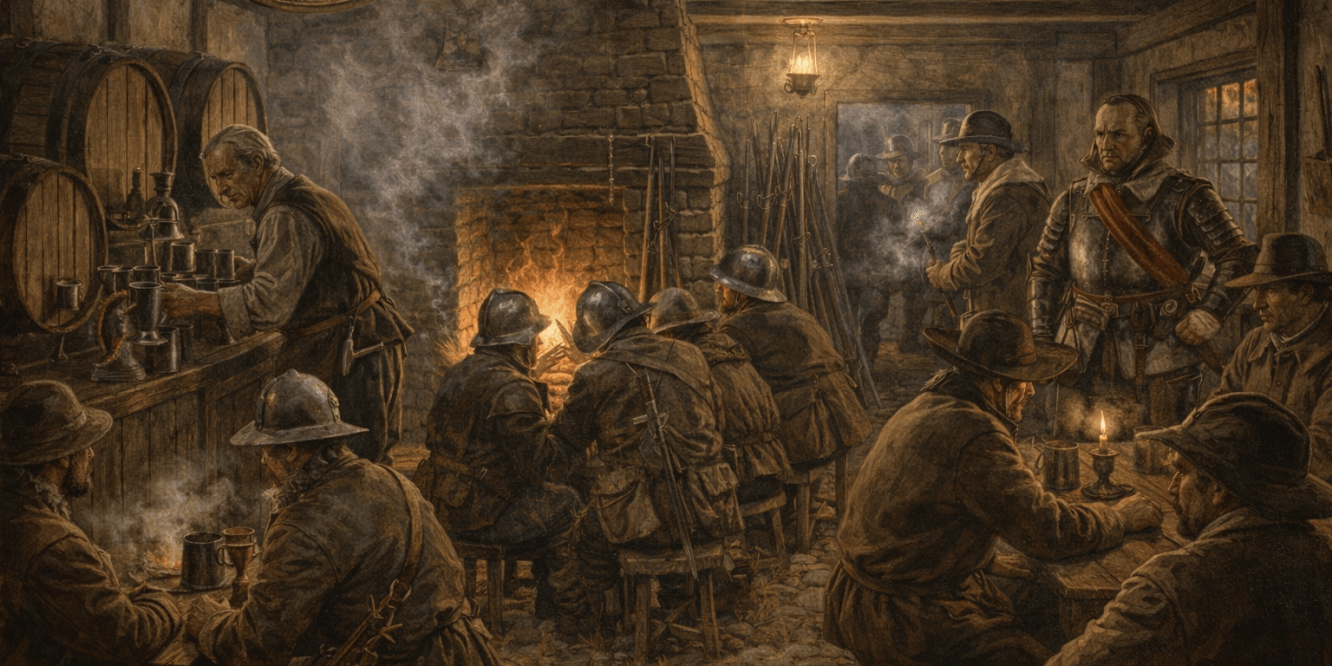
We can imagine a winter night in 1644, when the Three Cups Inn was a place of smoke, noise, and tension. Outside, the Test ran black under the bridge, swollen with rain, while the wind rattled the shutters. Inside, the taproom was crowded with Parliamentarian soldiers “Roundheads” stamping mud from their boots, their muskets stacked by the door, their breath rising in the cold air. The landlord moved quickly between them, drawing ale from barrels that were already half‑empty from the day’s demands. A corporal barked orders for more straw in the loft; an Officer demanded a private chamber; while common soldiers cursed as they tried to warm their hands by the fire. Local men — even the Inn keeping Wigges kept their heads down, knowing that a careless word could bring trouble. The war had not come to Stockbridge as a battle, but as a rough presence: loud, hungry, impatient, and impossible to ignore.
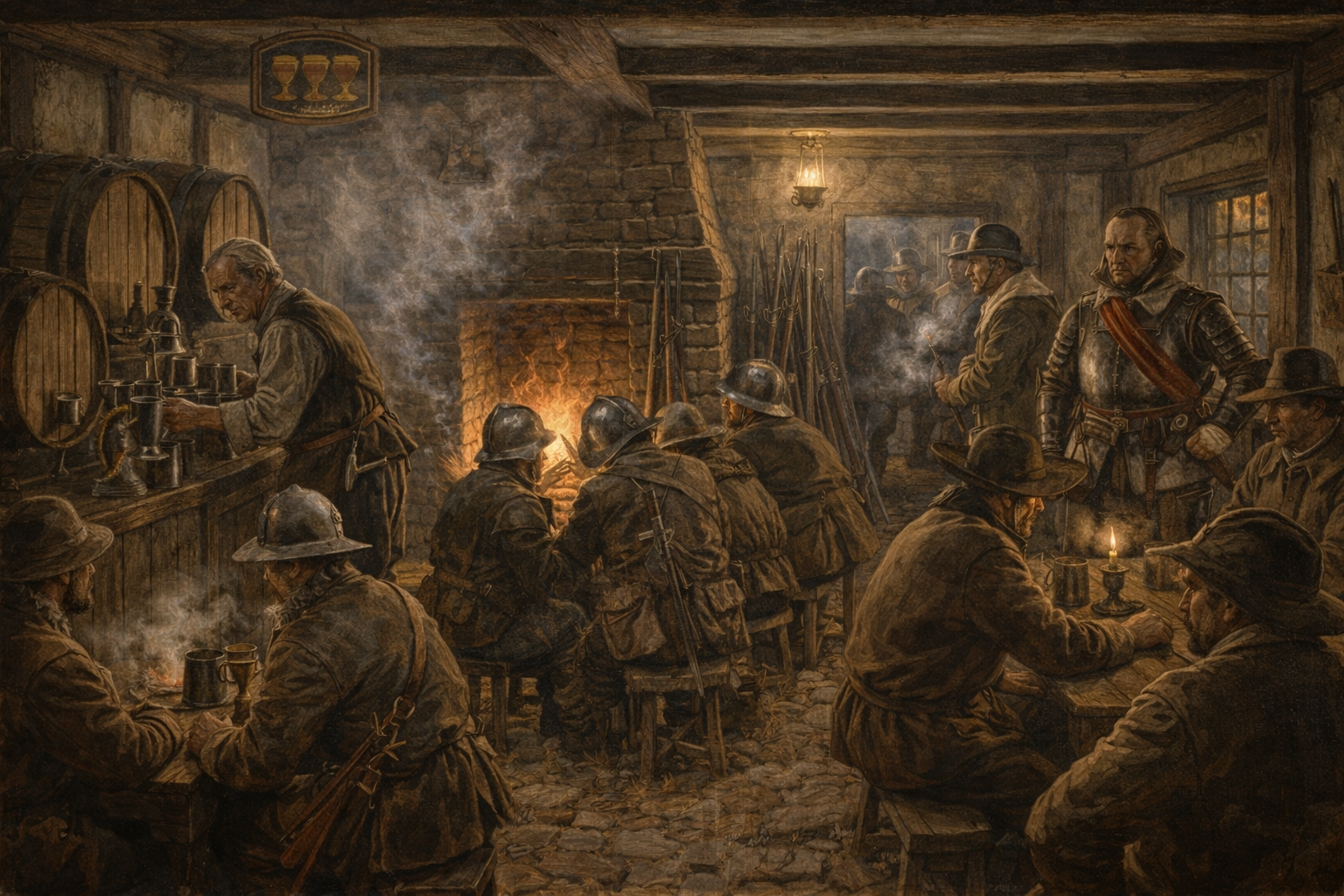
For the Wigges, the war meant militia musters for the men, forced loans, and the constant fear of billeting of rough soldiers in their homes and at the Inn. Soldiers tramped through Stockbridge, arguments about loyalty and religion broke out, soldiers drained the people’s provisions into their own bellies. The war was not fought in Stockbridge, but it was felt there — in the empty barrels, the broken doors, the unpaid bills, and the uneasy silence after the troops moved on.
William Wigge would have been liable for militia service, meaning he would have been called to muster with a pike or musket, or to serve as a watchman on the Salisbury–Winchester road. He would have been assessed for forced loans, taxation, and provisioning, all of which strained his household finances. When troops passed through Salisbury or Stockbridge, he might be ordered to provide a horse, a cart, ale or grain, often without compensation. Anne Wigge was a young woman during the worst years of the conflict — old enough to remember soldiers at the door, young enough to need protection from them.
Even if he wasn’t a political man —a few rural yeomen were — William Wigge lived in a world where politics arrived uninvited. Ministers were ejected, neighbours argued, and rumours travelled faster than wagons. Stockbridge was a strategic spot as a crossing point for the River Test, located between Winchester, Salisbury, and the Royalist stronghold of Basing House. As the war ebbed and flowed, Royalist forces traversed the Town followed by Parliamentary forces, each would have been on the look out for spies from the other side, trying to learn of troop movements and the make up and numbers of troops on the move, the local population would have been held in deep suspicion, and anyone considered a spy could expect to be shot or hanged with a minimal recourse to the law. An Inn represented a hotbed of spies both real and imaginary.
William’s priority would have been simple: keep his family safe, and keep try to make sure he got some form of payment when soldiers filled his Inn.
1655 — State Interference: The End of the Wigges
In 1649 Charles I was executed, and by 1651 the War was over. Parliament took control of the Country, but that was short lived, and in 1653 Cromwell mounted a coup and declared a Protectorate as he felt that Parliament no longer reflected the wishes of the people. This lasted for five years and ushered in much stricter laws on Inns and Inn Keepers, as Inns were considered as breeding grounds for disorder, centres of Royalist plots, and places of drunkenness, immorality and sedition. Ale houses were now licensed, Inn keepers had to be “a fit and able person” magistrates could shut down disorderly houses, fine unlicensed sales and order the whipping or imprisonment for repeat offenders.
From 1650 being drunk, serving a drunk person, allowing drunkenness on the premises, and allowing “tippling” (hanging around drinking without cause) would lead to fines for both the drinker and landlord, as well as imprisonment and public whipping. Other than the punishments most of these laws are essentially still in place today, and seem pretty reasonable.
In 1654 new laws came in limiting opening hours, as well as banning Sunday drinking apart from travellers, forbidding the hosting of “idle persons”, banning gaming and music, and requiring landlords to report “suspicious strangers”. Again a number of these provisions lasted for centuries.
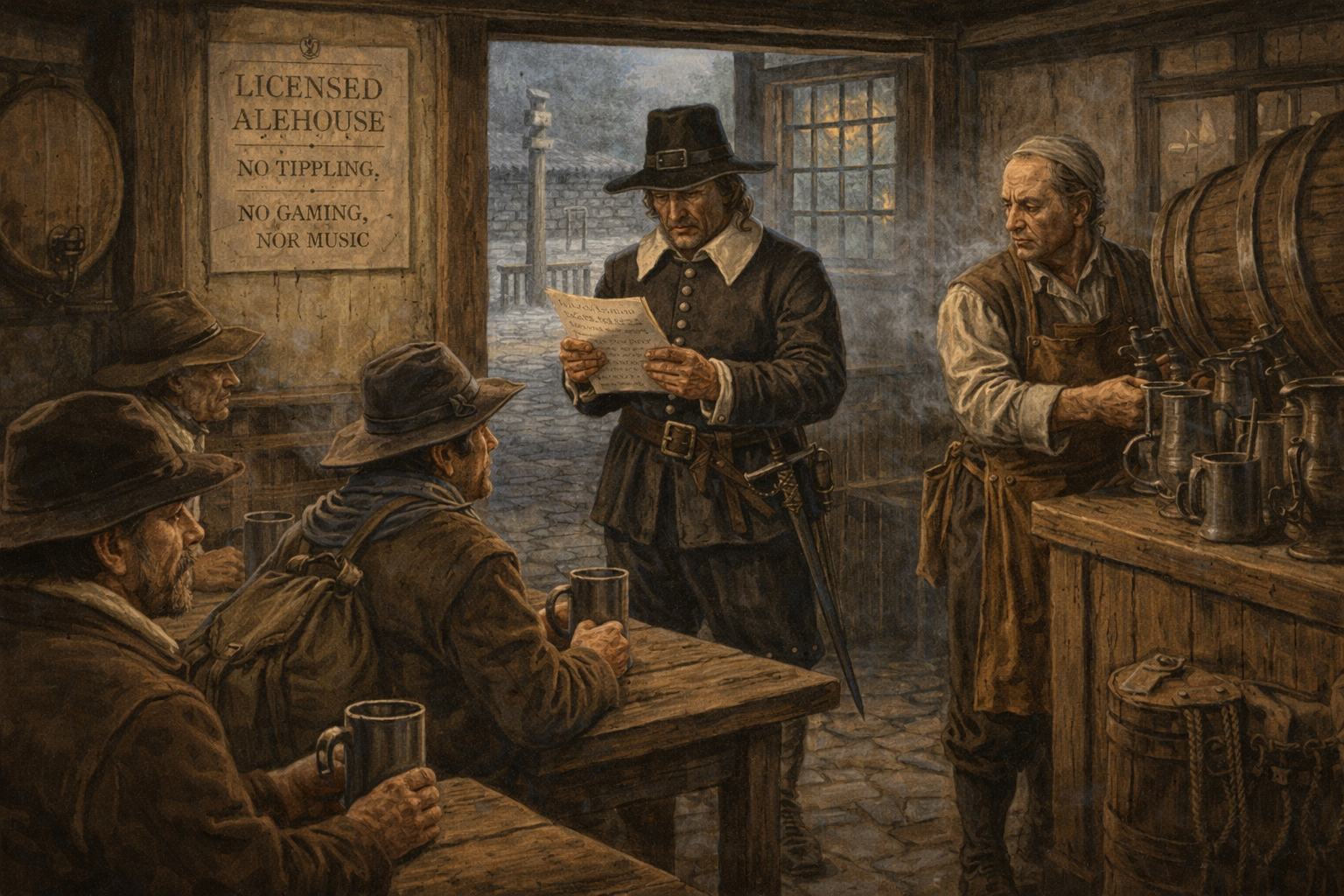
1655 was the year of the strictest Puritan crackdown, the Three Cups was now in the hands of William and Dorothy’s daughter Anne, who was married to Richard Easton, a Salisbury shoemaker. Local power was in the hands of Major-Generals – Military Governors who enforced Puritan morality. Many licenses were revoked, some ale houses shut down, soldiers patrolled drinking houses, and Inns were monitored for Royalist sympathies, Inn Keepers being interrogated about their customers, and any drunkenness was treated as a criminal offence.
1655 represented the final straw; Anne and Richard sold the Three Cups out of the family, opting for the money rather than run the pub under such conditions. The Three Cups Inn was sold for £60 (about ££295,000 in terms of today’s relative income) to Sarah Moody a widow of Little Somborne and John Whitman of Houghton, the son of a Husbandman – a smallholder renting or owning a small parcel of land for his own cultivation. What the relationship was between the widow and the Husbandman’s son is not known, they may have been joint owners, or Sarah may have provided the capital whilst John ran the Inn.
The Wigges had run the Three Cups Inn, at least for some decades, possibly for much longer. Already, the Inn was a social crossroads: yeomen, shoemakers, widows, soldiers, and a twenty year legal dispute all intersecting through one building, but the state had broken the Family’s will to continue.
What happened next? Find out in Part 2.

 Travelling Through Time to Trace Your Ancestors