
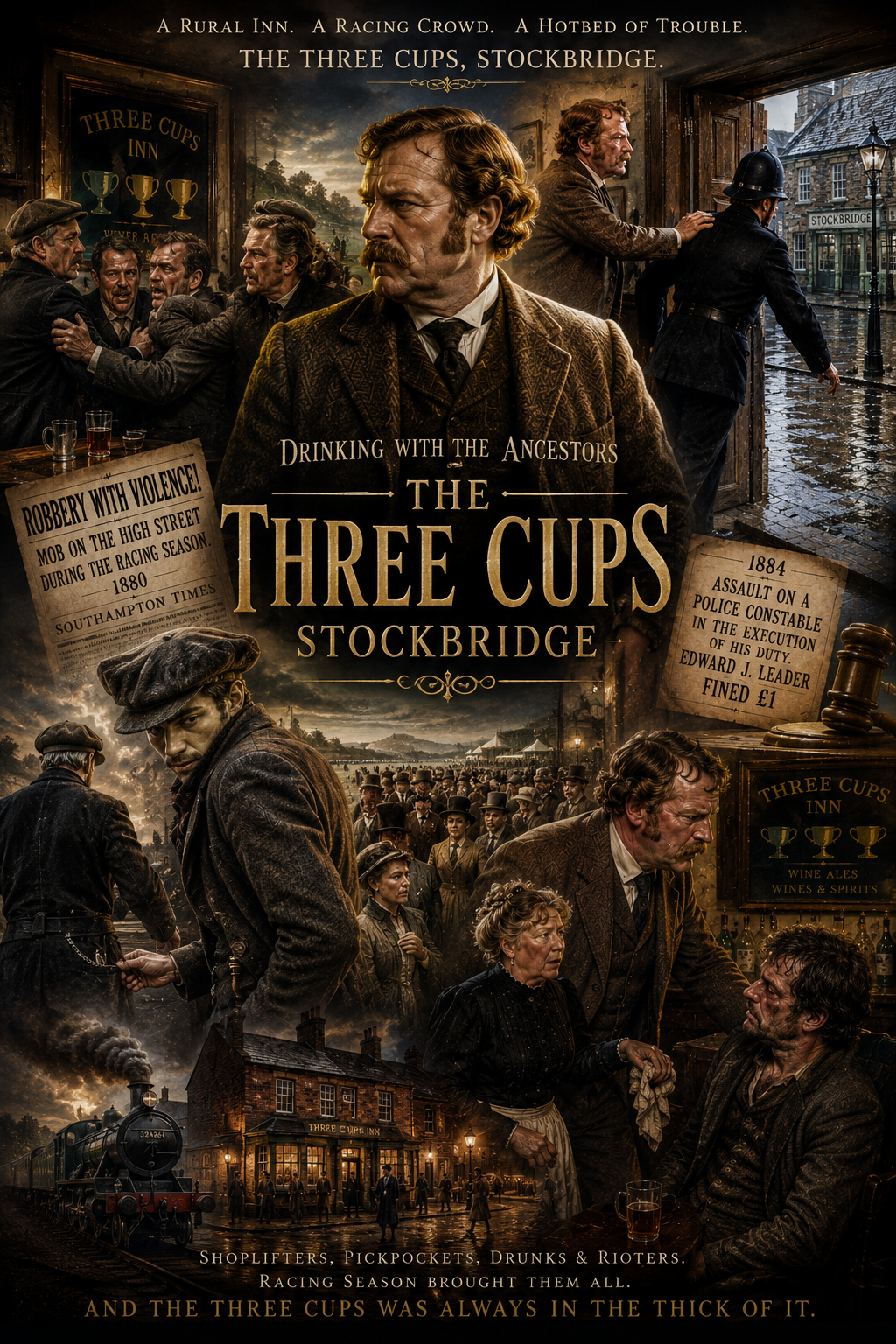
So as we saw in Part 5 Police Sergeant Knapton successfully drove the Tonge family out of The Three Cups Inn in Stockbridge, and in 1874 an application was made to the Magistrates by George Wilson, late of Whitchurch, Innkeeper, for the Three Cups Inn, Stockbridge, lately occupied by Henry Tonge to be temporarily endorsed over to him until the next transfer day which was granted, Saturday, May 2nd. 1874.
George Wilson — The Brewery Man (1874–75)
George was brought in as a temporary landlord, and a change of landlord also brought a change of ambience at the three Cups Inn. Perhaps there was resentment at the way the Tonges had been hounded by Knapton, or perhaps George Wilson was less able to control his clientele, but this culminated not long after his arrival in 1874 with a cry for help to Knapton and a brawl in the Three Cups!
Benjamin Freemantle, a Stockbridge resident, was summoned by Sergeant Knapton, for unlawfully assaulting him in the execution of his duty, however Freemantle did not show up for the Magistrate’s hearing. Knapton proved that a legal summons to appear whad been served on Freemantle and so the case progressed in his absence.
Knapton deposed that on the 25th of April at about 20 minutes to 11 o’clock he was on duty in the High Street Stockbridge, when he was called to the Three Cups Inn by the Landlord George Wilson for the purpose of expelling the defendant from it. Kanpton ordered Freemantle to leave, but he refused and sprang forwards as if to strike him, adding:
“You gave me seven days once, you shall give me seven days for something this time.”
So there was clearly already bad blood between them. A tussle ensued, Knapton seizing Freemantle, who in return collared Knapton by the throat, Knapton freed himself, and eventually succeeded in putting Freemantle to the door, at which point another man named Charles Vince joined in to try to free Freemantle, eventually Knapton with some help, probably from the bar staff, managed to get Freemantle out of the Inn. The landlord, who was also in Court, corroborated Knapton’s evidence. The Bench stated they considered it an aggravated offence, and accordingly committed the Freemantle to Winchester gaol for two calendar months with hard labour, and issued a warrant of commitment. Freemantle therefore got considerably longer than the seven days he had received previously.
A summons was next preferred by Knapton against Charles Vince, also of Stockbridge, for unlawfully resisting him in the execution of his duty whilst trying to remove Freemantle from the Three Cups Inn. Knapton deposed to having served the defendant with a copy of the summons produced. The magistrates, after hearing his evidence of the charge, convicted the defendant in a sum of £4 penalty, and 8s. costs, and in default of payment two months’ imprisonment in Winchester Gaol with hard labour.

Sergeant Knapton’s one man crusade against drunks in Stockbridge continued, and the next case was for George Rogers, another well-known resident of Stockbridge, summoned by for being drunk and riotous on the public highway in Stockbridge, on the 16th day of August. Once again the defendant did not appear, but the service of the summons on him was proved by Sergeant Knapton, who deposed that on the 16th day of August last, whilst on duty at Stockbridge about half-past 11 o’clock in the evening, he heard some men swearing on the turnpike road, and found the defendant there using bad language and endeavouring to urge some other person with him to fight. The defendant was drunk, and was requested by Knapton to go home, but refused to do so. Rogers was summarily convicted with the penalty of 10s. and costs 8s., and in default of payment 14 days imprisonment in Winchester Gaol with hard labour. At the same sessions Sergeant Knapton had Charles Chant fined for being drunk and disorderly in Stockbridge.
The targeting of the Three Cups continued, in November 1874 a women was brought before the magistrates for stealing half-a-crown (2 shillings and 6 pence) from the till, she had waited till George’s daughter Sarah was serving, ordered a drink that meant that she had to leave the till, and then took the money. Sarah noticed it gone and Sergeant Knapton was called, the woman was apprehended and searched, the money found, and she was subsequently charged found guilty and imprisoned for three weeks in Winchester Gaol with hard labour.
Tragedy struck George the following year 1875 when his wife Sarah died at 71 years of age, and after the trouble with locals and the loss of his wife, George decided that it was time to go.
Charles Hood — Pensioner Who Beat the Charge (1876–82)
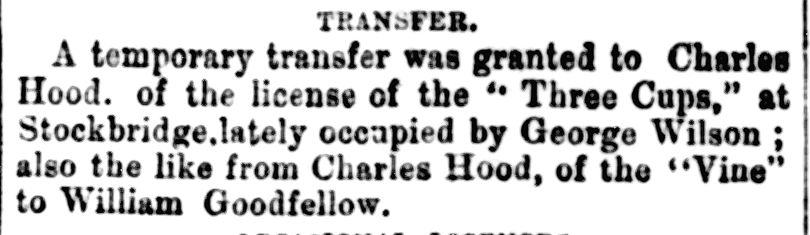
Charles Hood who was the next custodian of the Three Cups was formerly the publican of the Vine in Stockbridge, which he passed over to William Goodfellow on taking up the Three Cups, so a well known local Publican.
Charles also had ownership of various properties around the area, which lead to him having an interesting past. In 1862 he was accused of setting fire to a cottage he jointly owned and rented out, possibly for the insurance money. Although he was found not guilty he had been apprehended and identified by a number of witnesses in the area of the Cottage in the hours of darkness just after the fire had started, and found to be in possession of a box of matches, and heacted had peculiarly in conversation with the witnesses during the fire, asking if any knew if it was insured as if he had nothing to do with the property, although one witness recognised him and replied “Well you should know better than me!”. None of that makes a man guilty of a crime, but the circumstances were decidedly odd.
Charles had been a Master Carpenter born in Rockbourne, before moving to Whistbury in Wiltshire, but turned to Inn keeping in later life, this was after the death of his first wife and a marriage to a lady nearly 30 years his junior, perhaps he wanted a fresh and more exciting life? He lived in the Three Cups with his family, a female servant, and two Parchment Maker Lodgers, one from Suffolk the other from Nottinghamshire. Sadly his younger wife died in 1874, and it was after this that he applied to leave the Vine and take on the Three Cups.
Being elderly Charles seems to have relied on his adult children to help with the running of the Three Cups, which may have been a mistake whilst the Inn was being closely Policed by Sergeant Knapton. In 1875 Charles was prosecuted by Knapton for supplying drink to another member of the troublesome Freemantle family, this time William Freemantle, whilst freemantle was already drunk. Sergeant Knapton obviously had the Freemantles and The Three Cups on his radar after his fight with Benjamin Freemantle the year before at the Three Cups. In court Charles the publican admitted the offence, but mitigated this by saying that he was absent at the time and it was actually his daughter who had served Freemantle, Charles paid the fine, but managed to argue against an endorsement on his Publican’s License, which otherwise would’ve meant a black mark with the Brewery.
1880 Robbery with Violence and Mobs on the High Street
When Stockbridge is seen today as the lovely, quiet, peaceful place it is, it’s hard to imagine how lively and downright anti-social verging on the riotous it could be in the past. Without a doubt this was associated the coming of the railway. The railway that had whisked young Harry Tonge away to London to avoid arrest by Sergeant Knapton, also whisked crowds of incomers and petty criminals and drunks into Stockbridge during the racing season, when money was being carried and spent in abundance.
The resident population of Stockbridge in 1880 was just over 800, which swelled by at least hundreds and probably thousands during the peak of the Horse Racing season in June and July. Inns and shopkeepers made their biggest profits of the year during this time, and even the poorest Agricultural Labourers waiting for the harvest season later in the year, could make an extra living, providing services to this throng on visitors. The throngs of visitors could be so vast that Inns were filled to overflowing, and the evenings, fueled by drink, excitement, and people with no permanent connection to the area, could become places that were edgy and filled with drama.
Bailey’s Magazine of Sports and Pastimes summed up the situation in Stockbridge during the Racing Season:
“… stands made their appearance and so did the scum of the racecourse that does the sport so much harm It was one of the most paradoxical of paradoxes that a lovely meeting like that of Stockbridge should have attracted the villainous concourse it did. The quiet little village was the home of the worst characters during the race week and after dark robberies in the streets and cries of murder were common enough. In quite recent times the London and South Western detectives brought about an entire change and showed other railway lines what can be done if the will to do be only there.”

A good example would be the case of Joseph Thompson, alias Brock, a groom, who had travelled from Bradford in the north of England, to pick pockets in Stockbridge during the racing season.
Thompson was up before the magistrates in July 1880 after being held on remand for a week, charged with stealing £1 or upwards in silver (i.e. silver coins) from a local man named Albert North. P.C. Fox applied for a further remand to produce two witnesses, who would not attend unless summoned. They had promised him to be there this morning, but had not yet turned up. After a short deliberation the magistrates decided to hear the case anyway.
Albert North, the prosecutor, said:
‘I am a dealer, living in Stockbridge. On the 25th June, at about half-past ten in the evening, the prisoner came up to me, as I was walking in the High Street, and caught hold of me by the right arm. As soon as he had hold of me I found his hand in my right-hand pocket. I had about 20s. in silver in there. Whilst he was doing this the mob came up and carried me up to the Grosvenor Arms Hotel, put me inside and went away. Immediately they were gone I felt my pocket and found the money gone.
(The reference here to “The Mob” without much explanation shows how common unruly behaviour was.)
I can swear that it was the prisoner who put his hand in my pocket. There were about a hundred people in the mob. When the prisoner took hold of me he said “this looks like the one.” Directly I got in the hotel I told Sir John Astley they had robbed me of all I had.
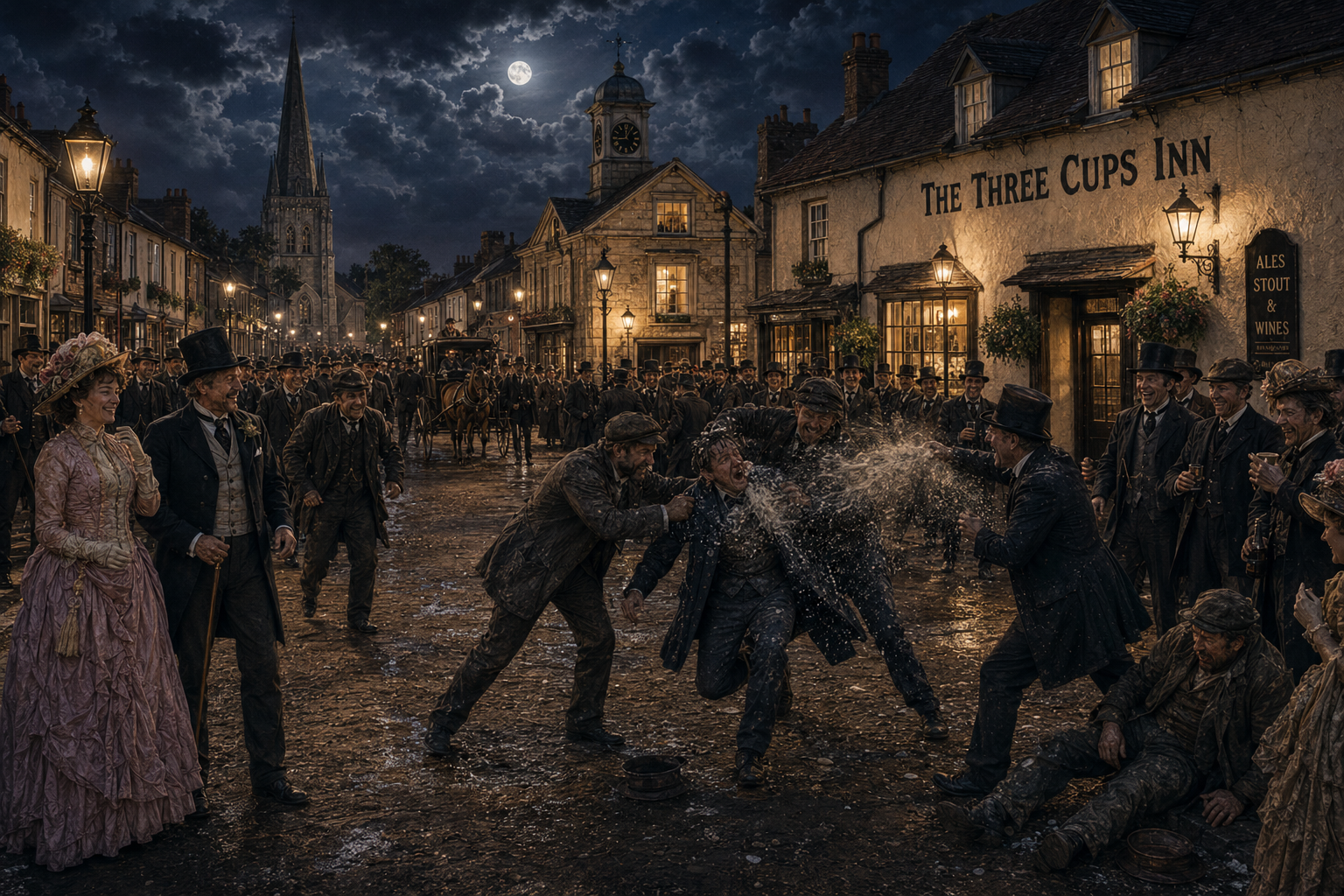
They carried me underhanded. My money was loose in my pocket. The flour was thrown over me on the way to the hotel. ‘
(The throwing of flour seems like a common occurence during such disturbances, probably originally to mark out a thieve or wrongdoer in a crowd, but taken up by rioters as a form of entertainment).
Police Sergeant Michael Fox then testified:
‘I was on duty on the evening in question, and was sent for to the hotel respecting a row, and in consequence of information received I apprehended the prisoner the next morning between nine and ten. He was identified by the prosecutor, and I charged him with robbing him. He replied that he was not out at half past ten. I had to procure assistance to take him to the station, as he was very violent and tried to slip out of his coat. It took six of us to take him. ‘
The prisoner, Joseph Thompson, then had the opportunity to have his say, and he started with accusing the Police Sergent of lying:
‘As God is my judge, that man does not understand an oath! Were you not in the Three Cups with me between 10 and 11 on the morning that you said you apprehended me?’
(Thompson seems to have been staying at The Three Cups).
Sergeant Fox: ‘No.’
Prisoner: ‘Did you not take hold of me and say “you have stolen 20s.,” and said nothing else?”
Sergeant Fox: ‘No.‘
Prisoner: ‘Did you not trip me up?’
Sergeant Fox: ‘Not until you struggled.’
Prisoner Thompson then stated that Sergeant Fox came to him at the station and said in front of another prisoner:
‘It is of no use your saying anything in court, for one of your own pals told me that he assisted in carrying the prosecutor to the hotel, and that you had taken the money.’
Quite what he thought this amounted to as a defence isn’t clear, but he then gave his version of the story. He had been apprenticed in the racing stables, and had lived with the Duke of Hamilton. On the night in question, ‘if he had said he was not out at half-past ten he had told a lie’ a rather theatrical way of saying that he wasn’t out that night.
He said that there were upwards of 200 people in the mob in Stockbridge that night (even though he said he wasn’t out in Stockbridge that night) and that someone had put down some disagreeable smelling stuff in the “Three Cups” and also at the Grosvenor Hotel. Because of this Sir J. A. Astley had offered a reward of £50 for the offender or offenders to be caught. Thompson then said that he heard a row, and saw the mob take the prosecutor to the hotel, and accuse him of the deed.that As soon as the mob was a little quiet Lord Boresford addressed it, and said they had made a mistake and brought the wrong man. He had never been before a court in his life, and thought it was impossible that a gentleman in a crowd, as the prosecutor was, and with flour thrown over him, could identify him. It was a strange thing that when he was taken in charge he had only fourpence in his possession. He could produce letters, which were in the hands of the police, to show that he gained an honest living.
The prisoner, having elected to be tried by the magistrates, they said they were of opinion that he was guilty of the charge brought against him, and the sentence was that he be imprisoned in Winchester Gaol for six months with hard labour.
This was the background of raucous Stockbridge in the 1880s, filled with the rich and famous, the hangers on, the aspirational, and the chancers who preyed on the unwary.
Drunk and asleep
A couple of years later n 1882 Charles Hood was charged with permitting drunkenness at the Three Cups, but successfully argued the drunk had walked in and fallen asleep without being served, which the man verified. The case was dismissed. Perhaps the magistrates had had enough of the petty persecutions for minor infractions that were trotted in before them when a Policeman had a grudge against a Publican. Charles was by now over 80 years old, and decided to retire, going to live with two of his sons in Southampton, one of whom, a Merchant Seaman, had married a Lodging House keeper, so it’s likely that Charles helped out with the running of the house during his son’s absence at sea. He gave way to a professional Manager, moved in by the Brewery.
Edward Jackson Leader — 1883-1885
In the 1881 census Edward Jackson Leader was working as a draper’s store manager in Stockbridge. Born in Herefordshire, he was then living in Newport on the Isle of Wight.
By 1883 Edward Leader, was working in Southampton, still in a Drapery Store, before taking over the Three Cups. On the face of it, it seemed an odd move, but Edward had already proved himself capable of handling difficult shoplifting customers in his previous role. Perhaps he cut an imposing figure and impressed the brewery with his ability to “look after the shop” when things turned rough?
Like a Mad Dog
He was given a baptism of fire on taking up the Inn in 1883 when a petty thief stole a towel, but what should have been a minor incident turned into a major one. On 22nd June 1883, during the Stockbridge Racing season, John Ford, a rough looking man who had a black eye, walked into the Three Cups and was seen by a servant girl to take a towel worth three pence and make off with it. He was apprehended by Police Inspector Duke, who found the towel in his possession. Ford decided to resist arrest, Detective Sergeant Young of Aldershot said after the prisoner was caught by Inspector Duke he was taken to the Grosvenor Hotel, before moving him to the railway station. But Ford was having none of it, he became very violent and it was found necessary to call in additional assistance, in this case from Police Constable Sherrings, Sherrings got Ford into the street where the prisoner behaved in a very brutal manner; he bit the constable, kicked him and everybody else who came within reach. Constable Sherrings attempted to control him by Frog-marching him (holding him by the collar and belt from behind) towards the Railway Station, but the struggle continued with Constable Sherrings kicked in an “un-English manner” in the jaw and other parts, as well as smashing the Constable’s watch and biting the Constable on the arm. The performance was described as Constable Sherrings “attempting to catch a mad dog more than anything else”.
At his trial Ford was charged with assaulting P.C. Sherrings whilst in the execution of his duty. Ford denied the assault and stated that he was first struck, so it was decided to call further evidence. Given the number of witnesses to Ford’s attack over a thruppenny towel, he didn’t really have any defence, and the magistrates sentenced the him to a month’s imprisonment with hard labour for stealing the towel, and two months for assaulting the constable. Stockbridge was certainly full of spectacle and entertainment in the late 19th century, albeit for all the wrong reasons!
More trying times
Edward Jackson leader had his patience put to the test again in 1884, and perhaps in a way that nobody expected, when he was summoned for assaulting Police Constable Bell while the officer was in the execution of his duty.
Police Constable Bell, who was stationed at Over Wallop, told the court that he was on duty at Stockbridge on the night in question. At about a quarter to ten in the evening he visited the Three Cups. Entering through the taproom into the bar, he was met by Mrs Leader, who came behind him and asked who had come through the next room. Constable Bell replied that it was he.
Almost immediately Edward Leader rushed out and, using a coarse expression, demanded:
“What do you do in my private bar?”
Constable Bell replied that he was on duty and had been sent there. Edward Leader told him that he would show the constable that he had no right to be there and ordered him to leave the house.
Realising that he was taking liberties, Constable Bell said he was going and reached out to take hold of the door. As he did so, Edward Leader, whose temper was evidently up, allegedly seized the constable by the shoulder and violently pushed him into the street, saying:
“That is the place for all such as you!”
Constable Bell replied that he would report the matter, to which Edward Leader answered:
“I don’t care.”
Constable Bell explained that he had gone to the Three Cups to see who was in the house, having received instructions to visit the premises, more evidence of the Three Cups being specifically targeted by the local Police.
Under cross-examination, Constable Bell admitted that he had found nothing wrong in the house. He said he had gone there “on a voyage of discovery” to see whether there were any drunken people present. He denied trying to make his visit as unpleasant as possible and said he had received his instructions a week earlier and had regularly been carrying out duty in Stockbridge since then. Apart from those in the taproom, he saw no one else. He was not injured by Edward Leader, although he said his shoulder had been pinched rather tightly. He also denied using any coarse language.
Representing Edward Leader, Mr Bell (the solicitor not the Policeman) admitted that the constable had every right to visit the premises. However, he argued that if the police came to the court for protection, it was for the magistrates to ensure that officers carried out their duties in an orderly and non-provocative manner. Mr Bell contended that the coarse language attributed to Edward Leader had in fact been used by the constable, as his witnesses would testify. The incident, he argued, amounted to nothing more than the constable being pushed towards the door, and it was for the Bench to decide whether that constituted a criminal assault. In his view, Edward Leader had merely accelerated the constable’s departure very slightly, in so trivial a manner that the magistrates should dismiss the case as too insignificant to merit their attention.
Charles Goddard, a labourer, then gave evidence. He told the court that he had been at the Three Cups on the evening in question and had seen Police Constable Bell walk straight through the taproom into the private bar. Edward Leader asked the officer what his business was, to which the constable replied, using a coarse expression:
“What has that to do with you?”
Charles Goddard said that Edward Leader then showed the constable the door, opened it, and merely placed his hand on the officer’s shoulder as he went out.
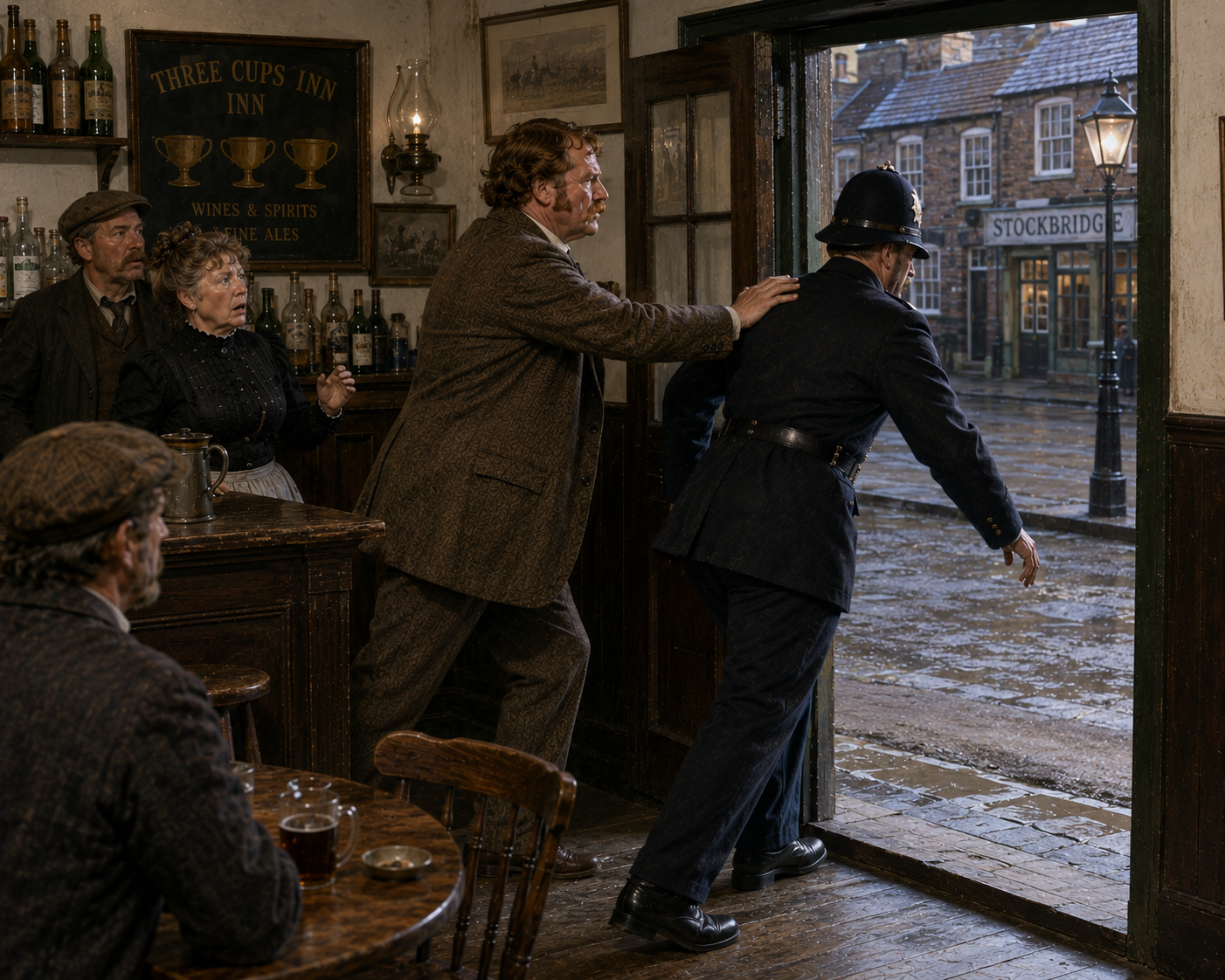
William Gilbert, a stableman, also gave evidence. He said that he saw Edward Leader place his hand on the constable while opening the door with his right hand. He heard nothing that was said but stated that it was not a violent push.
The Chairman announced that the Bench were unanimous in finding that an assault had taken place. He added that, if there was any class of people who ought to support and protect the police in the execution of their duty, it was publicans.
Leader was fined £1 and ordered to pay 13 shillings in costs; he asked for time in which to pay the fine, but the request was refused, and the money was paid immediately.
Edward obviously became disenchanted with being a Landlord in Stockbridge, once you had a black mark with the Police, your life would prove to be difficult, so after a few years he left, and by 1891 he was once again working as a draper in Southampton.
John Gardner —The end of an Era (1889–98)
John Gardner next took over the Three Cups and was there for the best part of a decade. He seemed to have less trouble with the Police and Magistrates, and in June 1890, race week, a license for off license sales and extended hours were granted to him.
“Fire!
1898 About seven o’clock on Wednesday evening John Gardner, noticed a good deal of smoke in the kitchen of The Three Cups, but took no particular notice of it at the time, thinking that the smoke was caused by irregular currents of wind down the chimney. A few minutes afterwards Mrs. Gardner had occasion to enter the room above, when to her horror she found it full of suffocating smoke and the flooring immensely warm.
Mr Gardner ripped off the skirting boards in a few moments, and discovered that a large beam, transversing the flue of the copper leading to the chimney, was being consumed in flames, and that the fire was fast spreading to the joists and flooring of the bedroom. Mr. Gardner immediately called in his neighbour Mr. Palmer a builder, and Sgt Stevens of the Fire Brigade, whose efforts were effective in extinguishing the fire. Had the conflagration not been discovered early the whole of the house and Inn would have been destroyed as the inn is built principally of large timbers.
A close call, that may have ended our story prematurely!
The End of an Era
In 1898 a cataclysmic event happend in the History of Stockbridge, for on Tuesday 5 July – Thursday 7 July 1898 the final race meting was held at Stockbridge.
The races didn’t end because of a lack of interest in Horse Racing, or because of public complaints about rowdy behaviour, in fact Horse Racing was as popular as ever, the prizes offered attracted good horse breeding stock, and it was an incredible boost to local prosperity, albeit at the cost of extra policing.
So why did it end? Well it ended because of an inheritance. Part of the racecourse, including the end of the straight mile, passed to a lady named Marianne Vaudrey through an inheritance. Marianne strongly disapproved of horse racing and gambling, so in line with her moral beliefs, she refused to renew the lease over her land. This was critical for the racing as without the full straight mile, the course no longer complied with the Jockey Club rules for a recognised racecourse, so racing could not continue.
Ironically the 1898 meeting was as prosperous as it had always been, with twenty one races taking place, substantial prize money, and huge spending by visitors into the economy of Stockbridge, with the Three Cups and other establishments, full of owners, trainers, jockeys, bookmakers, stable staff and racegoers, making it a fitting end to over a century of racing associated with Stockbridge. A last beery “Hurrah!”
Sadly on the first day of the races a man named Charles Davis was accidentally kicked inthe head by a horse, was rushed to Andover Cottage Hospital, but died of his injuries. A collection at the racecourse for his widow and children raised over £200, an enormous amount in 1898, roughly equivalent to over £100,000 in relative labour earnings.
This collapse of seasonal trade coincided with the departure of John Gardner and the coming of the new Century. The future of the Three Cups looked bleak, and its existence was held in the balance as the 20th Century dawned. It was under the Police spotlight because of antagonism with the Publican, had lost its most lucrative trade by the demise of the Stockbridge Races, and had been ravaged by fire. The Three Cups future was looking bleak.


