1850 A Hulbert Returns
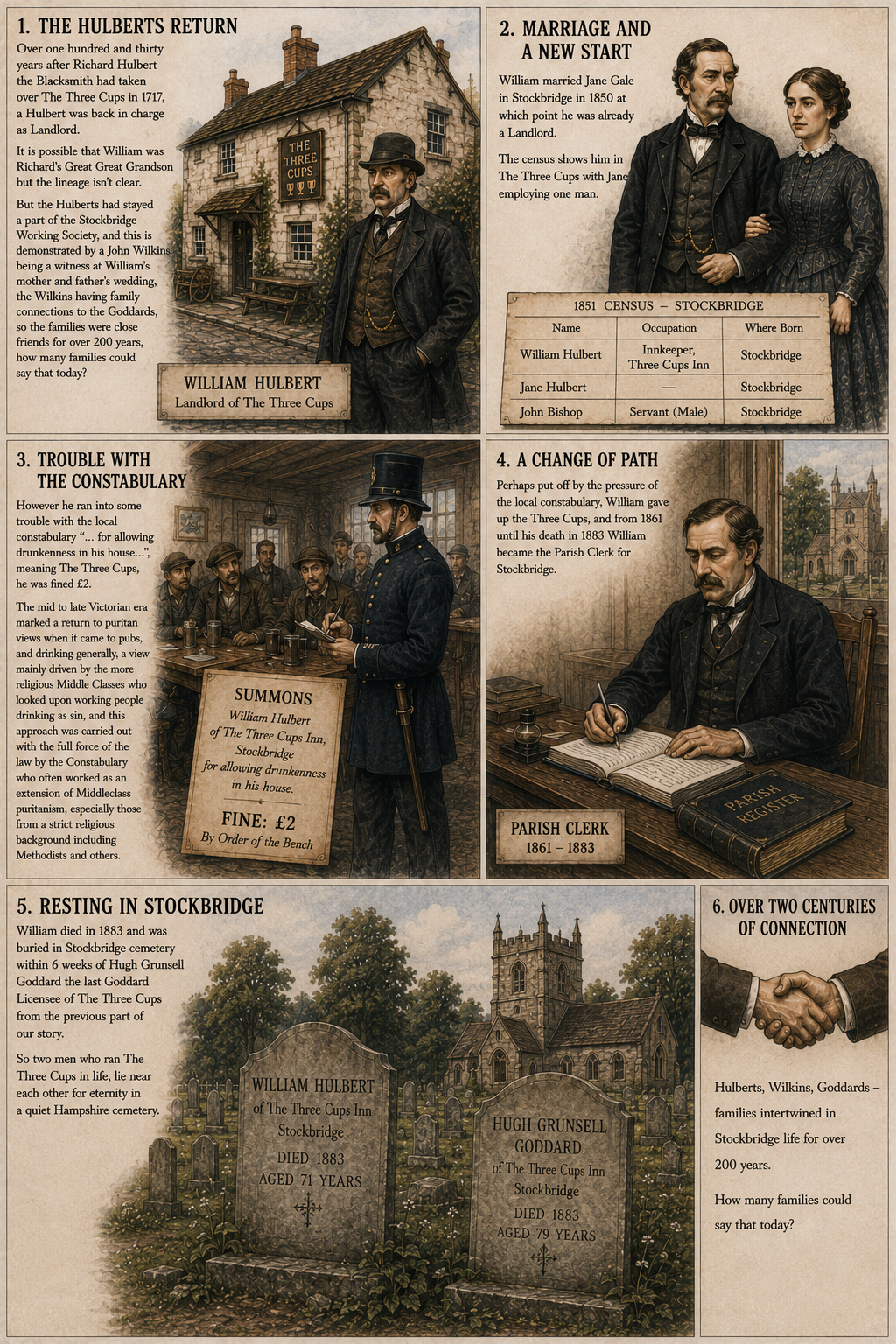
Over one hundred and thirty years after Richard Hulbert the Blacksmith had taken over The Three Cups in 1717, a Hulbert was back in charge as Landlord. It is possible that William was Richard’s Great Great Grandson but the lineage isn’t clear. But the Hulberts had stayed a part of the Stockbridge Working Society, and this is demonstrated by a John Wilkins being a witness at William’s mother and father’s wedding, the Wilkins having family connections to the Goddards, so the families were close friends for over 200 years, how many families could say that today?
William married Jane Gale in Stockbridge in 1850 at which point he was already a Landlord and the census shows him in the Three Cups with Jane employing one man. However he ran into some trouble with the local constabulary “…. for allowing drunkenness in his house…” meaning The Three Cups, he was fined £2. The mid to late Victorian era marked a return to puritan views when it came to pubs, and drinking generally, a view mainly driven by the more religious Middle Classes who looked upon working people drinking as sin, and this approach was carried out with the full force of the law by the Constabulary who often worked as an extension of Middleclass puritanism, especially those from a strict religious background including Methodists and others. It is from this time that we start to see a noticeable increase in prosecutions of publicans at the Three Cups.
Perhaps put off of by the pressure of the local constabulary, William gave up the Three Cups, and from 1861 until his death in 1883 William became the Parish Clerk for Stockbridge. He died in 1883 and was buried in Stockbridge cemetery within 6 weeks of Hugh Grunsell Goddard the last Goddard Licensee of The Three Cups from the previous part of our story. So two men who ran The Three Cups in life, lie near each other for eternity in a quiet Hampshire cemetery.
1861 Henry Tonge Bricklayer
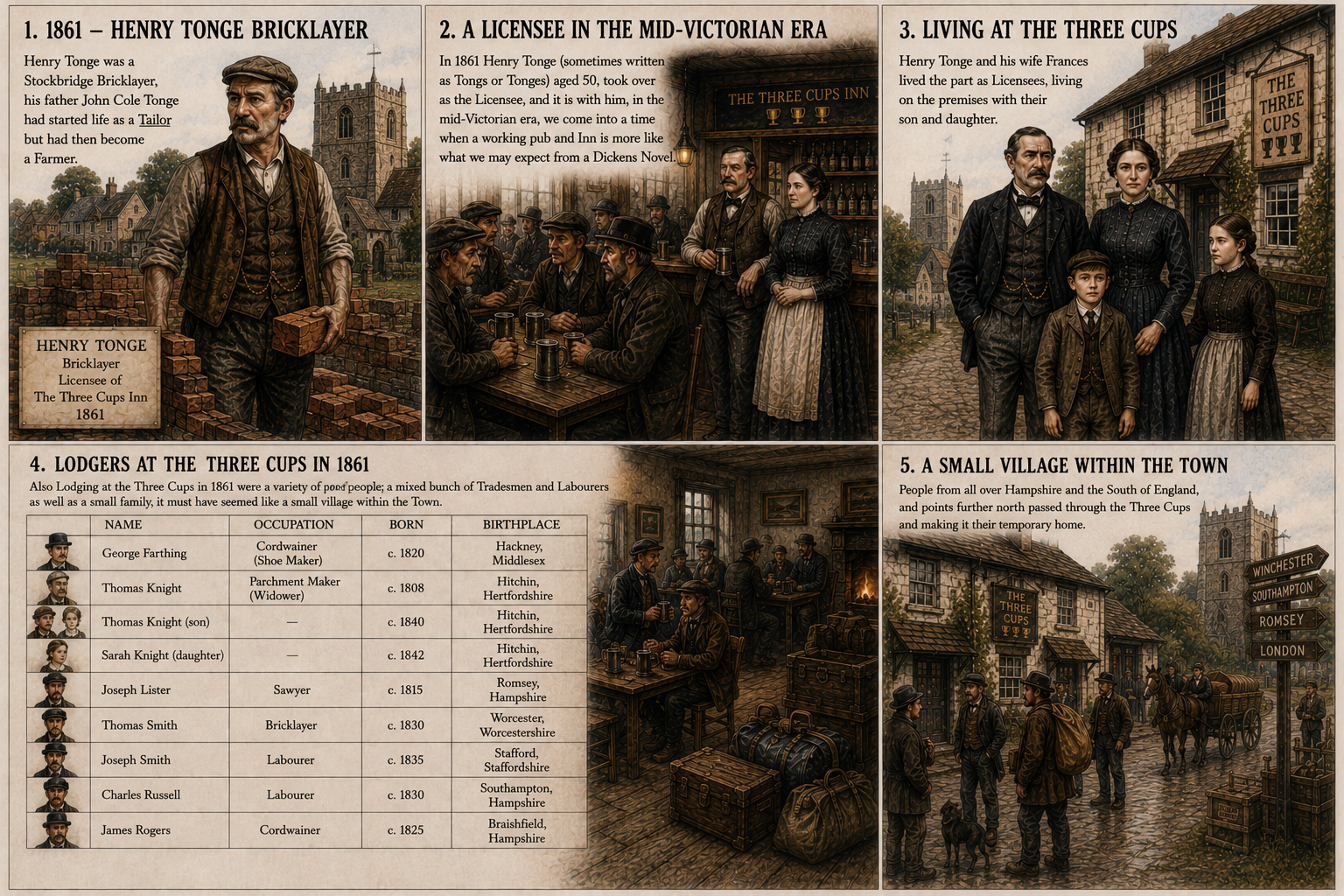
Henry Tonge was a Stockbridge Bricklayer, his father John Cole Tonge had started life as a Tailor but had then become a Farmer.
In 1861 Henry Tonge (sometimes written as Tongs or Tonges) aged 50, took over as the Licensee, and it is with him, in the mid-Victorian era, we come into a time when a working pub and Inn is more like what we may expect from a Dickens Novel.
Henry Tonge and his wife Frances lived the part as Licensees, living on the premises with their son and daughter. Also Lodging at the Three Cups in 1861 were a variety of people; a Cockney Cordwainer (Shoe Maker) from Hackney called George Farthing, Thomas Knight a Widower and Parchment Maker from Hitchin in Hertfordshire and his son and daughter, a Sawyer called Joseph Lister from Romsey, Thomas Smith a Bricklayer from Worcester, Joseph Smith a Labourer from Stafford, Charles Russell also a Labourer from Southampton, and James Rogers a Cordwainer from Braishfield in Hampshire. A mixed bunch of Tradesmen and Labourers as well as a small family, it must have seemed like a small village within the Town, with people from all over Hampshire and the South of England, and points further north passing through the Three Cups and making it their temporary home.
1871 Signs of Friction between Henry and the Authorities
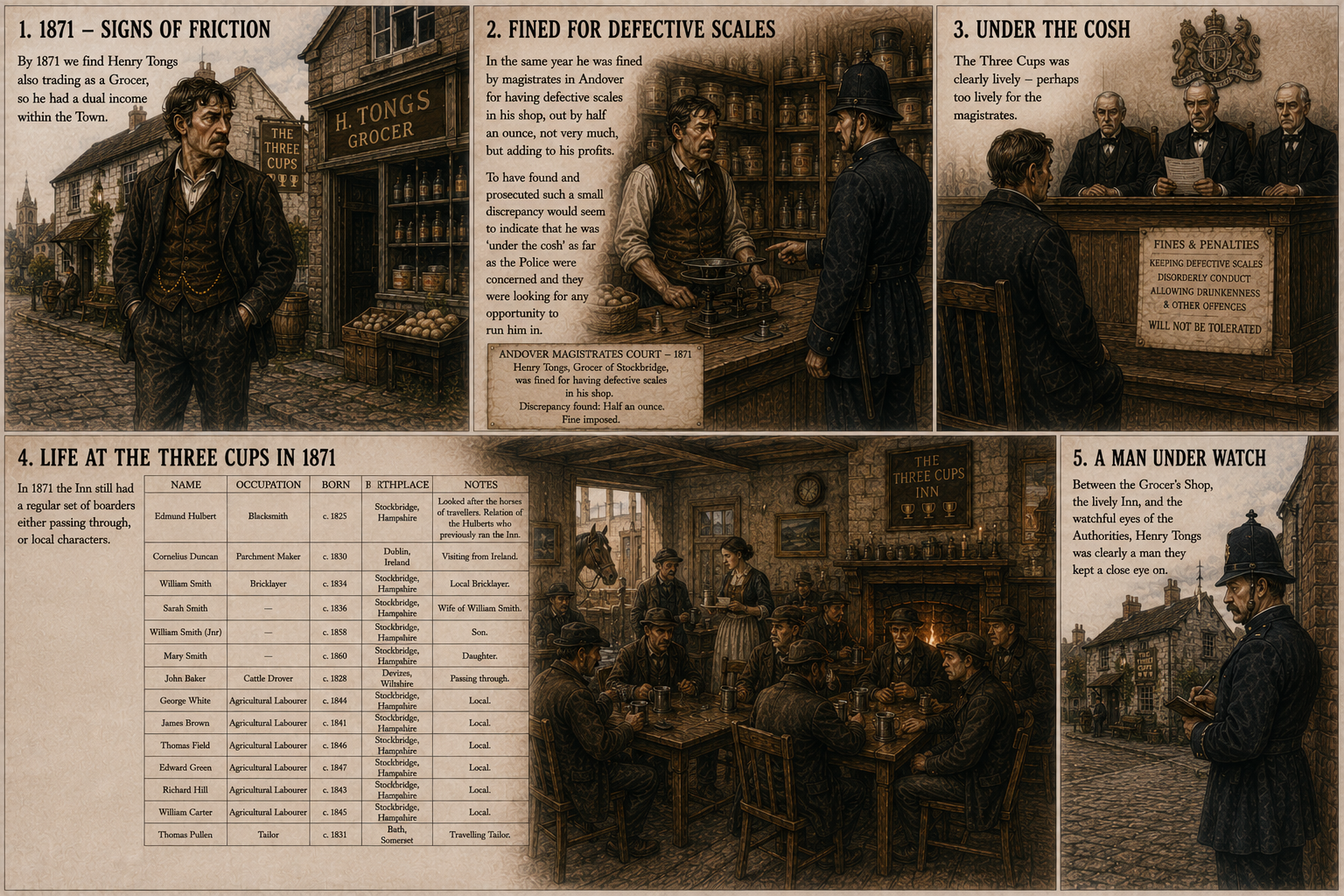
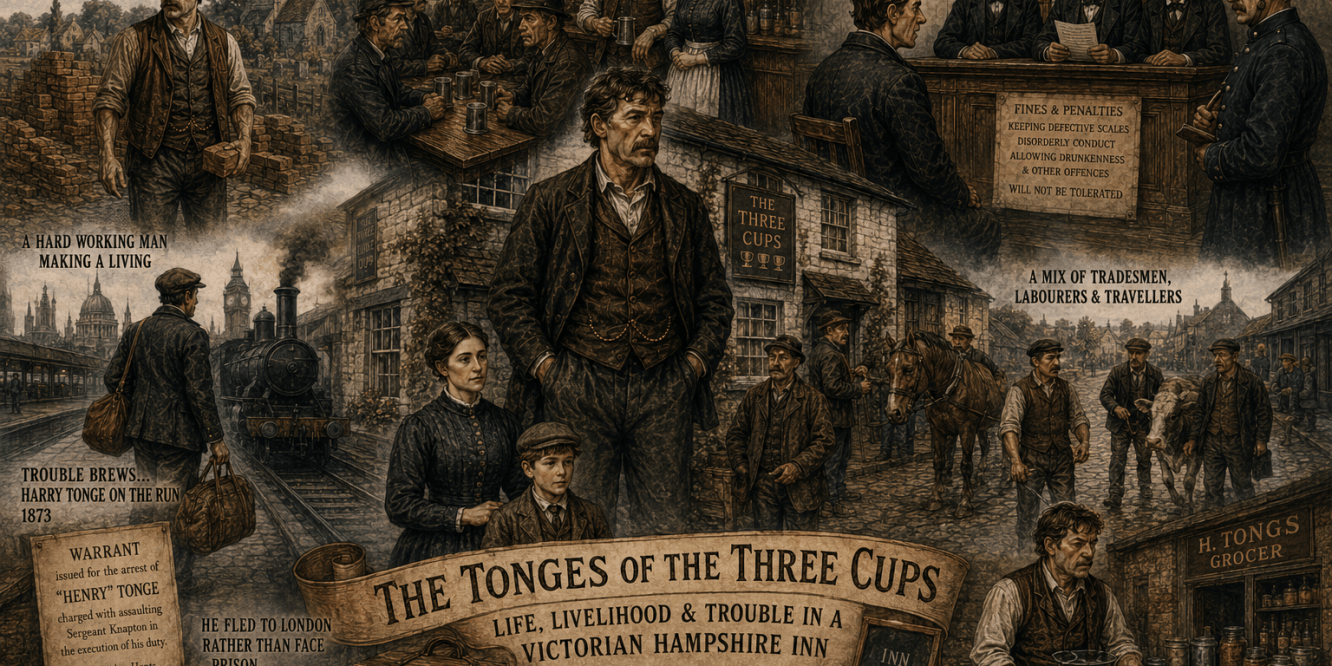
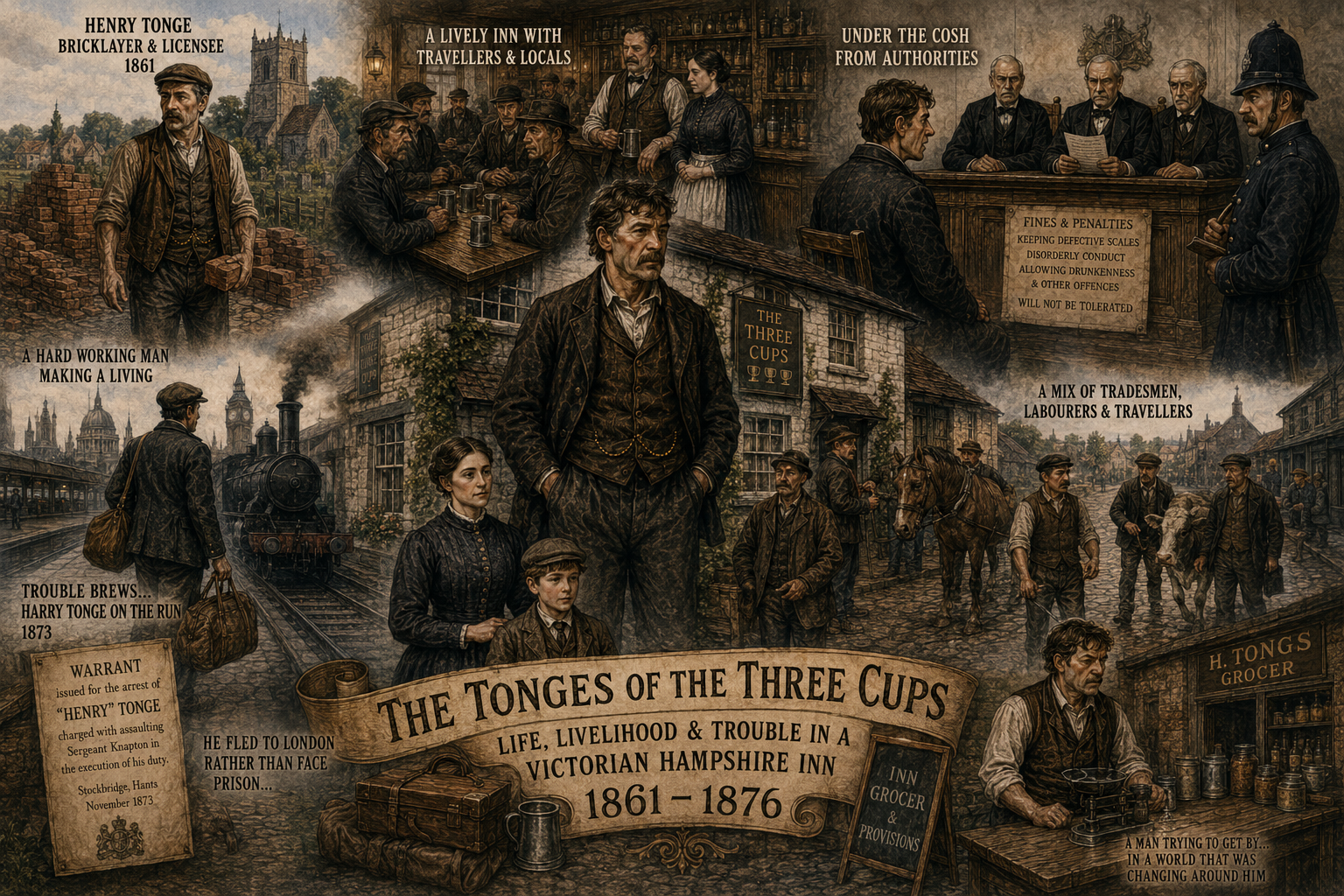
By 1871 we find Henry Tongs also trading as a Grocer, so he had a dual income within the Town, not satisfied with that, in the same year he was fined by magistrates in Andover for having defective scales in his shop, out by half an ounce, not very much, but adding to his profits, although to have found and prosecuted such a small discrepancy would seem to indicate that he was “under the cosh” as far as the Police were concerned and they were looking for any opportunity to run him in.
The Three Cups was clearly lively — perhaps too lively for the magistrates. In 1871 the Inn still had a regular set of boarders either passing through, or local characters, including Edmund Hulbert a Blacksmith who would’ve looked after the horses of travellers and was a relation of the Hulberts who previously ran the Inn, Cornelius Duncan a Parchment Maker from Dublin, a local Bricklayer and his family, a Cattle Drover, half a dozen local Agricultural Labourers, and a Tailor from Bath.
1871 A Quiet Sunday Morning Pint
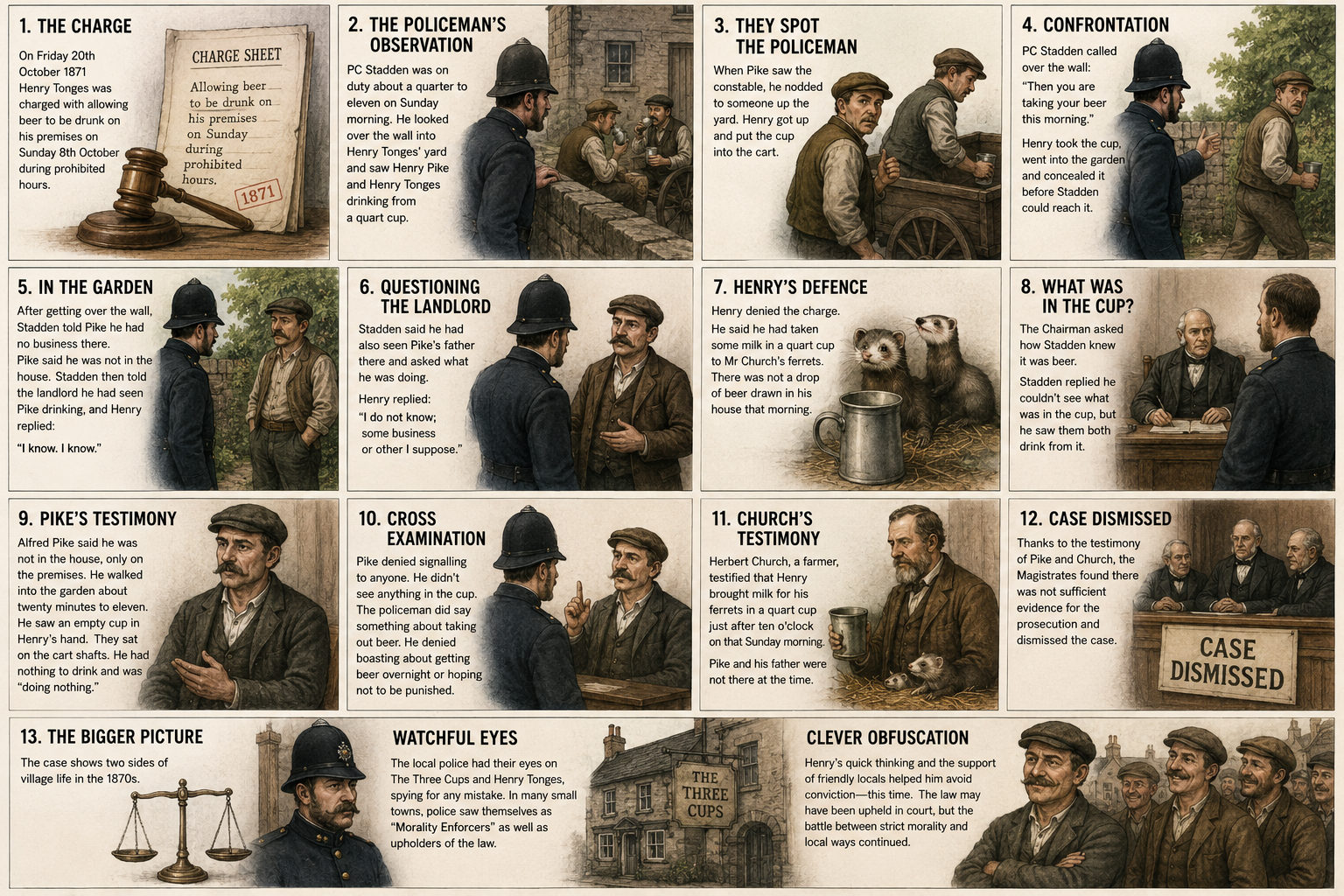
On Friday 20th October 1871 Henry Tonges was charged with allowing beer to be drunk on his premises, on Sunday, the 8th October during prohibited hours.
Police-constable Stadden said that he was stationed at Stockbridge, and on Sunday morning, about a quarter to eleven, he was on duty and visited the premises of Henry Tonges, looked over the wall into the yard and he there saw Henry Pike, a parchment maker of Stockbridge, with an upright quart cup in his hand which he was drinking out of. After he had drank out of it he handed the cup to Henry who also drank out of it. Pike then noticed PC Stadden looking over the wall. According to PC Stadden when Pike caught sight of him he signalled to someone up the yard. He nodded his head. They were sitting on the shafts of a cart and Henry then got up and put the cup in the cart.
PC Stadden said that he called to Henry over the wall:
“Then you are taking your beer this morning.”
Henry put his hand in the cart and took the cup out and went away into the garden and concealed it before Stadden could get there. When Stadden got over the wall he told Pike that he had no business there, and Pike replied that he was not in the house, and Stadden told him that he had no right on the premises. Stadden then went into the garden and told the landlord that he had seen Pike there drinking that morning and Henry said:
“I know. I know.”
Stadden then told Henry that he had seen Pike’s father there also, and asked what he had been doing there, Henry replied:
“I do not know; some business or other I suppose.”
Obviously they were not going to tell the Constable more than they needed to!
Henry denied the charge and said that they were not sitting on the shafts of a cart at all. He went down with some milk in a quart cup to give to Mr. Church’s ferrets; but there was not a drop of beer drawn in his house that morning.
The Chairman of the Bench asked PC Stadden how he knew that there was beer in the cup, and Stadden replied that he could not see what was in the cup; but they were drinking something, and he saw them both drink out of the cup. He went into the garden after Henry but he had so concealed the cup that Stadden could not find it.
Alfred Pike said he was a fellmonger, and was working at Stockbridge. He was not in the defendant’s house on Sunday morning the 8th of October, but he was on the premises. It was about twenty minutes to eleven when he walked into the defendant’s garden. He got to the garden by walking across a stream. He did not have anything to drink; but he saw an empty cup inHenry’s hand. Henry and himself were sitting on the shafts of a cart. The Police-constable came and asked him what he was doing there and he replied that he was “doing nothing.” The policeman did not say anything to him about having any beer. When the policeman left they went back into the garden again.
Pike also said under cross examination that there was nothing in the cup that he could see, he did not signal to anyone; but his father was in the garden. The policeman did say something about taking out beer. He remembered meeting the policeman on the bridge which crosses the Test, and having some conversation with him; but could not recollect that he told him that if he got in some beer over night he would not want to go to the publichouse on a Sunday morning. In reply to the policeman he did not say that he hoped he would not get punished. He did not say anything so stupid.
The next witness for the defence, Herbert Church, said that he was a farmer, and lived at Stockbridge, near the defendant. On the Sunday morning in question, he remembered the defendant bringing some milk for his ferrets in a quart cup. There was about a pint in the cup, and it was a little after ten o’clock when he brought it to his father’s house. It was a straight quart cup. The ferrets had the milk and the defendant took the cup back. The defendant had the ferrets and used them a few days before, and he promised he would give them some milk. Neither Pike or his father were there when Tonges brought the milk.
Fortunately for Henry his story held up, given the testimony of Pike and Church, and the Magistrates decided that there was not sufficient evidence for the prosecution, and dismissed the case. You could argue that Henry’s clever obfuscation and orchestrated story with friendly locals had won the day in spite of the law, but on the other hand the story also shows is that the local Police had their eyes on The Three Cups and Henry Tonge, to the point of going out of their way to spy on him in the hope of a chance mistake. In many small towns the Police saw themselves not just as upholders of the Law, but as “Morality Enforcers” as well, and would go out of their way to prosecute those they considered to have looser morals than their own.
1872 Harry Tonge Drunk and Riotous
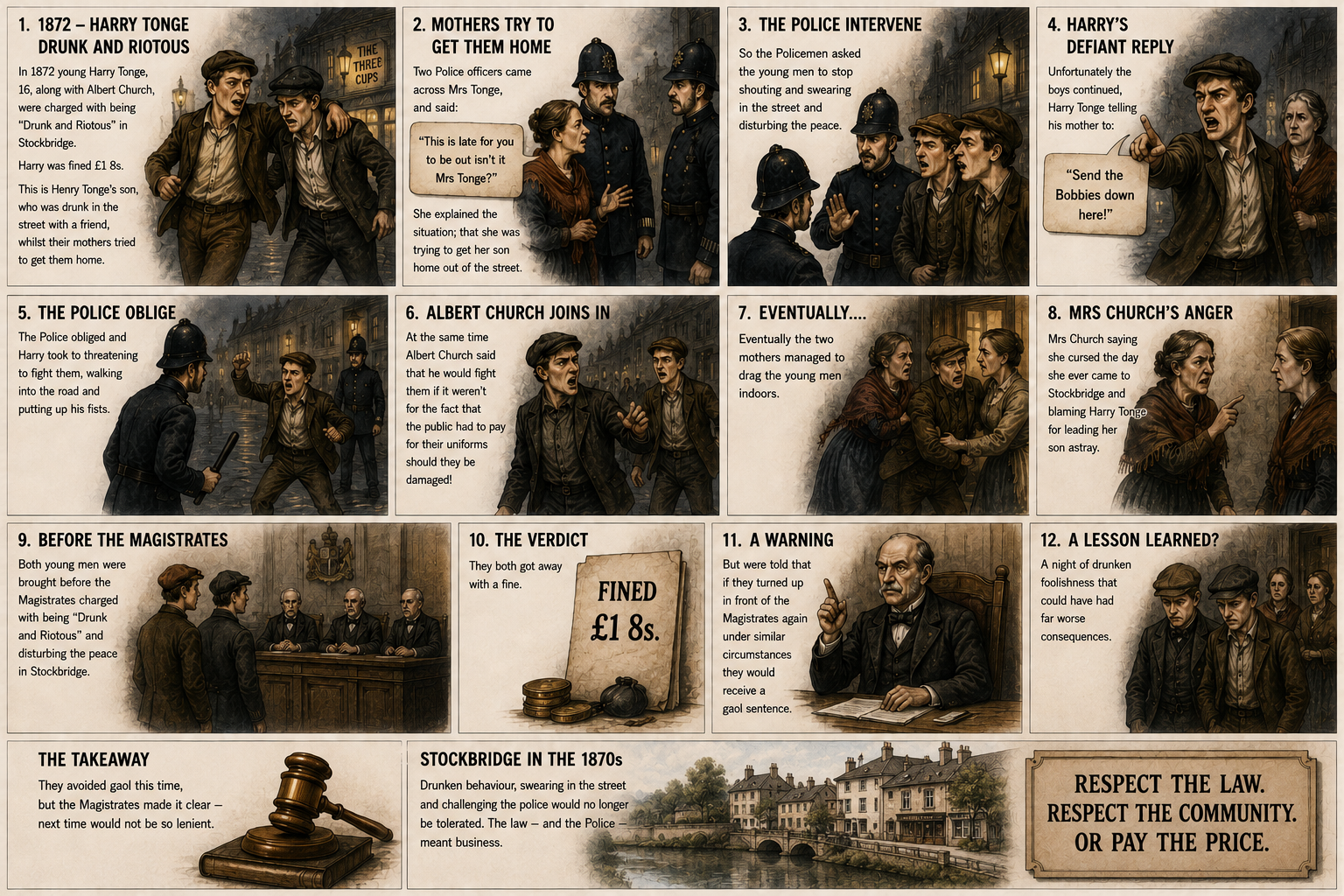
In 1872 young Harry Tongs 16 along with Albert Church were charged with being “Drunk and Riotous” in Stockbridge, Harry was fined £1 8s. This is Henry Tonge’s son, who was drunk in the street with a friend, whilst their mothers tried to get them home.
Two Police officers came across Mrs Tongs, and said:
“This is late for you to be out isn’t it Mrs Tongs?”
She explained the situation; that she was trying to get her son home out of the street, so the Policemen asked the young men to stop shouting and swearing in the street and disturbing the peace. Unfortunately the boys continued, Harry Tongs telling his mother to:
“Send the Bobbies down here!”
The Police obliged and Harry took to threatening to fight them, walking into the road and putting up his fists, at the same time Albert Church said that he would fight them if it weren’t for the fact that the public had to pay for their uniforms should they be damaged! Eventually the two mothers managed to drag the young men indoors. Mrs Church saying she cursed the day she ever came to Stockbridge and blaming Harry Tonge for leading her son astray.
They both got away with a fine, but were told that if they turned up in front of the magistrates again under similar circumstances they would receive a gaol sentence.
1873 Another Nice Sunday Morning Pint
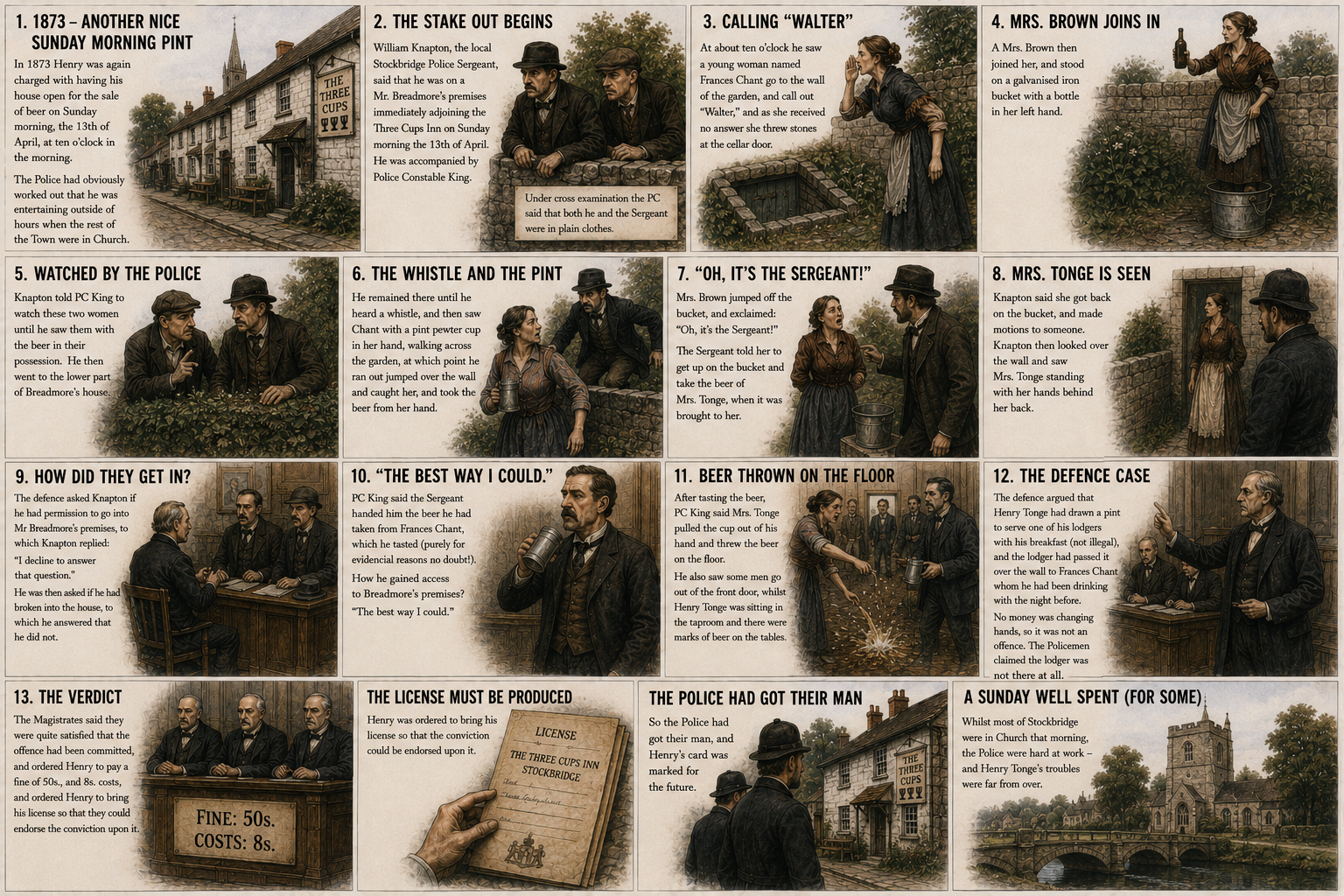
In 1873 Henry was again charged with having his house open for the sale of beer on Sunday morning, the 13th of April, at ten o’clock in the morning. The Police had obviously worked out that he was entertaining outside of hours when the rest of the Town were in Church.
Mr. Godwin, solicitor, of Winchester, appeared for Henry.
William Knapton the local Stockbridge Police Sergeant, said that he was on a Mr. Breadmore’s premises immediately adjoining the Three Cups Inn on Sunday morning the 13th of April. He was accompanied by Police Constable King. Sergeant Knapton said that at about ten o’clock he saw a young woman named Frances Chant go to the wall of the garden, and call out “Walter,” and as she received no answer she threw stones at the cellar door, and a Mrs. Brown then joined her, and stood on a galvanised iron bucket with a bottle in her left hand. He then told PC King to watch these two women until he saw them with the beer in their possession. Knapton then went to the lower part of Breadmore’s house, and said that he saw Mrs. Brown with money in her hand, and remained there until he heard a whistle, and then saw Chant with a pint pewter cup in her hand, walking across the garden, at which point he ran out jumped over the wall and caught her, and took the beer from her hand. Mrs. Brown jumped off the bucket, and exclaimed:
“Oh, it’s the Sergeant!”
The Sergeant told her to get up on the bucket and take the beer of Mrs. Tonge, when it was brought to her. Knapton said she got back on the bucket, and made motions to someone, Knapton then looked over the wall and saw Mrs. Tonge standing with her hands behind her back.
Cocerned at the Police Officer’s elaborate stake out for such a minor infraction the defence asked Knapton if he had permission to go into Mr Breadmore’s premises, to which Knapton replied:
“I decline to answer that question.”
He was then asked if he had broken into the house, to which he answered that he did not.
Police Constable King corroborated his story adding that The Sergeant handed him the beer he had taken from Frances Chant, which he tasted it (purely for evidencial reasons no doubt!). He then said that after he had done so Mrs. Tonge pulled the cup out of his hand and threw the beer on the floor. He also said he saw some men go out of the front door, whilst Henry Tonge was sitting in the taproom and there were marks of beer on the tables.
The defence pushed the issue of how the Police had gained access to the neighbour’s premises, and asked how the PC had gained access to it? He replied:
“The best way I could.”
The questioned was pressed and the Magistrate said that the Policemen must answer the question, given that they were not charged with burglary, to which the defence lawyer said:
“But he may be charged with breaking into the house.”
Under cross examination the PC said that both he and the Sergeant were in plain clothes and that no bottle of beer had been found to corroborate the story.
The defence lawyer then laid out the case that Henry Tonge had drawn a pint to serve one of his lodgers with his breakfast (not illegal) and that the lodger had passed it over the wall to Frances Chant who he had been drinking with the night before. This wouldn’t have been an offence as no money was changing hands. However the Policemen claimed that the lodger was not there at all.
The Magistrates said they were quite satisfied that the offence had been committed, and ordered Henry to pay a fine of 50s., and 8s. costs, and ordered Henry to bring his license so that they could endorse the conviction upon it.
So the Police had got their man, and Henry’s card was marked for the future.
1873 Harry On The Run
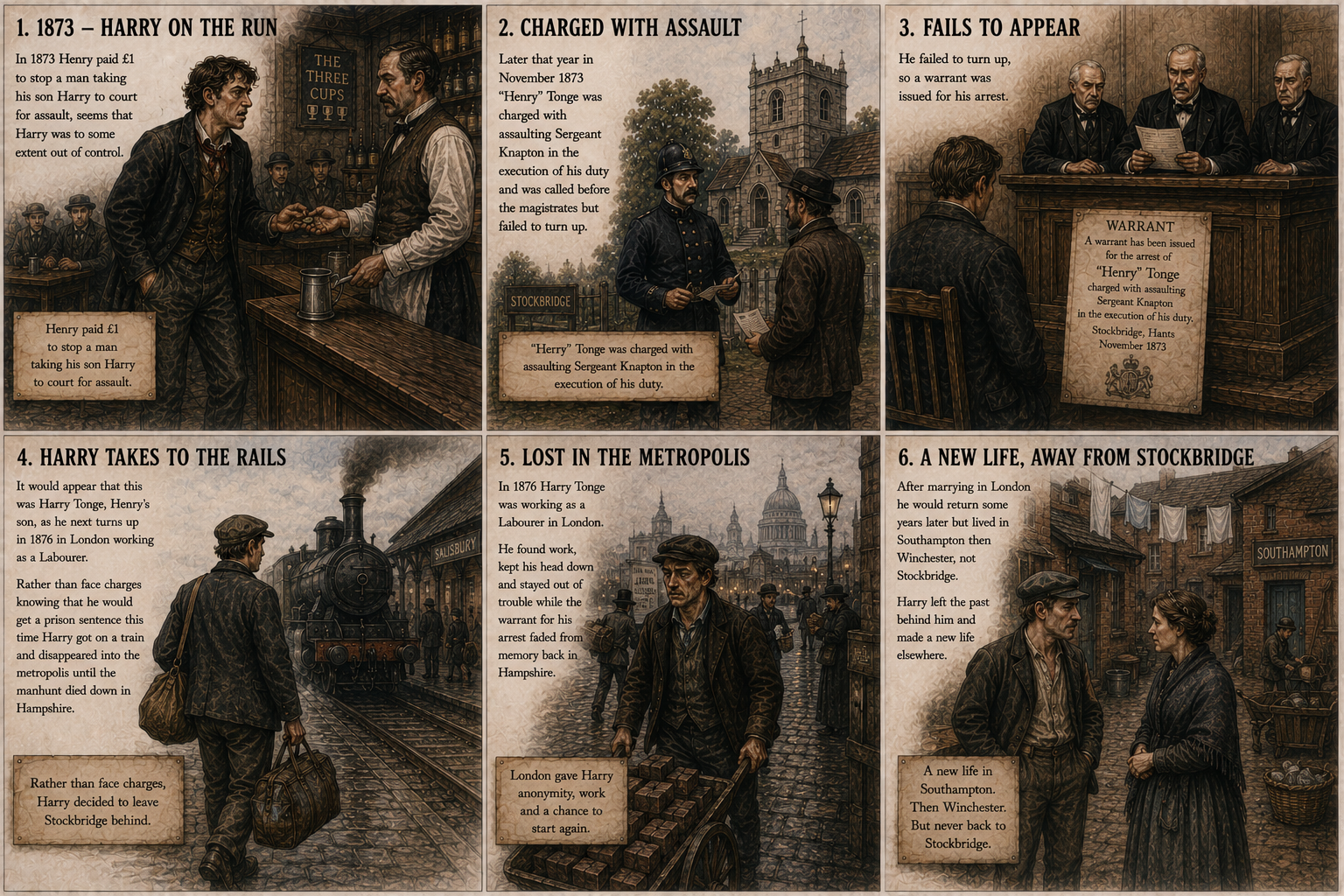
In 1873 Henry paid £1 to stop a man taking his son Harry to court for assault, seems that Harry was to some extent out of control. Later that year In November 1873 “Henry” Tonge was charged with assaulting Sergeant Knapton in the execution of his duty and was called before the magistrates but failed to turn up, so a warrant was issued for his arrest. It would appear that this was Harry Tonge, Henry’s son, as he next turns up in 1876 in London working as a Labourer. Rather than face charges knowing that he would get a prison sentence this time Harry got on a train and disappeared into the metropolis until the manhunt died down in Hampshire. After marrying in London he would return some years later but lived in Southampton then Winchester not Stockbridge.
1874 The Final Act
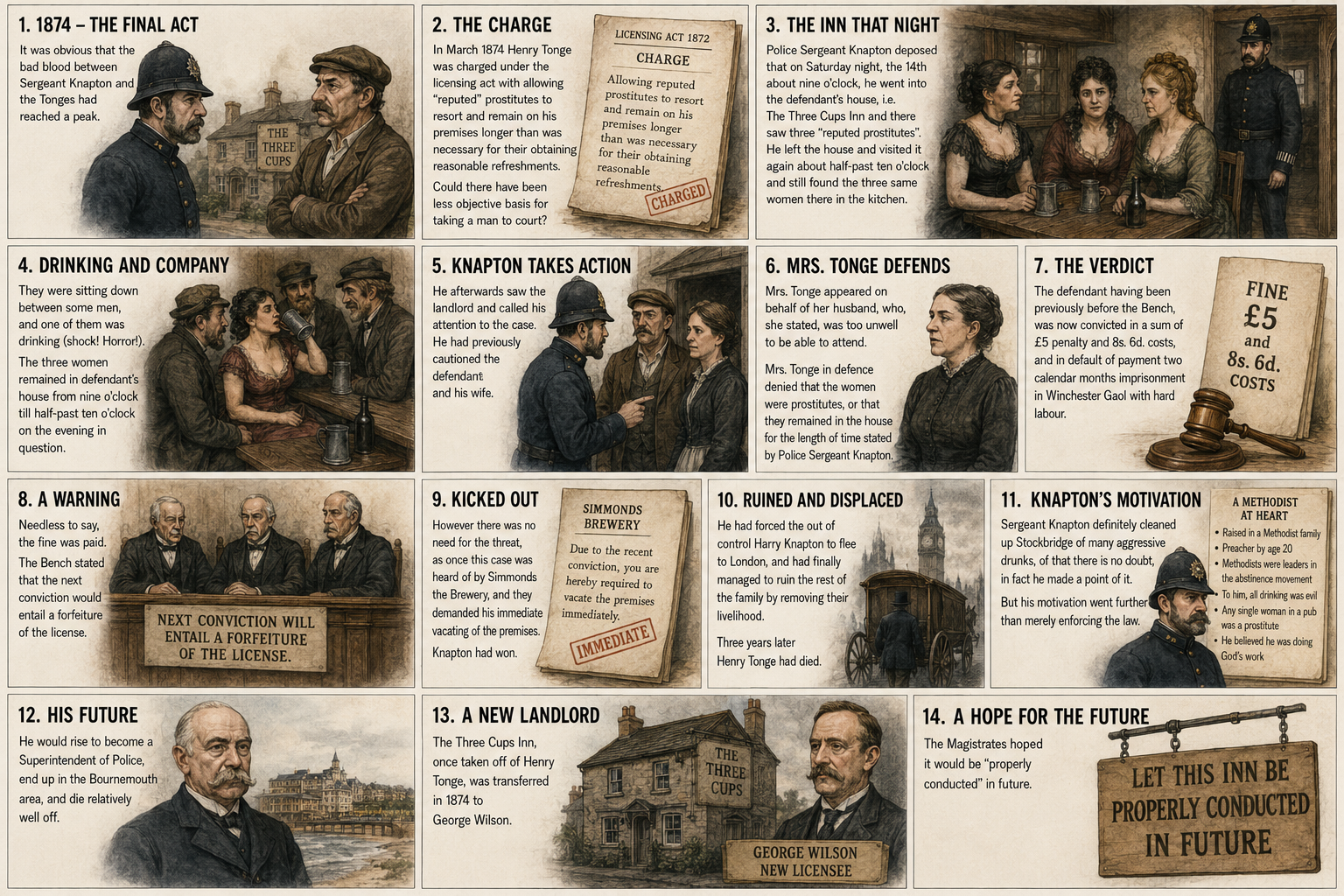
It was obvious that the bad blood between Sergeant Knapton and the Tonges had reached a peak.
In March 1874 Henry Tonge was charged under the licensing act with allowing “reputed” prostitutes to resort and remain on his premises longer than was necessary for their obtaining reasonable refreshments. Could there have been less objective basis for taking a man to court?
Mrs. Tonge appeared on behalf of her husband, who, she stated, was too unwell to be able to attend. The offence was proved by Police Sergeant Knapton (of course), who deposed that on Saturday night, the 14th about nine o’clock, he went into the defendant’s house, i.e. The Three Cups Inn and there saw three “reputed prostitutes”. He left the house and visited it again about half-past ten o’clock and still foundnthe three same women there in the kitchen. They were sitting down between some men, and one of them was drinking (shock! Horror!). He afterwards saw the landlord and called his attention to the case. He had previously cautioned the defendant and his wife. The three women remained in defendant’s house from nine o’clock till half-past ten o’clock on the evening in question.
Mrs. Tonge in defence denied that the women were prostitutes, or that they remained in the house for the length of time stated by Police Sergeant Knapton.
The defendant having been previously before the Bench, was now convicted in a sum of £5 penalty and 8s. 6d. costs, and in default of payment two calendar months imprisonment in Winchester Gaol with hard labour. Needless to say, the fine was paid. The Bench stated that the next conviction would entail a forfeiture of the license.
However the was no need for the threat, as once this case was heard of by Simmonds the Brewery, and they demanded his immediate vacating of the premises. Knapton had won. He had forced the out of control Harry Knapton to flee to London, and had finally managed to ruin the rest of the family by removing their livelihood. Three years later Henry Tonge had died.
Sergeant Knapton definitely cleaned up Stockbridge of many aggressive drunks, of that there is no doubt, in fact he made a point of it as we shall see in the next part of the story. But his motivation seemed to go further than merely enforcing the law, and the reason why can be traced back to his upbrining in Dorset in a Methodist Family, at the tender age of 20 he was already a Methodist preacher, and the Methodists were at the forefront of the abstinence movement. No doubt in his eyes all drinking was evil, and any single woman who would enter a public house was a prostitute. So he would go to any lengths to persecute the Tonges with a completely clear conscience. As far as he was concerned he was doing God’s work. He would rise to become a Superintendent of Police would end up in the Bournemouth area, and die relatively well off.
The Three Cups Inn, once taken off of Henry Tonge, was transferred in 1874 to George Wilson. The Magistrates hoped it would be “properly conducted” in future.


One Reply to “Drinking with the Ancestors: The Three Cups Stockbridge Part 5 – Victorian Carryings-On”