John Marshall — The End of an Era (1903–09)
After John Gardner gave up the Three Cups, John Marshall took over, and he was aptly named given what he would have to contend with. Stockbridge went into a Social decline with the forced collapse of the Seasonal Racing Industry. Seasonal employment nose dived, and the rich flow of race goers spending in the town was no more. Discontent grew and sometimes exploded.
On June 9th 1903 William Goater a 36 year old labourer, was indicted for wounding Thomas Frampton, by stabbing him with a knife, with intent to do him grievous bodily harm in The Three Cups Inn. He pleaded not guilty.
About seven o’clock on the evening in question the men were in the Three Cups; Goater seemed in a quarrelsome mood, and complained that someone was going to throw him in the river, and alluding to Frampton said:
“There’s another (expletive deleted) who was going to throw me in the river.”
John Marshall the Landlord said that both men were sober, and Frampton told Goater he did not want to have any wrangle with him, but a minute or two later Goater pulled out a knife and said:
“I’ll swing for some (expletive deleted) yet!”
Frampton said that then without any provocation Goater ran at him with an open pocket knife, Frampton warded the blow from his neck, and was cut in the left arm.
John Marshall bravely jumped in “collared” Goater, took away the knife, and threw him out of the Three Cups into the street.
Mr. Robert Newton Barnes, surgeon, said the wound in Frampton’s arm was about half an inch in length and an inch deep. It penetrated the muscles of the arm. Police Sergeant Barton said he was shown the wound in Frampton’s arm. Later he arrested the Goater at Longstock, and when arrested Goater said:
“I’ll own I made a dab at Frampton, and it don’t matter a (expletive deleted) if it’s killed him. I was upset at the time, and did not know what I was doing.”
Before the magistrates Goater contended that he only took the knife out to frighten Frampton, and if Frampton had remained sitting down nothing would have happened. He also said rather unbelievably that he had no idea that the knife touched Frampton.
Unsurprisingly the jury found Goater guilty, and he was sent to gaol for six months with hard labour.
Once The Three Cups had been tarnished by this unusually violent event, it’s card was marked by the Police who kept a close watch on the place, less with an eye for protection, and more with an eye to close it down. As in 1908 when a drunk was seen to have entered the Inn, and although he was not served by either John Marshall or his daughter the barmaid, a successful prosecution was brought and John Marshall was fined. The pressure was on.
Too Many Pubs
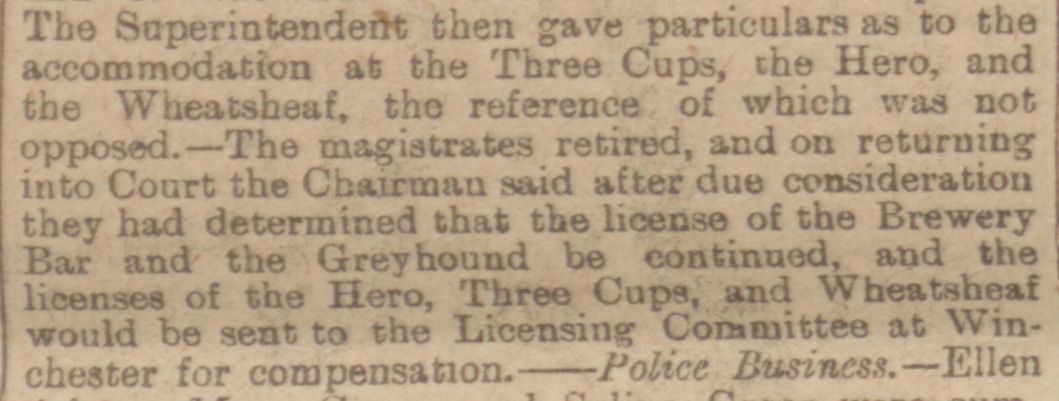
The high number of pubs, thirteen in total in Stockbridge in 1900, was commercially and socially unsustainable, and due to the growing influence of the Temperance movements during the late Victorian period, gave the excuse to pursue the Public Houses for closure. The Western Gazette, reported in 1909:
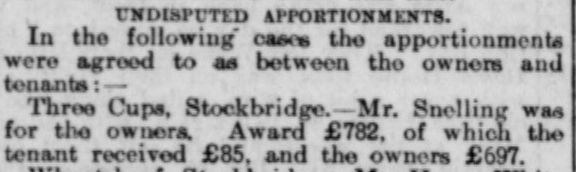
Followed by the closure of the Three Cups and the paying off of John Marshall as reported in the Hampshire Chronicle:
Fowgies
That could have been the end of The Three Cups Inn. And for a long time it was.
But then our story steps back in time and to the far reaches of the UK to set the scene on a family that, although not Publicans, would keep the “Old Three Cups” alive even though the Inn itself had ceased.
There was a Soldier, a Scottish Soldier
Our search goes back to the mid Victorian period and Private John Fowgies of Her Majesty’s 60th Rifles.
According to his discharge papers, John Fowgies was born in the parish of Carlisle, Cumberland, the son of a Weaver named George Fowgies. John worked as a smith before joining the Army, he attested for the 1st Battalion 60th Regiment (King’s Royal Rifle Corps) on 28th July 1846 he gave his age as 18 years old.
After his initial training he transferred to the 2nd Battalion of the 60th Rifles, who had recently returned from a posting in Canada, but this didn’t last long as on 10th March 1847 John deserted, only to be captured and brought back to his regiment eight days later. Court Marshalled at Chatham he was imprisoned through April and May 1847.
He served till 1850, when on the 18th January he deserted again, before rejoining his regiment in 1858, apparently voluntarily, after an eight year absence! Tried again, he was sent to prison for 56 days, but this was remitted to a week.
On 10th April 1860, less than two years after re-joining the army John deserted for a third time from his regiment in Dover and remained absent for nearly six weeks until 19 May 1860, when he was apprehended. Marched back to camp he was Court Marshalled and imprisoned from 20 May 1860 until 17 January 1861, before rejoining the regiment on 18 January 1861, and lost 225 days of reckonable military service. His desertion coincided with his Battalion receiving a posting to China, the implication being that he didn’t want a posting so far from home, and engineered his absence to mis the embarkation date, followed by a spell of imprisonment further removing any likelihood of being sent on to join his Battalion.
Indeed by July 1861 he had been transferred to the 1st Battalion of the 60th Rifles at Aldershot. Within six months on 2 December 1861, he decided to desert a fourth time, resulting in another Court Martial, imprisonment and further forfeiture of service before rejoining his regiment yet again. He served in the 1st Battalion till March 1864.
On 25 June 1864, John Fowgies appeared before a court martial at Curragh Camp, Ireland. The charge was: Desertion and Re-enlisting. He was sentenced to 56 days’ imprisonment, of which 2 days were remitted. Presumably this referred to the army realising what he had done at the end of one of his previous desertions.
Curiously, the Army recorded his age as 18 years on enlistment, but this is almost certainly incorrect. His marriage certificate, records his residence as Aldershot, although he married Emma Clarke at St John’s Church, Winchester, on 14 May 1870. He is recorded as 38 years old, suggesting a birth around 1831–1832. The 1871 Census places him at Colchester, serving with the 4th Battalion, 60th Rifles.
By the time he was discharged in November 1878, the Army described him as 44, another figure that does not reconcile with the earlier age of 18. Like many Victorian military records, the documents contain contradictions that must be treated with caution.
A Remarkable Turnaround
Given John’s disciplinary history, one might expect his career to have ended in disgrace, instead, the opposite happened. When the Regimental Board met at Winchester on 12 November 1878, it reported that his official character was “Good”.
Even more remarkable was the record of his conduct badges. The Board noted that he already possessed four Good Conduct Badges, and would become entitled to a fifth Good Conduct Badge on 14 November 1878. Good Conduct Badges were earned only after sustained periods of exemplary service and could be forfeited for misconduct. Their award demonstrates that, after the troubles of his early military career, John spent many years rebuilding both his reputation and the confidence of his commanding officers.
John was discharged at Winchester on 26 November 1878, having completed 21 years and 3 days of military service, although only 20 years and 37 days counted as pensionable service after deductions for imprisonment and forfeited time. His intended place of residence after leaving the Army was recorded as: Westhill Terrace, Aberdeen.
Despite his intention to move to Scotland, after discharge John and Emma moved up the road to Stockbridge, where John worked as a Gardener, Emma as a Dressmaker, and their eldest son George as a Baker.
The Fowgies Family of Stockbridge – Builders, Firefighters and the Old Three Cups
The Fowgies family became a familiar and respected name in Stockbridge during the first half of the twentieth century, playing an important part in the town’s commercial, civic and social life. On 14th May 1870, John married Emma Clarke, née Simpson, at St John’s Church in Winchester. John eventually left the Army in November 1878, following a remarkably turbulent career, and died in Hampshire in 1906.
John and Emma had a son, Herbert Fowgies, born in Winchester around 1873, who would establish the family business that became such a familiar part of Stockbridge life.
Herbert married Annie Turton, who had been born in the Wallops in 1876. Their earlier children were born outside Stockbridge: Frederick John in Kingston upon Thames around 1898 and Herbert junior in Norbiton in January 1900. However, by August 1902, when their son Alick Frank Fowgies was born, the family had established itself in Stockbridge.
Over the following years the family grew, with Winifred Bray born in 1905, Cyril Walter in June 1907, Marjorie Annie in 1909, Jean Patricia in 1912 and Ernest Charlie in 1915. All were born in Stockbridge, demonstrating that the family had put down firm roots in the town.
Herbert established himself as a builder, carpenter, decorator and undertaker, operating a business that would eventually pass to his son Cyril. In a small town such as Stockbridge, these trades frequently overlapped, and a local builder might be called upon to undertake everything from repairing houses and constructing outbuildings to making coffins and arranging funerals.
The older Fowgie boys went from Builder’s apprentices in Stockbridge working for their father, to joining the Navy and the Life Guards, before both went into the RAF.
We have a particularly interesting contemporary glimpse of Herbert’s business during the First World War. An invoice dated 5 February 1918, issued by H. Fowgies of Stockbridge, records the provision of an oak coffin, brass fittings, shroud and trimmings for Second Lieutenant Oswald William Morgan. The total charge was £10. The invoice describes the firm as builders, carpenters, undertakers and house decorators, illustrating the range of services it provided to the local community.
As Herbert’s children grew up, the family became increasingly involved in the wider life of Stockbridge. Two of his sons, Cyril and Alick, were particularly active in local affairs.
In the early 1930s,they established Stockbridge’s first Scout troop, an important addition to the recreational and educational opportunities available to the town’s young people.
In WW2 Earnest became an officer in the Royal Engineers, and Herbert a Chaplain in the RAF building on his experiences in WW1.
Cyril, known affectionately to his friends as “Kicks”, became a particularly prominent figure. In addition to running the family building business, he served for many years on Stockbridge Parish Council and took an active interest in the town’s ancient manorial traditions. He was a regular foreman of the annual Court Leet and also served as a Court Baron, participating in ceremonies that preserved something of Stockbridge’s historic system of local administration. It was in this role that we find the Fowgies in the building that had been the Three Cups in the 1930s and probably before, and it wasn’t till 1969 that the registrar of births deaths and marriages moved her office from the old three cups to Stockbridge Town Hall.
He also became station officer in charge of Stockbridge Fire Station, another role that placed him at the heart of community life.
Herbert died in 1945, aged about 72, bringing to an end the career of the man who had established the family’s building business. His wife Annie survived him until1950.
That same year marked a significant turning point, not only for the Fowgies family but also for the history of one of Stockbridge’s oldest and best-known building, for In 1950, Cyril Fowgies wound up the family building business and converted part of his house and former offices into a restaurant called “The Old Three Cups”.
The premises had previously formed part of the historic Three Cups Inn, whose history, as we have seen, stretched back centuries and which had once been an important coaching inn serving travellers along the main road through Stockbridge.
Cyril’s conversion gave the building a new commercial purpose, reflecting the changing character of Stockbridge in the middle of the twentieth century. The days when coaching inns depended upon passing horse-drawn traffic had long disappeared, and the town was increasingly adapting to the demands of modern motorists, visitors and diners. The Old Three Cups restaurant therefore represented another stage in the evolution of the historic property, linking its long association with hospitality to the commercial life of post-war Stockbridge.
Cyril remained closely associated with the town until 1963, when he and his wife moved to Winchester. They subsequently lived at Teg Down Meads.
His brother Alick had died in March 1950, aged only 47, the same year in which the family building business came to an end.
Cyril died in 1985, aged 77. His obituary remembered him as a well-known former Stockbridge resident and recalled his considerable contribution to the town through his business, the Scouts, the Parish Council, the Court Leet and the fire service.
By then, the Fowgies family had left a lasting mark on Stockbridge. From Herbert’s building and undertaking business to Cyril’s transformation of the Old Three Cups, their activities had been woven into the everyday life of the town for more than half a century.
Their story also provides an intriguing contrast between the generations: from John Fowgies, the nineteenth-century soldier whose repeated desertions brought him before military courts, to his son Herbert, who established a successful local business, and his grandson Cyril, who became one of Stockbridge’s best-known civic figures.
And it was Cyril’s decision in 1950 that ensured the Fowgies name would become part of the continuing story of the “Old” Three Cups.
The Martinez Family and the Three Cups, Stockbridge (1978 to the Present)
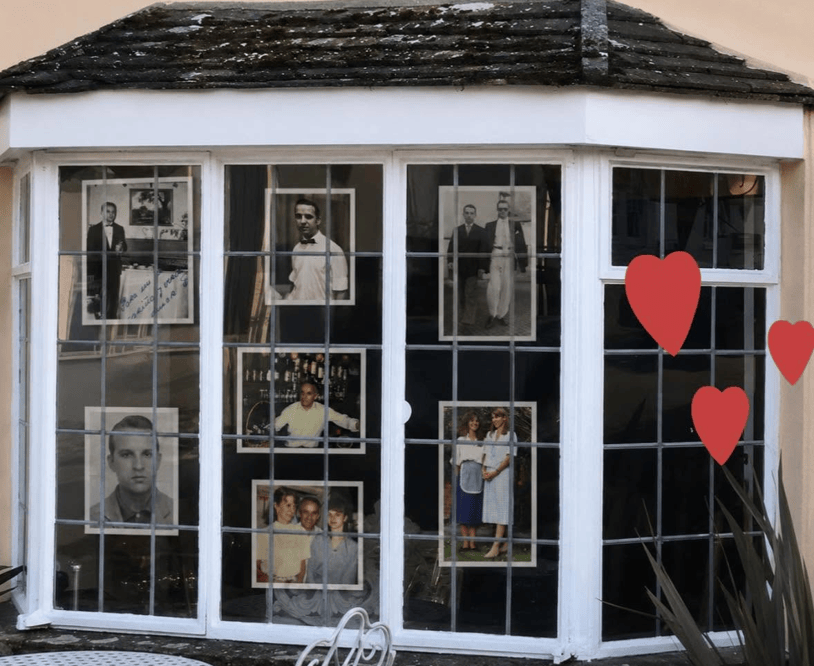
In 1978, the Three Cups entered another chapter of its long history when Francisco and Rosemary Martinez took over the establishment.
Francisco Martinez had grown up in Spain, where he gained experience in the hospitality industry. Following the Spanish Civil War, he came to England, initially working in London before meeting Rosemary in Hampshire. The couple married and had four children: Vincent, Frankie, Angela and Lucia.
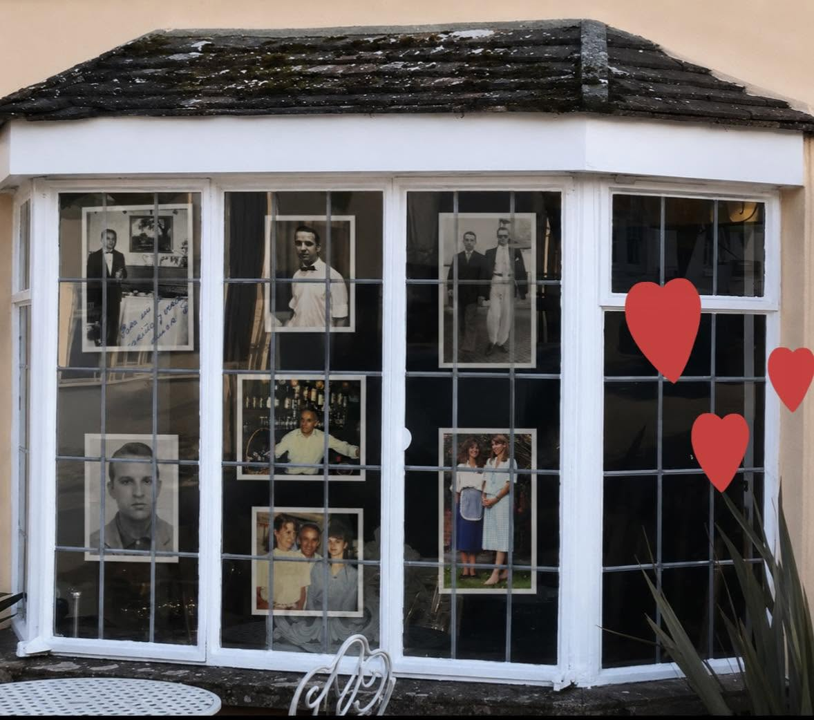
In 1970, the family decided to emigrate to Australia, travelling to Sydney under the assisted-passage migration scheme popularly known as the £10 Pom scheme. Francisco continued working in the catering trade, finding employment as a cook.
After eight years in Australia, the family returned to England in 1978 and took over the Three Cups in Stockbridge.
Their daughter Lucia Martinez grew up around the hotel and became closely involved in its operation. In 1990, aged just 20, Lucia bought her parents out and took over the business herself.
The Martinez family’s association with the Three Cups thus spanned a significant period of its late twentieth-century history, beginning with Francisco and Rosemary’s arrival in 1978 and continuing through Lucia’s ownership and management.
During their tenure, on 27 November 1984, the building was formally designated Grade II listed under the name The Old Three Cups Hotel, recognising its historic and architectural importance.
The Martinez family’s involvement represents an important stage in the transformation of the former coaching inn into the hotel and restaurant familiar to later generations of Stockbridge residents and visitors.
A modern chapter in a very old book.
With its pedigree as an Inn in full bloom, The Three Cups is once again a Village within an Inn within the Town of Stockbridge!