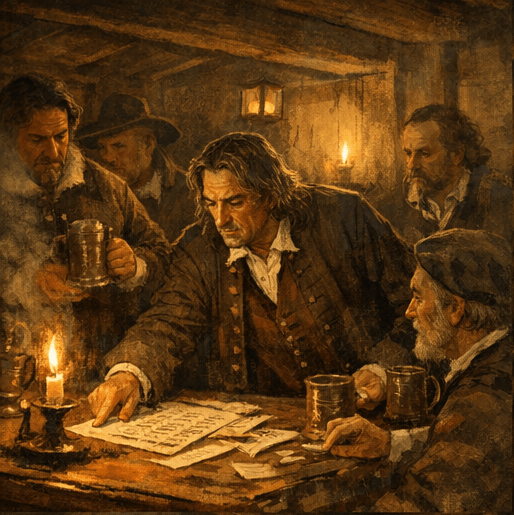
1650s Under the Puritan Boot
In Part 1 we saw the early history, now we move on; in 1679, twenty four years after the Wigges had sold the Three cups Inn to Sarah Moody and John Whitman in 1655, The Whitmans decided to sell up.
At some point Sarah Moody disappeared from the picture, but John Whitman’s father who was now a Miller, became more prominent. during the quarter of a century that the Whitman’s ran the Inn, England went through seismic upheavals.
For the first five years England was under Cromwell and his Major‑Generals. The Test Valley Inns suffered during this time. Alehouses were shuttered early. Horse‑races vanished from the downs. Parish officers were on the prowl for Sabbath‑breakers. The Whitmans at the Three Cups were most likely supporters of Parliament given when they took the Inn over from the Wigges, but they would have needed to keep to the rules serving “travellers only”.
It was a time of quiet, colourless obedience with the countryside holding its breath. But with Cromwell’s death the Puritan stranglehold started to break down, his son Richard Cromwell, became head of state, Lord Protector, but lacked the strength of character of his father. Richard proved incapable of controlling the army or Parliament. England slid into chaos: rival generals and factions fought for power, and the country teetered between military dictatorship and anarchy. Richard Cromwell owned Hursley Manor so his centre of strength and wealth was not far from Stockbridge, despite this control lapsed during his two years of power between 1658 and 1659.
By 1659 England was sliding again toward civil war: parliament tried to take power back from Cromwell’s Generals by ordering the disbanding of a number of Regiments and civilians retaking control of power that had moved to the military. Major General Lambert and some radical officers of the Army Council, staged a coup, marched on Parliament and closed it by force, garrisons mutinied, and rival factions fought skirmishes in the streets. It never became an all out war.
In Stockbridge gossip would have thickened in church porches, soldiers would have been overheard grumbling about unpaid arrears, parish constables quietly stopped enforcing the stricter rules, waiting to see who would come out on top. By early 1660, the country was exhausted, people craved normality, not power struggles between rival factions.
1660 Return of the King
Enter General Monck, pragmatic and loyal to whichever government was most able at ruling the country, he was one of Oliver Cromwell’s most competent and effective Generals, the de-facto ruler of Scotland as Military Governor, he decided that only a stable monarchy could end the disorder. So in February 1660, having mustered his army along the River Tweed, he marched his army from south from Coldstream — the famous “Coldstream March” — to restore order in London.
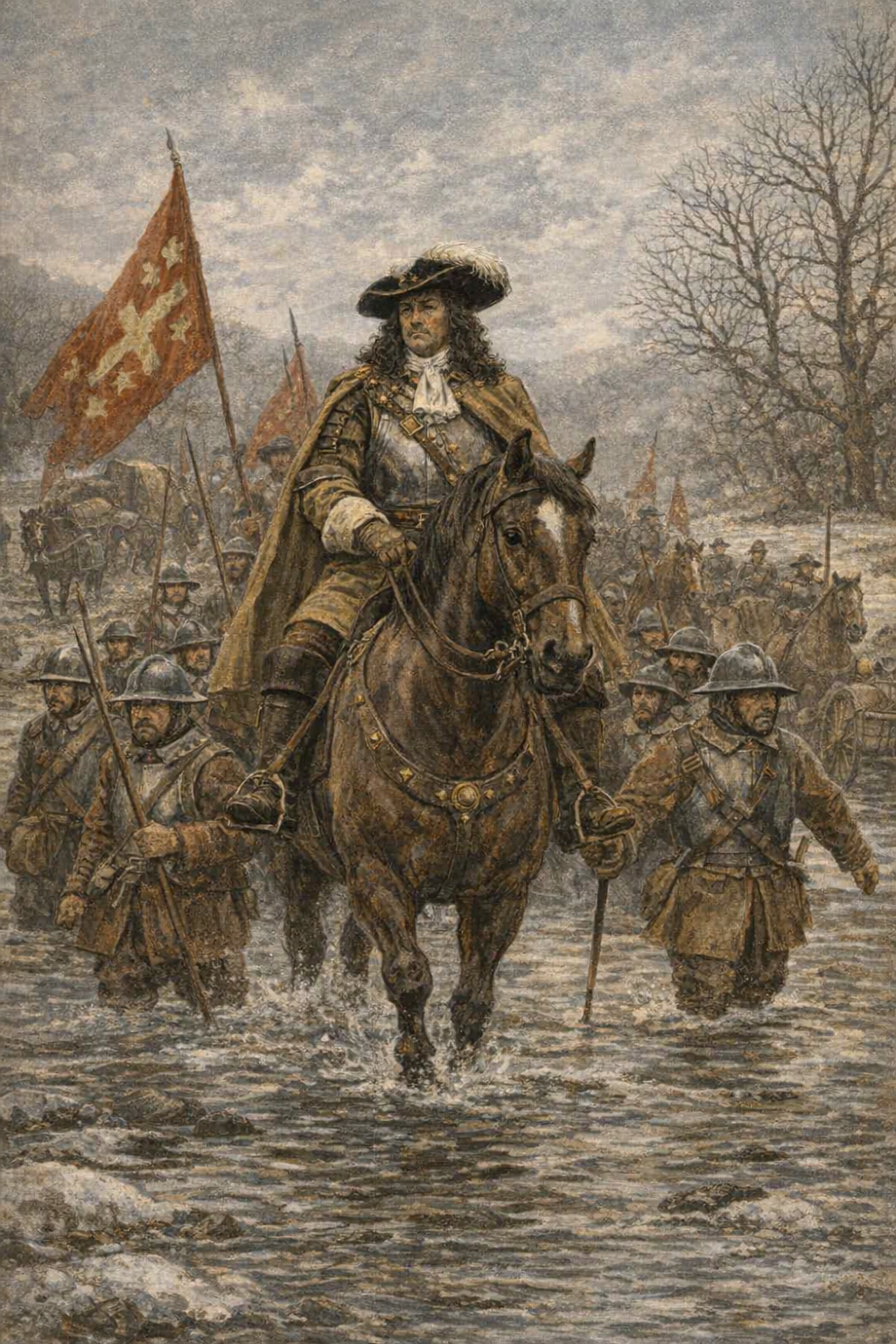
Monck restored Parliament, and brokered a deal where it was agreed that Charles II would return and England would become a Kingdom once again.
The mood was generally jubilant, after so many years of Warfare followed by Puritan austerity. Church Bells rang, Theatres reopened, and Inns boomed to overflowing with relaxion of the rules, and traditional pastimes like Maypoles started to reappear at night, as if grown out of the ground as draconian laws failed to be enforced. The Three Cups is suddenly came alive again.
For the Whitmans, father and son, it was a mixed blessing, business must certainly have picked up, but if politically they had Parliamentary leanings, and their position may have been strained by the restoration of the Monarchy.
Plague
Having settled down from this political upheaval, in 1665-1666 a new catastrophe hit in the form of The Great Plague, that notably devastated many major towns, especially London, but also affected Winchester and Southampton, and to a lesser extent Salisbury.
The main upshot for The Whitmans at The Three Cups would have been the complete disruption of trade between London and the West Country, Stockbridge being a major stopping point on that route. The plague also disrupted local communications and trade between Southampton and Winchester to Salisbury, again Stockbridge being a major point on that route. Business for the Inn must have almost collapsed outside of local trade, as people feared mixing too closely for fear of the plague, having seen or heard what was happening in the major towns around them. Travellers would have been treated with suspicion, and turned away from Stockbridge by Parish Constables, as refugees in fear of infection attempted to leave the larger towns and move to the countryside and Markets and Fairs the life blood of the Inn temporarily collapsed.

Fear of a Catholic King
Once the plague had passed, and the survivors with inherited herd immunity, including the Whitmans, tried to get back to normality with some years of relative stability, albeit with steadily rising taxes to pay for the war with the Dutch. But increasing fear that when the King Charles II eventually died, the next in line was his Catholic brother James, started to harden people’s political positions. This came to a head in 1679 with false news about a “Popish Plot” to overthrow the King and replace him with his Catholic brother James spread like wildfire (even before the internet!) and the instigation of the Habeas Corpus act in Parliament to curb the King’s powers to imprison Englishmen without trial, lead to a rift between King and Parliament.
And it is precisely at this point that the Whitmans decided to sell the Three Cups Inn in 1679. Perhaps fearing more civil unrest Thomas Whitman and his son John sold the Inn to Henry Whithed of Tytherley, an esquire, for £80 — a sign of rising value, amounting to around £366,000 in today’s relative income, the equivalent of about 30% more than they paid for it 24 years before, despite the setbacks of politics and plague. But why was that? Why this particular buyer?
1679 Henry Whithed “Esquire”
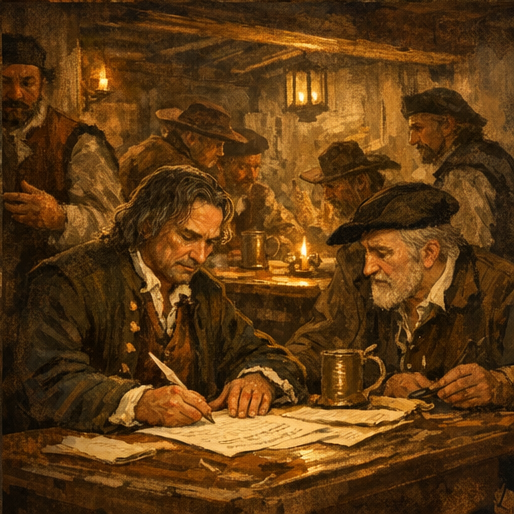
Well, the clue came from the fact that Henry Whithed (sometimes transcribed under the modern spelling as “Whitehead”) was referred to as an “Esquire” on the documents. In the 1600s, Esquire (Esq.) was not a casual courtesy title. It was used for: he landed gentry, magistrates, MPs, and other men of significant social standing. It wasn’t something usually applied to innkeepers, tradesmen, or small yeomen. The only Henry Whithed who would seem to fill the bill for this at the time was the local MP for Hampshire. A seemingly unlikely candidate to buy an Inn.
However it was a shrewd move from his perspective. It gave him an investment in a business that would benefit should stability return, Inns were hubs of political organisation and agitation, Stockbridge was a notoriously corrupt borough, so keeping close control and patronage could guarantee success in an election – owning an inn gave influence over voters, meetings, and borough business.
There was still a risk with the then current political situation, but unlike the Whitmans, Henry Whithed came from a powerful family and had the means and wherewithal to withstand political and social pressure or indeed minor officers of the state – it would take a brave Parish Constable to try to impose himself on an Inn owned by the local MP. His father had been a Parliamentary Colonel of Foot and an MP (unlike John Whitman whose father was a simple Yeoman then a Miller) and Henry had also married into the ferociously powerful Parliamentary Norton family, his wife’s father having helped win the Battle of Cheriton, and carried out the siege of Basing House, two pivotal battles in the Civil War, and too powerful to be fully dealt with after Charles II restoration.
However Henry was smart; the new King couldn’t rock the boat if he wanted to avoid the fate of his father, and needed powerful families in Hampshire to hold the peace and get things down, and Henry had been made a Captain of Militia Horse, Justice of the Peace for Hampshire, and a Freeman of Portsmouth and Winchester during the restoration, so he had a boot in both camps.
So from Henry’s point of view the purchase of the Three Cups inn had a number of advantages, and if things turned sour and military unrest broke out again, then having a base and following in Stockbridge gave him a significant military strategic advantage as it sat on the key political artery of the London/Exeter and Southampton/Winchester/Salisbury roads.
Of course it is highly unlikely that Henry Whithed would have taken any part of the day to day running of the Three Cups, he would have either employed an Innkeeper or leased the premises to an Inn Keeper.
A Research First
As far as I can see the association of Henry Whithed the MP with the Three Cups Inn has never been described before in an historical narrative. And this would also seem to be the first genuinely solid evidence of the Three Cups confronting Stockbridge’s parliamentary corruption culture. So here we have potentially two historical research “firsts” in a single article.
The Drama of the 1680 Stockbridge Election
Now here’s the rub, in 1680 the year after Henry Whithed took on the Three Cups, Stockbridge’s borough corporation was caught selling burgess-ships and votes. Parliament investigated, and the scandal was so extreme that the borough was temporarily disenfranchised and the corporation dissolved.
Although Henry Whithed bought the Three Cups in 1679, undoubtedly to bolster his chances of election to Parliament in the following year and was deeply involved in the political goings on in Stockbridge, his role in the Stockbridge scandal of 1680 was as the challenger, not as one of the borough’s corrupt officials.
When the Stockbridge election of 1680 descended into confusion, the Three Cups would have become the natural headquarters for Henry Whithed and the men who backed him. The inn’s long, low rooms — already thick with the smoke and noise of an election day — would have filled with Whithed’s supporters arguing over the poll, comparing notes on who had been admitted as a burgess, and tallying the shifting loyalties of a tiny electorate that could be turned by a single vote. Nothing in the surviving record places Whithed on the corrupt side of the affair, but the atmosphere inside the Three Cups must have been charged: messengers coming and going, alehouse benches crowded with aggrieved voters, Whithed himself conferring with allies over the legality of the return. It was from this setting — part campaign room, part counting‑house, part pressure‑cooker — that Whithed resolved to challenge the result. His petition to Parliament, read later that October, emerged not from secret dealing but from the open, noisy, and very public agitation of a candidate and his circle who believed the borough officers had mishandled the poll.
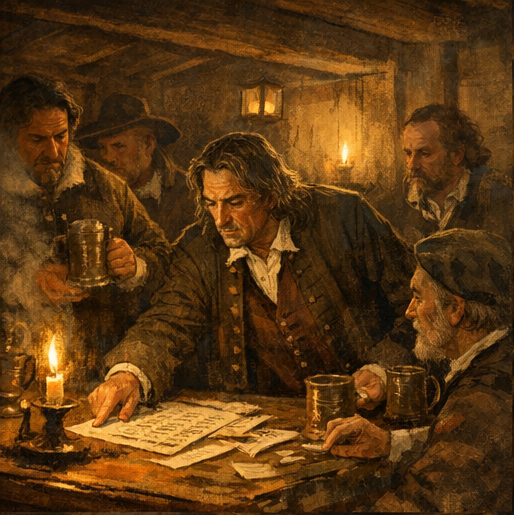
Whatever took place within the Three Cups that summer, it was the legitimate bustle of a contested election in a borough already sliding towards notoriety, not the corruption that would soon bring down the Stockbridge corporation.
When Henry lost the election in 1680, and formally petitioned Parliament to contest the result, he pulled the trigger that brought the borough’s wider abuses under scrutiny. The subsequent investigation uncovered the corporation’s sale of votes and burgess‑ships, but Henry Whithed himself was never named or accused in any part of the inquiry. His involvement was that of a candidate pressing for redress in a corrupt system, not a participant in the corruption that ultimately led to the dissolution of the Stockbridge corporation.
Whithed was briefly seated in Parliament on petition in 1680, but when Parliament dissolved the corrupt Stockbridge corporation in 1681, the borough lost its right to return MPs. No member could sit for Stockbridge until the corporation was restored in 1684 — the same year Whithed died. Part of the case to have the franchise reinstated to Stockbridge was based on the economic demands of Royalist Troops on the businesses of Stockbridge 50 years before during the Civil War, the argument being that they were just compensating the voters for what the KIng’s own forces had taken away from them without compensation.
Henry Whithed Junior
Henry’s death marked the end of the Whithead Family as a political force. It seems that his son, also a Henry Whithed took over ownership, this coincided with “The Glorious Revolution” of 1688 When William of Orange and Mary Stuart, landed at Torbay and marched on London, causing the King, James II, to march West to Salisbury to intercept them, passing through Stockbridge on the way, and stopping for a meal at The Swan Inn.
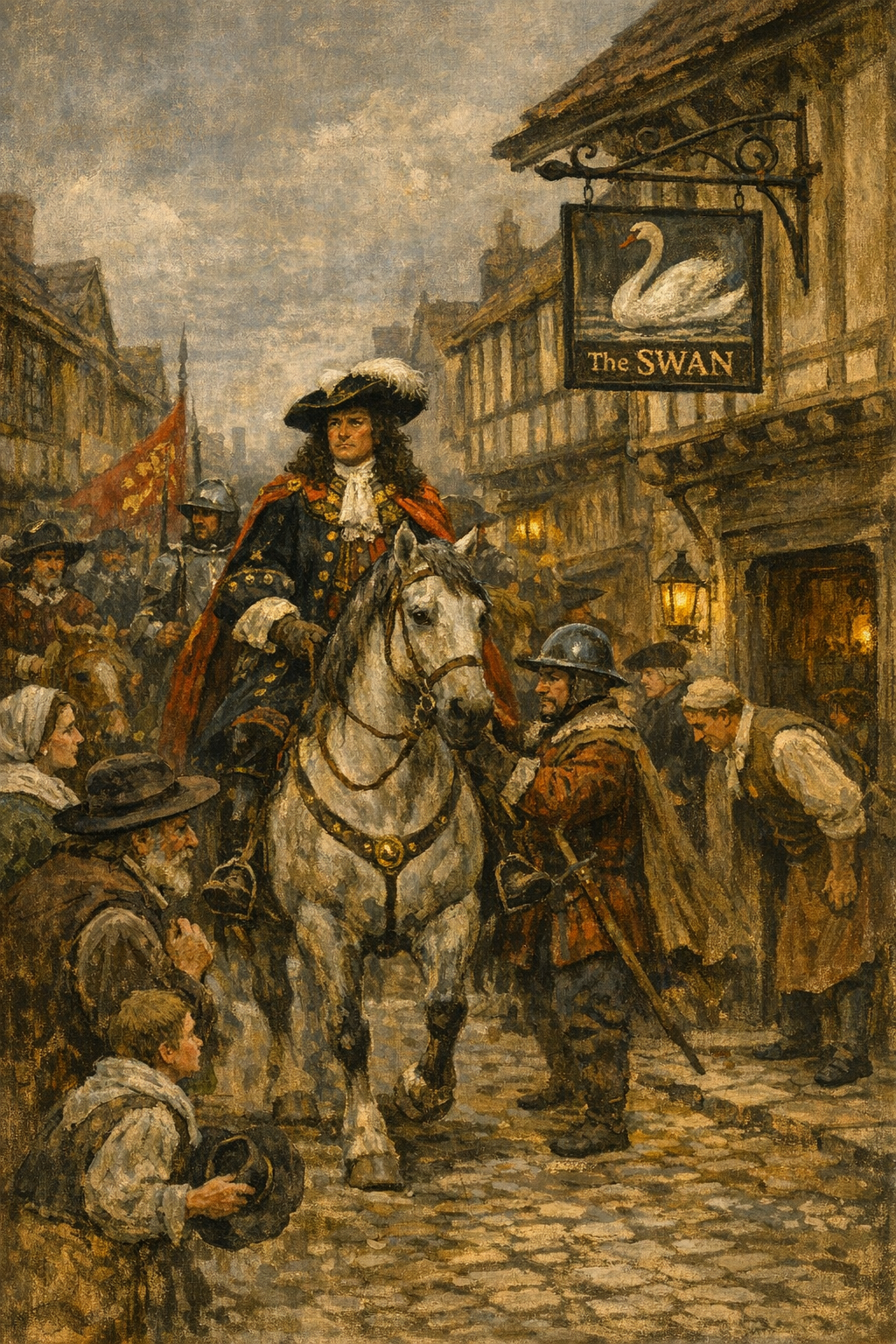
Unsurprisingly James avoided eating at the Three Cups given the Political leanings of the Whithed family. A year later James was ousted and William and Mary installed as Rulers.
The Departure of the Whitheds
The Three Cups remained in Whithed ownership until 1717, when Henry Whithed of Norman Court — son of the MP who had fought the corrupt election of 1680 — conveyed the inn to Richard Hulbert, a Stockbridge blacksmith. The transfer marks the end of the Whithed family’s direct connection with the town’s political life, and their 38 year ownership of The Three Cups Inn. Without the political ambitions of his father, Henry Whithed Junior had less use for the Inn in Stockbridge.
The 1717 conveyance describes:
“Lease and release of the inn called Three Cups in Stockbridge (bounds given), a piece of meadow of one acre on the north side of the inn, with all buildings, yards, gardens, orchards, commons and common of pasture belonging.”
The Three Cups Inn was now effectively a working estate at the heart of the Stockbridge economy.
In Part 3 we’ll see what happened next.


One Reply to “Drinking with the Ancestors: The Three Cups Stockbridge Part 2: Plague, Parliament, and Political Scandal at The Inn”